
Hidden-space inspection • buying guide
Best Borescopes for Automotive, Plumbing, and Wall Inspections
Choose a borescope by access diameter, probe control, cable behavior, focal range, and the inspection job—not headline resolution alone.
The best borescope for an engine is often the wrong camera for a drain. Automotive work rewards a small head, short-range focus, and a tip you can steer toward a cylinder wall. A plumbing run needs cable length and pushability before articulation. A wall cavity may need a semi-rigid cable that holds its shape without turning a small access hole into a large repair.
That is why this guide has one verified product recommendation rather than an artificial top three. The Teslong TD450S single-lens model has an exact manufacturer page, current support material, and specifications that match the merchant listing. It is a strong fit for short automotive and accessible wall-cavity inspections when its 8.5 mm head fits. It is not a general-purpose sewer camera, and it should not be bought for every job merely because the probe is rated IP67.
Focused Gadgets has not physically tested this camera. This is a source-based fit analysis using the exact ASIN, manufacturer documentation, safety guidance, and current merchant destination. A borescope shows surfaces within its field of view; it does not measure depth, identify a material, prove a defect’s cause, or make drilling and disassembly safe by itself.
Quick answer
- Choose the Teslong TD450S for short, steerable inspections. Its 5.08-foot semi-rigid probe, 8.5 mm camera head, 210-degree two-way articulation, fixed close focus, and built-in 4.5-inch screen suit engine bays, cylinder access that is large enough, HVAC housings, and nearby wall cavities.
- Do not choose it for long pipe runs. Five feet disappears quickly after a trap or bend, and an articulating gooseneck is not a drain-camera push rod. For deep plumbing, prioritize the required length, a purpose-built push cable, a head that clears the pipe, and a system rated for the environment.
- Do not buy on “1080p” alone. Access diameter, focus distance, lighting, lens direction, cable behavior, and the ability to retrieve the probe safely determine whether the image is useful.
| Inspection job | First specification to check | Useful camera format | TD450S fit |
|---|---|---|---|
| Engine, intake, brake, or HVAC housing | Smallest opening and target direction | Short articulating probe with close focus and local screen | Strong when 8.5 mm fits and the target is within five feet |
| Wall or cabinet cavity | Safe access point, cable stiffness, and reach | Semi-rigid probe that holds a curve; articulation for looking sideways | Good for nearby cavities through a sufficiently large existing opening |
| Sink branch or short accessible pipe | Bends, internal diameter, and retrieval path | Waterproof probe with enough reach and controlled stiffness | Conditional; useful only for short visual checks, not clearing a blockage |
| Long drain, sewer, or buried line | Total run, bends, pushability, and location needs | Purpose-built pipe camera with push rod, reel, and often a sonde | Poor; the probe is too short and the articulation mechanism is not a drain rod |
Measure the route before comparing cameras
A borescope has to reach the target before image quality matters. Trace the entire path: the smallest opening, the tightest bend, the distance to the target, and the space needed to withdraw the head without snagging it.
Our guide to using a borescope covers the complete pre-insertion safety check, focus and lighting setup, controlled insertion, image capture, retrieval, and cleaning workflow.
Probe diameter is a hard constraint. The TD450S camera head is 8.5 mm, or about 0.33 inch. That may fit many access holes and automotive openings, but “small” is not a measurement. Check the exact spark-plug passage, inspection port, grommet, or drilled opening rather than assuming an 8.5 mm head will pass because the outer fastener is larger.
Probe length is not the same as usable reach. The TD450S probe is 1.55 meters, or 5.08 feet. Every bend, grip point, and section left outside the opening reduces useful depth. A 16-foot phone endoscope may reach farther, but a long soft cable can coil instead of advancing and may be harder to aim.
Cable behavior changes by task. A semi-rigid gooseneck can be shaped before insertion and tends to hold a curve, which helps across a wall bay or around an engine component. A pipe camera uses a different push-cable design so force at the reel reaches the camera head farther down a line. An articulating tip adds control near the target, but its internal mechanism also creates a part that should not be forced around a blockage.
Teslong TD450S: best for short automotive and wall inspections
The exact Amazon listing resolves to Teslong’s TD450S 8.5 mm single-lens configuration, manufacturer SKU TD450SD85L155. That distinction matters because Teslong also sells a dual-lens TD450S. The two variants share a name and monitor format but do not have the same optics or lighting. The linked ASIN has one forward-facing, 2-megapixel camera surrounded by eight adjustable LEDs.
The handheld monitor has a 4.5-inch IPS panel with an 854 by 480 display resolution. It records photos and video to an included 32 GB microSD card and charges over USB-C. Teslong specifies a 3000 mAh battery and three to four hours of operation. Those are manufacturer figures, not results from Focused Gadgets testing.
The screen resolution and saved-file resolution should not be confused. The current Teslong page lists 1920 by 1080 and 1280 by 720 recording choices, while Amazon’s embedded specification table presents 1920 by 1080 stills and 1280 by 720 video. Firmware, listing revisions, or selected modes may explain the difference. If a particular output mode is essential, confirm it for the shipped unit instead of treating “1080p” in a title as proof of the live image or recording mode.
Why articulation is useful
The probe tip moves through a manufacturer-stated 210-degree two-way arc. That lets the operator look toward a cylinder wall, valve area, side of a housing, or framing member after the head passes through an opening. With a straight fixed camera, the usual alternatives are rotating the entire cable or attaching a mirror, both of which can be awkward in a confined route.
Two-way articulation is not full four-way steering. It bends along one plane, so the cable or handle still needs to rotate when the target lies elsewhere around the circumference. The control should also be returned to a straight position before withdrawal. Teslong warns against forcing the control when the tip meets resistance, sharply bending the probe, or pulling it out while articulated.
Focus and lighting set the working distance
The TD450S is fixed-focus, with a documented depth of field from 0.79 to 3.94 inches and a 70-degree field of view. It is designed to see close surfaces, not to provide a sharp room-wide view through a wall. If the lens is pressed against a piston crown or pointed into an open cavity several feet away, the image can be unhelpful even though the camera is technically inside the space.
Eight adjustable LEDs illuminate the target. More brightness is not always better: shiny cylinder walls, wet pipe, and metallic surfaces can reflect the ring light into the lens. Start low and increase illumination until texture becomes visible without a white hotspot. The camera cannot determine whether a dark mark is oil, corrosion, carbon, moisture, or shadow; save the image and confirm the finding with the appropriate test or inspection.
The strongest fit is local, app-free inspection
The integrated screen avoids pairing a phone, granting app permissions, or exposing a personal device to a greasy work area. Photos and videos can document what was visible at a specific time. That workflow suits a mechanic checking an accessible cylinder, a homeowner looking past a cabinet opening, or a technician inspecting a nearby HVAC cavity.
The compromises are equally concrete. An 8.5 mm head is wider than slimmer professional probes. Five feet is short for drains and long chases. The single forward lens relies on articulation for side views. Teslong says the TD450S probe is not replaceable because its steering mechanism is integrated with the handle, so probe damage is more consequential than damage to an interchangeable cable.
Choose this model when the measured route fits those constraints and steerability near the target matters. Skip it when reach, a slimmer head, a side-view lens, replaceable probes, or a pipe-camera reel is the real requirement.
Automotive inspection: access and interpretation come first
Before inserting a camera, make the equipment safe according to its service procedure. Shut the engine down, allow hot parts to cool, isolate moving components, and keep the probe away from live electrical hazards. Teslong’s safety guidance specifically says not to use the camera near moving parts, flammable substances, or live wiring.
For a cylinder inspection, verify that the head and bent section can pass through the complete spark-plug route without scraping threads or becoming trapped. The TD450S includes a temperature warning and shutdown behavior, but that is protection for the tool—not permission to put it into a hot engine. Teslong lists a probe operating range of 32 to 113 degrees Fahrenheit on the Amazon specification table.
A borescope image can reveal a visible surface pattern, deposit, foreign object, or obvious damage. It cannot by itself establish compression, leak-down performance, crack depth, or root cause. Use it to narrow the next diagnostic step, not to replace the measurement that confirms a repair decision.
Wall inspection: a camera does not make a blind hole safe
A borescope complements non-invasive screening. A thermal camera can show temperature patterns across a larger area, while a borescope can show a small section of the cavity after a safe access path already exists. Neither tool sees through every material or proves what caused a stain.
Use an existing access opening where possible. Before drilling, account for wiring, plumbing, gas lines, structure, and any regulated materials that may be hidden in the assembly. If those risks are not known, use an appropriate detector or qualified professional rather than relying on the borescope to discover a hazard after the bit reaches it.
Inside the cavity, keep the lens within its close-focus range and articulate slowly. A five-foot semi-rigid probe can cross a nearby bay, but insulation, fire blocking, and framing can stop it. For moisture investigations, the image may help locate visible water or staining, but a leak investigation still needs confirmation with moisture measurements and source tracing.
Plumbing inspection: waterproof does not mean drain-ready
The TD450S camera probe is rated IP67; the handheld monitor is not. Teslong describes the rating as protection for the probe to a maximum depth of one meter for up to 30 minutes under the stated standard. That does not make the complete tool suitable for continuous submersion, chemicals, pressurized lines, sanitary hazards, or every drain-cleaning environment.
For a short, open, cool pipe where the camera can be retrieved without force, the probe may provide a useful look. It is a poor substitute for a purpose-built drain camera when the run is long, contains several bends, or needs locating from above ground. A pipe-camera reel, durable push rod, self-leveling head, sonde, and replaceable skid solve different problems than a handheld articulating scope.
Never use the camera as a rod to punch through a clog. Do not send the articulated section past an obstruction that can trap it, and do not insert it into a line that may contain hazardous chemicals or energized equipment. A visual of a blockage also does not identify the correct clearing method or the pipe’s remaining structural strength.
When a phone-connected borescope makes more sense
A long, dual-lens phone borescope is a different tool rather than a cheaper version of the TD450S. It can be easier to carry, offers much more reach, and can switch between forward and side views without a mechanical steering joint. The compromises are an app-dependent setup, the phone connection, and a semi-rigid cable that cannot actively aim itself after insertion. Our articulating-versus-dual-lens comparison explains which architecture fits different route geometries.
The Kinpthy and Elecshion C-E64 now have enough exact listing and model evidence for conditional recommendations, provided the buyer confirms the connector and current app support for the phone they will use. The Elecshion is strongest as a budget camera for a known wall-cavity route; our Elecshion C-E64 review examines that fit and its UseePlus dependency. See the phone borescope comparison for the broader connector and cable-control tradeoffs.
Which borescope should you buy?
Buy the Teslong TD450S single-lens articulating borescope if you need an app-free camera for short automotive, HVAC, cabinet, or wall-cavity inspections; its 8.5 mm head fits the measured access; and steering near the target matters more than long reach.
Choose a different format when the route is narrower than 8.5 mm, extends beyond five feet, needs four-way control, demands a side-view lens without steering, or requires a drain-camera reel and locator. The job determines the camera architecture.
Before ordering, confirm that the linked offer still identifies the single-lens TD450S configuration, then verify current specifications, included accessories, warranty, availability, and price at the merchant and manufacturer. Prices and bundles change. The product card below is a buying reference, not evidence of hands-on testing.
Frequently asked questions
Is an 8.5 mm borescope small enough for an engine?
Sometimes. Measure the complete access route for the exact engine, including threads, bends, adapters, and the articulated section behind the camera head. Do not infer clearance from the nominal size of a spark plug or external opening.
Is the whole TD450S waterproof?
No. Teslong’s IP67 statement applies to the camera probe. Keep the handheld monitor and its ports dry, stay within the documented immersion limit, and do not assume compatibility with chemicals or pressurized systems.
Does articulation replace a side-view camera?
It can aim the forward lens toward a side surface when there is enough room for the tip to bend. A dedicated side lens can change direction without sweeping the tip, while four-way articulation can steer in more than one plane. Each format has different clearance needs.
Can I use the TD450S to inspect a clogged drain?
Only for a short, controlled visual check where the probe can enter and return without being forced. It is not a clog-clearing rod or a long-run sewer camera. Use purpose-built plumbing equipment for deep, dirty, chemically exposed, or location-sensitive work.
Is recorded 1080p the same as a 1080p screen?
No. The TD450S display is 854 by 480 pixels. A saved file can have more pixels than the screen used to frame it, and resolution alone does not guarantee focus, lighting, detail, or diagnostic value.
Can a borescope confirm the cause of a wall stain?
Not by itself. It may show visible water, staining, gaps, or components in a small field of view. Confirm moisture with an appropriate meter and trace the source before opening or repairing the assembly.
Models discussed
Use these as starting points for checking fit. We do not publish a price or claim hands-on testing.
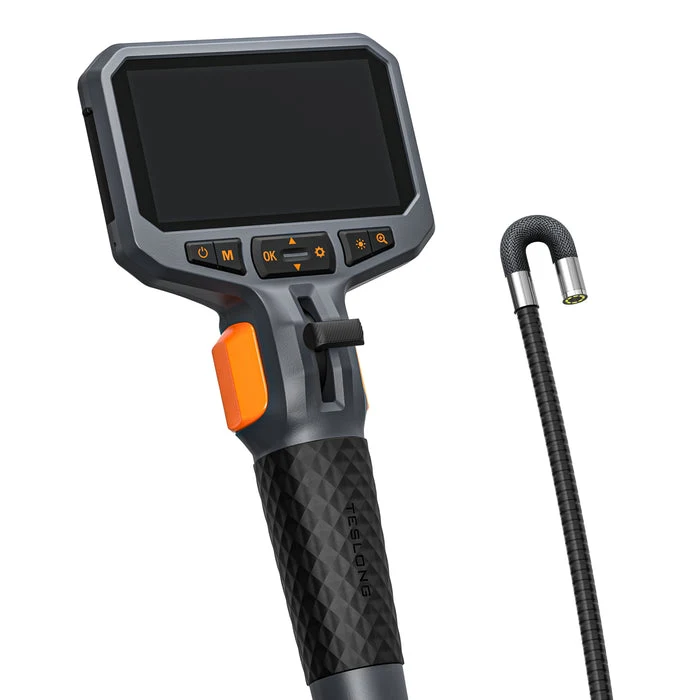
Product reference
Teslong TD450S Single-Lens Articulating Borescope
Best for: Short automotive and accessible wall-cavity inspections
Trade-off: 8.5 mm head and five-foot reach; the integrated articulated probe is not replaceable
How this guide was researched
We compare documented product features against the job each buyer needs done. We have not physically tested these products. Check current specifications and availability with the manufacturer or merchant.
Affiliate disclosure: If you buy through a qualifying link, we may earn a commission at no extra cost to you.