
Hidden-space inspection • comparison
Articulating vs. Dual-Lens Borescope: Which Inspection Camera Is Best?
Compare articulating and dual-lens borescopes for automotive, plumbing, wall, and phone-based inspections—and choose the right camera format.
Search results for the best borescopes often mix tools that solve different access problems. A short articulating camera can steer toward a valve or cylinder wall after it enters an opening. A long dual-lens endoscope cannot steer, but it can switch between forward and side views and reach much farther through a known route. A phone-connected model reduces hardware cost, while a dedicated screen avoids connector and app problems.
Those are not small feature differences. They determine whether the camera reaches the target, points in the right direction, produces an interpretable close-up, and comes back out safely.
Our verdict: choose an articulating borescope for short inspections where aiming the tip matters. Choose a dual-lens phone endoscope for a longer, relatively open route where forward and side views are useful and you have verified phone compatibility. Among the three models here, the Teslong TD450S is the stronger automotive and app-free choice, the Kinpthy W400-B25 is the better-documented long-reach phone option, and the Elecshion C-E64 is the budget wall-cavity option for buyers who can confirm its connector and UseePlus workflow.
Focused Gadgets has not physically tested these cameras. This comparison uses the exact current product listings, available manuals, app records, and Teslong’s first-party support documentation. Image quality, cable behavior, waterproofing, durability, and app reliability have not been independently measured by us.
Quick answer
- Best for short automotive and equipment inspection: Teslong TD450S. Its dedicated monitor and two-way articulating tip make it easier to aim inside a nearby cavity. The 8.5 mm head and roughly five-foot probe must fit the route.
- Best for long phone-based inspection: Kinpthy W400-B25. Its roughly 16.4-foot semi-rigid cable, forward and side cameras, and documented adapter package suit long accessible routes when the phone supports the hardware and app.
- Best budget option for walls and cabinets: Elecshion C-E64. Its 16.5-foot dual-lens cable can inspect a known cavity through a safe access point, but connector and UseePlus compatibility are part of the purchase.
- None is a sewer camera. A long semi-rigid cable is not a push rod, and an IP rating does not turn a small inspection camera into a drain reel with a sonde.
| Buyer decision | Teslong TD450S | Kinpthy W400-B25 | Elecshion C-E64 |
|---|---|---|---|
| Camera control | Two-way articulating forward camera | Fixed forward and side cameras | Fixed forward and side cameras |
| Viewing hardware | Built-in 4.5-inch monitor | Compatible phone or tablet | Compatible phone or tablet |
| Approximate reach | 5.08 ft | 16.4 ft | 16.5 ft |
| Probe diameter | 8.5 mm | Listing identifies 7.9 mm | Listing identifies 7.9 mm |
| Strongest fit | Short engine, HVAC, machine, or nearby wall inspection | Longer phone-based checks with broader adapter support | Occasional wall, cabinet, duct, or appliance checks |
| Main limitation | Shorter reach and no separate side lens | App, connector, and long-cable control | App and connector dependence with thinner manufacturer support |
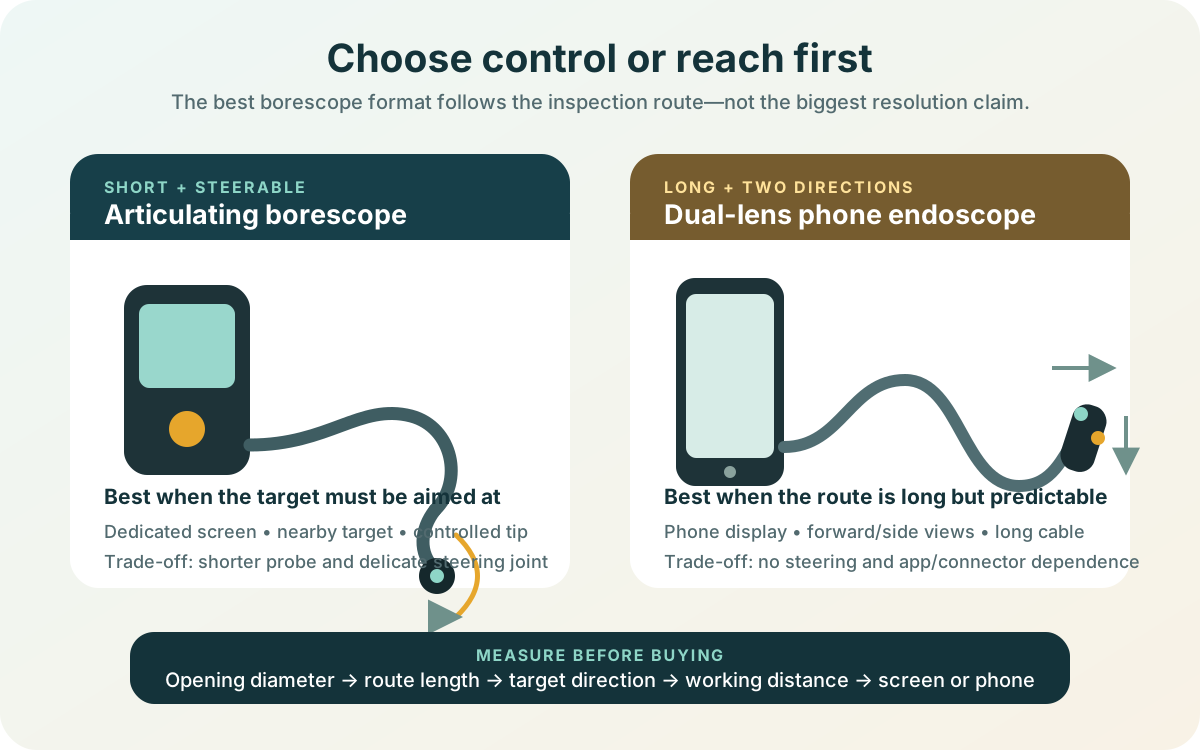
What “best borescope” should mean
The best inspection camera is not the one with the largest resolution number. It is the one whose head fits the smallest opening, whose cable can follow the route, whose lens can face the target, and whose focus range matches the distance to the surface.
Start with four measurements:
- Smallest opening: measure the actual passage, not the fastener or trim around it.
- Route length: include bends and the section that must remain outside for control.
- Target direction: decide whether the camera approaches the surface head-on or must look sideways.
- Working distance: estimate how close the lens will be once it reaches the target.
Only then compare resolution, screen size, recording, or accessories. A sharp camera that cannot make the bend is useless. A 16-foot cable that coils inside a wall is not 16 feet of controlled reach. A side lens that faces the wrong surface is not a substitute for steering.
Our broader best borescopes guide organizes those constraints by automotive, plumbing, and wall jobs. This comparison goes one level deeper: it explains which camera architecture gives you control at the target.
Articulating borescope: best when you must aim after insertion
An articulating borescope has a bending section near the camera head. A wheel, lever, or joystick moves the tip after the probe is inside the cavity. The Teslong TD450S provides two-way movement through a manufacturer-stated 210-degree arc.
That control is useful when the access opening and target do not line up. After entering a spark-plug passage, for example, a straight camera may point at the piston crown while the surface you want is on the cylinder wall. Articulation lets the operator redirect the lens without withdrawing the probe and reshaping the entire cable.
Two-way does not mean the head can look freely in every direction. The tip bends along one plane. To inspect another part of the circumference, the operator still rotates the probe or handle. Four-way systems add another steering plane, but they are a different product class.
Articulation also adds a vulnerable mechanism. Teslong warns users not to over-torque, fold, yank, or force the probe, and to straighten the bending section before removal. If the tip is articulated behind an obstruction, pulling harder can damage the control wires or trap the head.
Choose articulation when:
- the route is short and the camera must look around a nearby corner;
- the target direction is uncertain before insertion;
- controlled aiming matters more than maximum cable length;
- a self-contained screen is preferable to a phone app.
Skip it when the route is longer than the probe, the head is too wide, or the job needs a purpose-built push cable rather than a steerable tip.
Dual-lens borescope: best when direction matters but steering does not
A dual-lens endoscope usually places one camera on the front and another on the side of the probe. A button in the app or inline control switches the view. This does not bend the tip. It changes which fixed camera is active.
The design works well when a long cable can reach the inspection area but the target may be beside the probe rather than directly ahead. In a wall cavity, the forward lens can help advance past framing or insulation while the side lens looks across the cavity. In a pipe or duct, switching views can show both the obstruction ahead and the nearby wall.
The advantage is immediate direction change without a mechanical articulation joint. The limitation is that neither lens can be pointed precisely. You can pre-bend a semi-rigid cable and rotate it from outside, but contact with bends and surfaces makes remote rotation less predictable as distance increases.
Choose dual lens when:
- a longer known route matters more than active steering;
- forward and side views are both useful;
- the cable can be pre-shaped or guided through a relatively open path;
- using a compatible phone is acceptable.
Skip it when the target needs precise aiming, the phone cannot supply the required connection or USB host behavior, or the route is likely to trap a long cable.
Teslong TD450S: best fit for short, steerable inspections
The exact linked TD450S configuration has an 8.5 mm single forward camera on a 1.55-meter, or 5.08-foot, probe. The tip provides 210-degree two-way articulation. The handheld unit includes a 4.5-inch screen, onboard photo and video recording, a microSD card, adjustable LEDs, and USB-C charging.
Its strongest advantage is control without a phone. A mechanic can keep a personal device away from oil and dirt, and the inspection does not depend on a mobile operating system, adapter, or app permission. The operator can also steer the lens toward a nearby surface after the head enters the opening.
Its constraints are equally important. The 8.5 mm head is larger than some professional or specialized probes. Five feet is enough for an engine bay, appliance, HVAC housing, cabinet, or nearby wall cavity, but not a long chase or drain. The linked version uses one lens, so side viewing depends on room for the tip to bend.
Teslong documents a fixed-focus range of approximately 0.79 to 3.94 inches for this configuration. That close focus is suited to surfaces inside machinery. It is not a room-view camera. A wall several feet across may appear soft or dark even when the camera is operating normally.
Buy the TD450S when you have measured the access, need to aim near the target, and value the dedicated display. Do not buy it simply because articulation sounds more professional; the mechanism offers no benefit when the target is sixteen feet away.
Kinpthy W400-B25: best fit for long phone-based reach
The Kinpthy W400-B25 combines a roughly 16.4-foot semi-rigid cable with forward and side cameras. The current product records identify a 7.9 mm head, adjustable LEDs, and support for iOS and Android through the included connector and adapter set. It uses the SUP-ANESOK app rather than a dedicated display.
That package makes it the more flexible phone-connected choice of these two long cameras. The extra reach can cross a cabinet run, follow a known duct route, or inspect a wall chase that is well beyond the Teslong probe. Switching lenses gives a second perspective without withdrawing the cable.
Long reach is not long control. A semi-rigid cable holds a pre-bent shape better than a soft wire, but it still meets friction at every bend. The farther the head travels, the less predictably a twist at the connector rotates the camera. The 16.4-foot figure is therefore a cable specification, not a promise of controlled reach through any path.
Compatibility should be tested immediately. A connector that physically fits does not guarantee that the phone supports the required accessory mode, power, or current app version. Confirm live view, both lenses, lighting, rotation, photos, video, and saved-file access while the product can still be returned.
Choose the Kinpthy when long reach, two viewing directions, and its broader documented adapter package matter more than precision steering. Choose a dedicated-screen camera when app independence is more important.
Elecshion C-E64: best budget fit for a known wall route
The Elecshion C-E64 uses the same general architecture: a 16.5-foot semi-rigid cable, forward and side cameras, a listing-stated 7.9 mm head, and adjustable LEDs. The selected Type-C offer depends on the UseePlus app and the exact connector package that ships.
Its strongest case is a planned, occasional inspection through an existing safe opening. A homeowner might look into a cabinet void, wall cavity, appliance enclosure, or accessible duct without paying for a dedicated monitor and steering mechanism. The side lens is useful when the cable runs parallel to the surface of interest.
The lower hardware cost shifts more risk to setup. The phone becomes the screen, recorder, power source, and software platform. Current app support and the supplied connector matter as much as the camera itself. The available documentation is also less complete than Teslong’s manufacturer support library.
Our detailed Elecshion C-E64 review covers its wall-inspection fit, UseePlus dependency, and return-window checks. Treat it as a conditional budget option, not as a universal replacement for an articulating borescope.
Probe diameter is the first pass-or-fail specification
An 8.5 mm camera and a 7.9 mm camera differ by less than one millimeter on paper, but either may be too large for a particular passage. Measure the narrowest part of the entire route, including threads, elbows, grommets, adapters, and the bending section behind the lens.
Do not force a head because the nominal opening seems larger. Threads, deposits, insulation, or an offset passage can reduce clearance. The probe also needs room to return after the cable changes shape.
A slimmer probe is not automatically better. Very small cameras may provide less light, fewer lens options, or a higher price. The right diameter is the largest head that safely fits while providing the control and image needed for the job.
Cable length is not controlled reach
The Teslong’s five-foot probe is short but locally steerable. The phone models are more than three times as long but cannot articulate. Neither is “better” until the route is known.
For an open wall bay, a pre-shaped semi-rigid cable can be effective. In a pipe with multiple elbows, the same cable may buckle or coil. In an engine, sixteen feet can create extra cable that must be managed while a short steerable probe reaches the target more directly.
Long drain and sewer work belongs to another category. A professional pipe camera uses a durable push rod, reel, camera skid, and often a locating sonde. None of the three products here should be used as a clog-clearing rod or assumed to work through a long buried line.
Fixed focus and lighting matter more than “1920P”
All three products use close-focus inspection optics. A fixed-focus lens can make a surface a few inches away look useful while a distant object inside a broad cavity remains soft. Resolution claims do not change the optical focus range.
Lighting is similarly situational. Bright LEDs help in a dark cavity, but polished metal, wet pipe, or light-colored plastic can reflect light directly into the lens. Start with lower brightness and increase it until texture is visible without a white hotspot.
Saved-file resolution, live-screen resolution, sensor detail, compression, focus, motion, and lighting are separate variables. Do not select the best borescope from “1080p” or “1920P” in a title alone.
Dedicated screen or phone app?
A dedicated screen starts faster, keeps a personal phone out of the work area, and avoids operating-system changes. It also adds cost, battery maintenance, and another device to carry. The TD450S stores media locally on a memory card, which can simplify job documentation.
A phone camera uses a sharper and more familiar display that the buyer already owns. Sharing files can be easier. The compromise is a chain of dependencies: physical connector, adapter, USB host support, accessory power, app availability, permissions, and OS compatibility.
For occasional clean inspections, a phone-connected model can be sensible. For frequent automotive or workshop use, an integrated monitor is easier to justify. Our phone borescope comparison examines the Kinpthy and Elecshion connection workflows in more detail.
Whichever format you choose, follow our borescope setup and inspection guide before the first job. It explains safe isolation, working distance, light control, orientation, retrieval, and how to avoid diagnosing a fault from one ambiguous image.
Best borescope by inspection job
Automotive and mechanical work
Choose the TD450S when the 8.5 mm head fits and you need to steer toward a nearby surface. Its short probe and dedicated screen suit cylinders, intake areas, HVAC housings, brakes, and machinery where the route is controlled.
Choose a dual-lens phone model when the opening is known, steering is unnecessary, and extra reach matters. Keep every probe away from moving parts, hot surfaces, live electrical hazards, and flammable substances. A camera image can reveal a visible condition; it cannot confirm compression, material depth, or root cause.
Walls, cabinets, and ducts
The Kinpthy and Elecshion formats make sense for longer cavities because their cables exceed sixteen feet and the side lens can view a surface beside the route. Use an existing safe access point where possible. A borescope does not locate live wires, water lines, gas lines, structure, or hazardous materials before drilling.
The TD450S is better when the cavity is nearby and the operator needs to aim around an obstacle. Pair visual inspection with the appropriate detector or measurement. A thermal camera can survey a larger surface, but neither tool sees through every material or proves a defect’s cause.
Plumbing and drains
All three can help with a short, controlled visual check in a compatible environment. The phone models offer more cable length, while the Teslong can aim around a nearby bend if there is room for articulation.
None should be treated as a general sewer camera. The monitor or phone is not waterproof, chemical compatibility is not established, and the cables are not designed to clear blockages. Stop before the route can trap the head or expose the equipment to an unsafe substance.
Return-window test plan
- Confirm the box, listing, connector, and camera arrangement match the ordered variant.
- Measure the camera head and compare it with the actual access route.
- Test live view, focus, lighting, image rotation, and recording on a known object.
- For the TD450S, move the articulation through its normal range and straighten it before withdrawal.
- For phone models, test every included connector and both camera lenses.
- Lock the phone, reopen the app, and confirm permissions and saved files still behave as expected.
- Practice advancing and retrieving the cable through a safe mock route before using a valuable machine or finished wall.
- Inspect the probe, seals, and connector after cleaning; keep the display hardware dry.
- Stop if the probe binds. Do not use the cable to push through an obstruction.
- Return the product if its real route control or focus does not match the intended job.
Frequently asked questions
Is an articulating borescope better than a dual-lens borescope?
It is better when the camera must be aimed after insertion. A dual-lens model is better when switching between forward and side views is sufficient and longer reach matters more than steering.
Is a borescope the same as an endoscope or inspection camera?
Retail listings use the terms loosely for small remote-viewing cameras. Product architecture matters more than the label: probe diameter, cable behavior, lens direction, focus, viewing hardware, and environmental limits determine the fit.
Which borescope is best for car repair?
For short mechanical access where steering matters, the TD450S is the strongest fit among these three. Confirm that its 8.5 mm head fits the exact opening and that the close-focus range suits the target.
Which inspection camera is best for walls?
A long semi-rigid dual-lens phone camera can work well through a known safe opening because it offers forward and side views. Choose Kinpthy for the broader documented adapter package or Elecshion as the conditional budget option. Use a detector or qualified professional before creating an opening.
Can I use a USB-C borescope with any Android phone?
No. Physical USB-C fit does not guarantee accessory power, USB host support, app compatibility, or permission behavior. Confirm the exact phone model and test the complete workflow immediately.
Does IP67 make a borescope safe for plumbing?
It describes limited dust and water protection for the rated probe under stated test conditions. It does not make the phone, monitor, connectors, or complete system safe for chemicals, pressurized lines, sanitary hazards, or indefinite submersion.
Bottom line
The best borescopes are matched to the geometry of the inspection. The Teslong TD450S offers the most control near a short-range target. The Kinpthy W400-B25 offers the most flexible documented phone connection and long reach. The Elecshion C-E64 offers a lower-cost route into dual-lens wall and cabinet inspection when compatibility is confirmed.
Choose the camera format before choosing the product. Measure the opening, trace the route, identify the target direction, and estimate the focus distance. That process will eliminate more bad purchases than comparing resolution claims or cable length alone.
Models discussed
Use these as starting points for checking fit. We do not publish a price or claim hands-on testing.
| Model | Format | Best fit | Trade-off |
|---|---|---|---|
| Teslong TD450S Single-Lens Articulating Borescope | 5-foot two-way articulating inspection camera | Short automotive and accessible wall-cavity inspections | 8.5 mm head and five-foot reach; the integrated articulated probe is not replaceable |
| Kinpthy W400-B25 Dual-Lens Phone Endoscope | 16.4-foot dual-lens phone endoscope | Long-reach inspections when phone and app compatibility are confirmed | App-dependent viewing and a long semi-rigid cable that cannot be actively steered |
| Elecshion C-E64 Dual-Lens Phone Endoscope | 16.5-foot dual-lens phone endoscope | Occasional wall, cabinet, duct, and appliance inspections through a known route | App and connector compatibility must be verified; no independent screen or complete manufacturer support library |
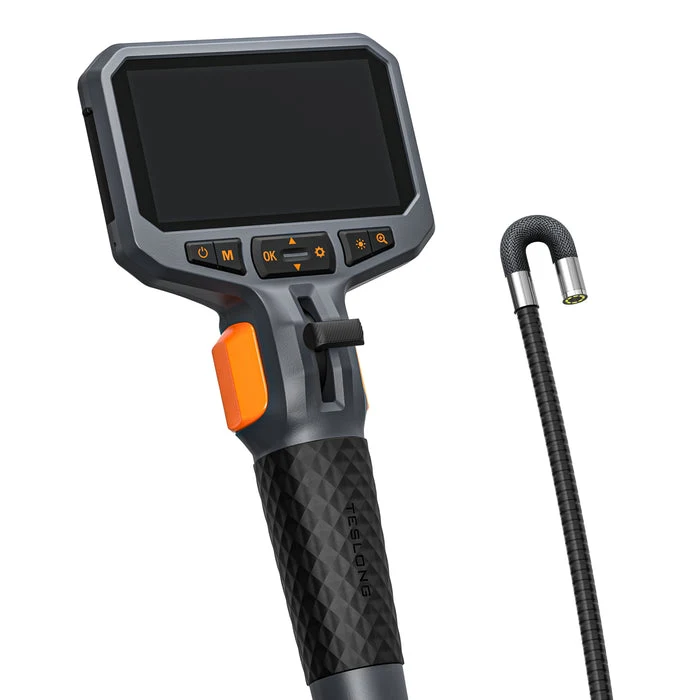
Product reference
Teslong TD450S Single-Lens Articulating Borescope
Best for: Short automotive and accessible wall-cavity inspections
Trade-off: 8.5 mm head and five-foot reach; the integrated articulated probe is not replaceable
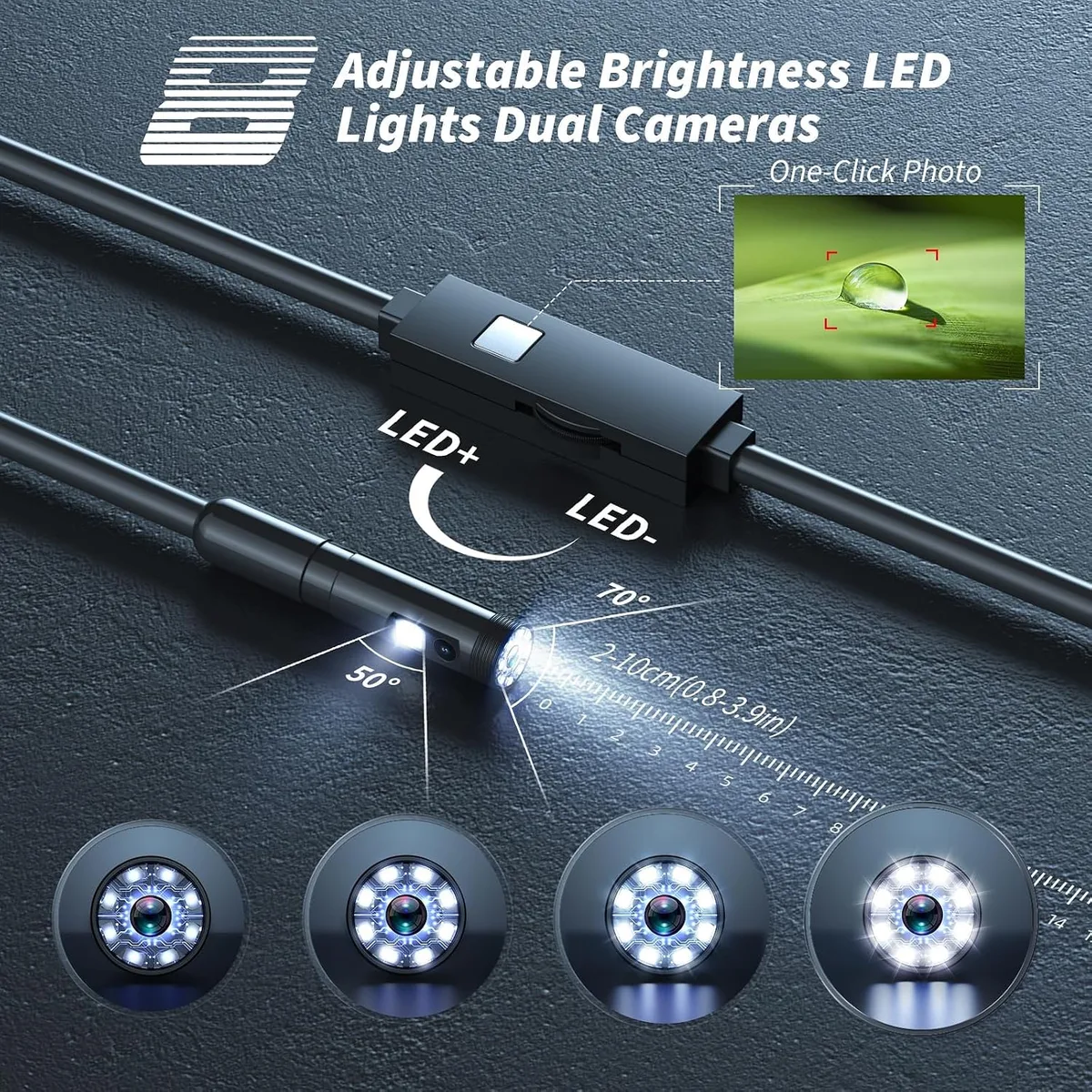
Product reference
Kinpthy W400-B25 Dual-Lens Phone Endoscope
Best for: Long-reach inspections when phone and app compatibility are confirmed
Trade-off: App-dependent viewing and a long semi-rigid cable that cannot be actively steered
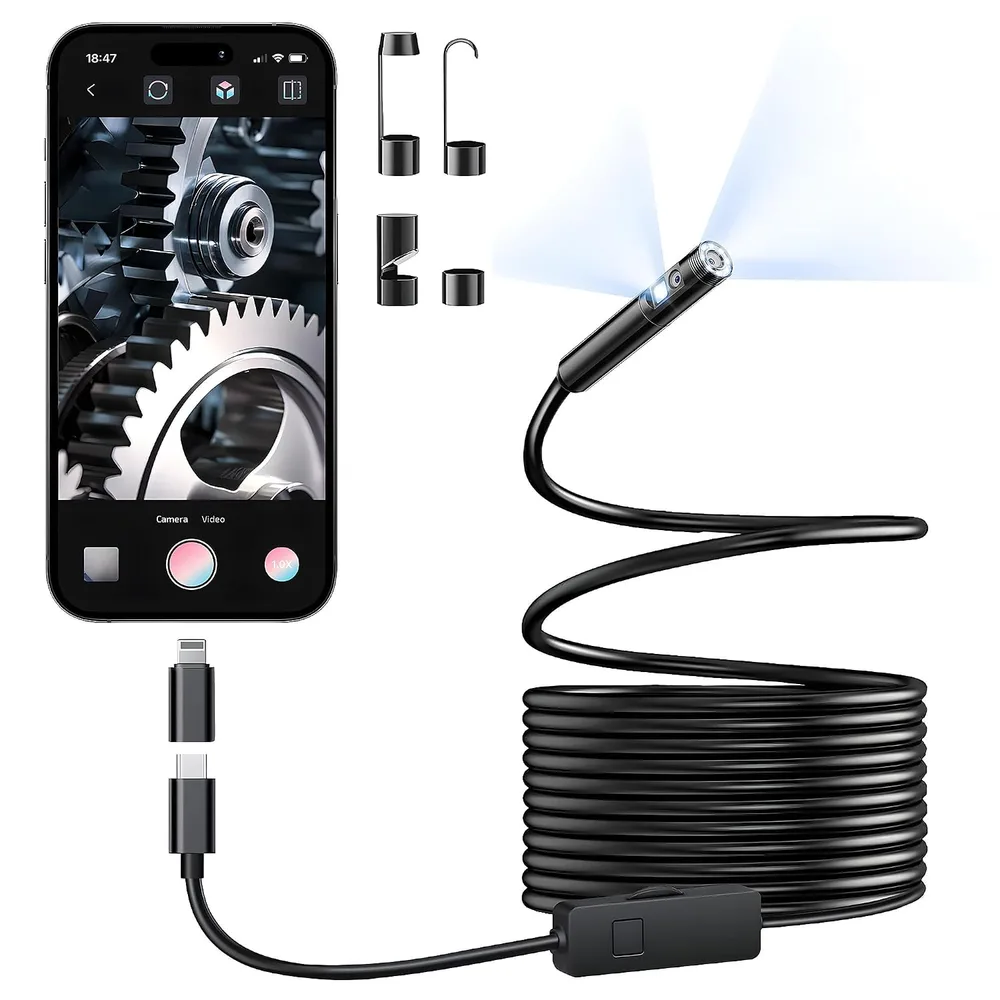
Product reference
Elecshion C-E64 Dual-Lens Phone Endoscope
Best for: Occasional wall, cabinet, duct, and appliance inspections through a known route
Trade-off: App and connector compatibility must be verified; no independent screen or complete manufacturer support library
How this guide was researched
We compare documented product features against the job each buyer needs done. We have not physically tested these products. Check current specifications and availability with the manufacturer or merchant.
Affiliate disclosure: If you buy through a qualifying link, we may earn a commission at no extra cost to you.