
Hidden-space inspection • comparison
Best Phone Borescope Cameras: Kinpthy vs. Elecshion for Long-Reach Inspection
Compare two dual-lens phone borescopes by connector support, probe diameter, cable control, lighting, app dependence, and inspection fit.
A phone borescope can put a camera 16 feet into a wall chase, cabinet void, vehicle duct, or short open pipe for much less than a dedicated inspection monitor. That reach is appealing, but it does not make the cable steerable, the phone waterproof, or the image automatically useful. Before comparing resolution claims, confirm that the plug fits your device, the app still supports its operating system, and a semi-rigid cable can actually follow the route and come back out.
The Kinpthy 16.4-foot dual-lens endoscope has the broadest documented connector package of these two. Its current listing identifies a 7.9 mm dual-lens head, included Lightning, USB-C, and Android adapters, and the SUP-ANESOK app. The Elecshion C-E64 16.5-foot dual-lens endoscope is now identifiable on the exact current listing and is the more focused budget candidate for wall cavities when its connector and UseePlus app work with the buyer’s phone.
Focused Gadgets has not physically tested either camera. This comparison uses exact merchant listings, listing-derived specification records, current affiliate destinations, and general inspection-camera safety guidance. Neither product has the kind of complete manufacturer documentation available for the Teslong model in our broader borescope buying guide, so every compatibility and waterproofing claim needs to be confirmed for the unit that actually ships.
Quick answer
- Choose the Kinpthy when you need the broadest documented phone-port support. The exact listing says it includes Lightning, USB-C, and Android connectors and works through the SUP-ANESOK app. That makes it the more defensible option for households using several phone generations.
- Choose the Elecshion for a budget wall-inspection setup after testing the exact phone. Its current listing identifies model C-E64, an approximately 8 mm dual-lens head, a 16.5-foot cable, and 8+1 LEDs. The main uncertainty is app and connector compatibility rather than product identity.
- Choose neither for deep or obstructed drains. A long semi-rigid cable is not a sewer-camera push rod. It can coil, buckle, snag, or fail to transmit useful pushing force around bends.
- Choose neither if app-free inspection matters. Both depend on a compatible phone or tablet, a physical connection, and software. A dedicated-screen borescope avoids those dependencies.
- Treat waterproofing as a probe claim. Keep the phone, plug, inline controls, and every component not explicitly covered by the rating dry.
| Feature | Kinpthy dual-lens phone endoscope | Elecshion dual-lens Type-C endoscope | Why it matters |
|---|---|---|---|
| Published cable length | 16.4 ft / 5 m | 16.5 ft / 5 m | Total cable length is not guaranteed usable reach around bends |
| Published head diameter | 7.9 mm | 8 mm | Either can be stopped by a smaller opening, fitting, or cable bend |
| Viewing directions | Forward and side lenses | Forward and side lenses | A side lens changes view without a mirror, but neither tip articulates |
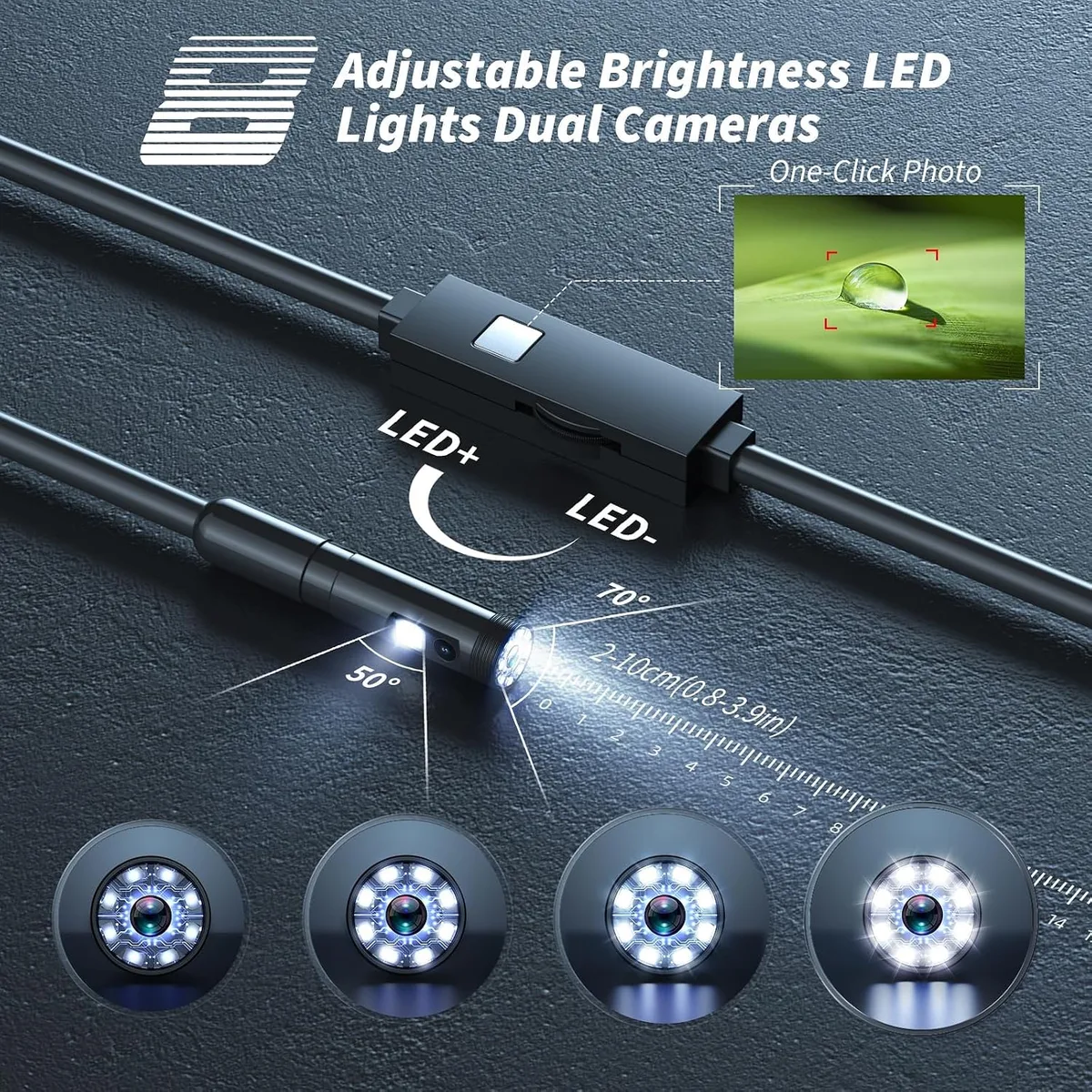
| Lighting | Eight adjustable LEDs in listing documentation | Eight forward LEDs plus one side-lens LED in listing documentation | Reflections can reduce detail on wet or metallic surfaces |
| Device connection | Listing says Lightning, USB-C, and Android connectors are included | Exact listing is identified as a Type-C variant | Port shape, operating system, OTG support, and app compatibility all matter |
| Display and storage | Uses the connected phone and app | Uses the connected phone and app | No independent screen, battery, or removable storage is documented |
| Evidence quality | Exact listing, traceable model record, and trademark owner; no complete official manufacturer support library found | Exact current listing identifies Elecshion C-E64; mirrored manual and current app records; no complete manufacturer support library found | Documentation quality affects confidence in compatibility, warranty, and replacement support |
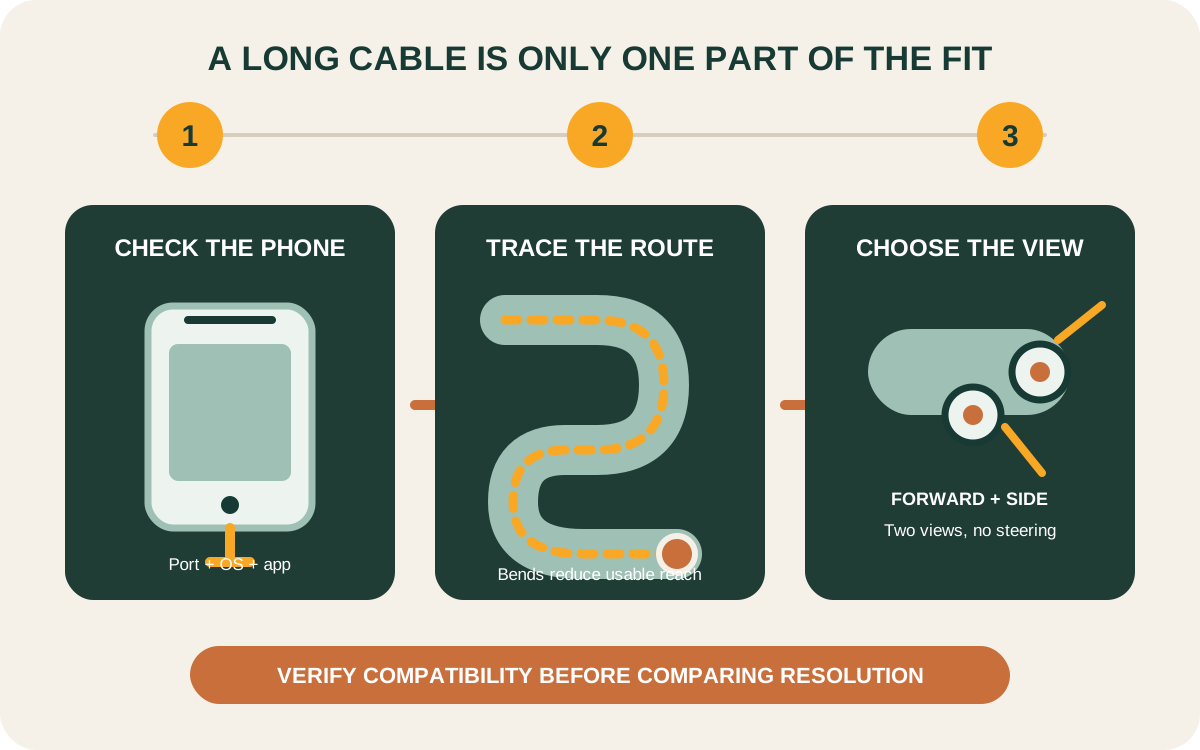
The connector decides whether the camera works at all
The most important difference is not a fraction of a millimeter at the probe. It is the connection at the other end.
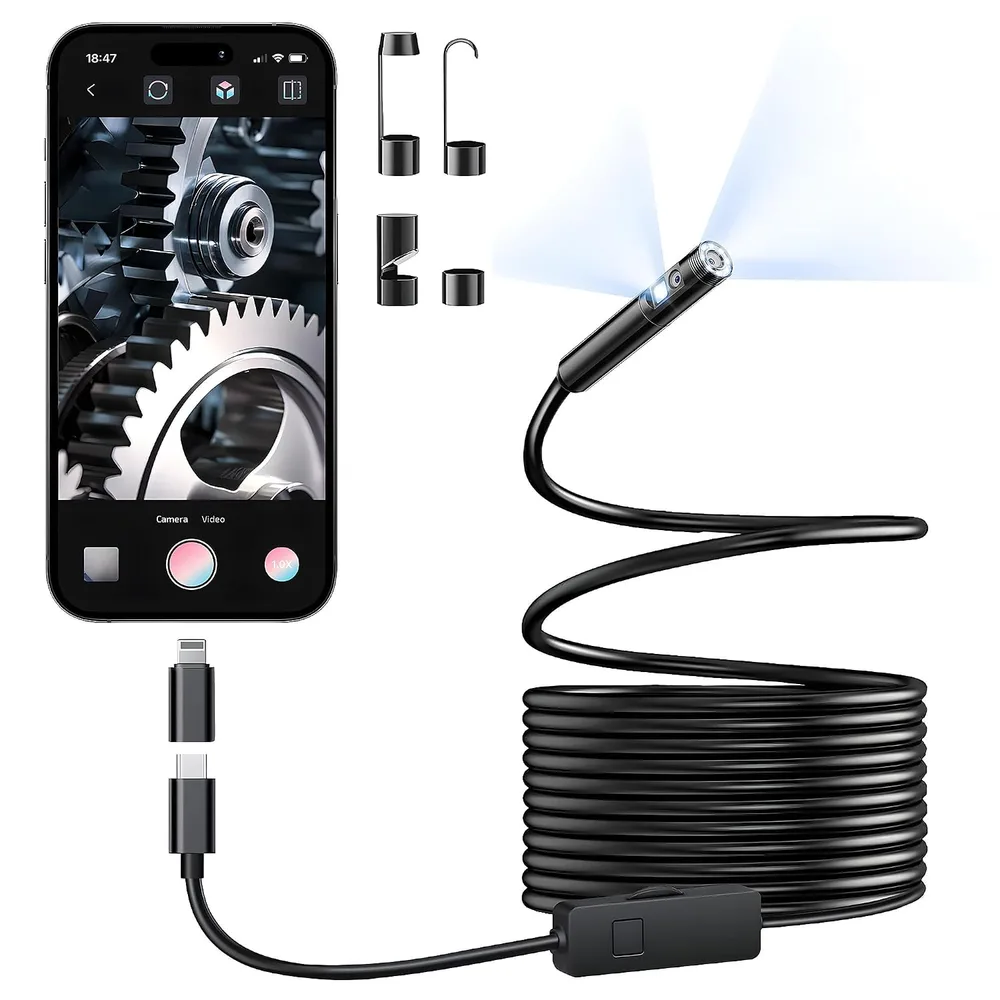
Kinpthy’s current listing says the package includes a Lightning connector, a USB-C connector, and an Android connector. It specifies iOS 9 or later and Android 7 or later and directs users to the SUP-ANESOK app. That is broader documented coverage, but the operating-system numbers should not be treated as a permanent guarantee. App-store availability, phone security policies, accessory permissions, and future OS changes can break a setup that once worked.
The exact Elecshion listing is labeled as a Type-C variant. USB-C describes the physical connector, not automatic compatibility. Some Android devices require USB On-The-Go support or a setting to power an attached camera. Newer iPhones use USB-C, while older models use Lightning. A Type-C plug does not help an older iPhone unless the exact seller supplies and supports a suitable adapter.
Before buying either model:
- Identify the phone or tablet’s exact port and operating-system version.
- Confirm that wired USB camera accessories are supported, including OTG where relevant.
- Find the named app in the official app store and read its current compatibility and privacy information.
- Confirm whether the camera draws power from the phone and how that affects a long inspection.
- Check whether photos and videos can be saved locally without creating an account or granting unrelated permissions.
Do this with the device you intend to use at the job. “Works with Android” and “works with iPhone” are categories, not compatibility tests.
Dual lenses solve direction, not navigation
Both products place one camera at the end of the probe and another on its side. The forward lens shows what lies along the cable’s path. The side lens can show a pipe wall, cylinder wall, duct surface, or object beside the tip without attaching a small mirror.
That is useful after the head reaches the right location. It does not steer the head there. These probes are semi-rigid rather than articulating: you can shape the cable before insertion and rotate it from outside, but you cannot bend the tip on command as you can with the Teslong in the broader guide.
A side lens also needs physical clearance and light. Pressing it against a surface produces blur or a bright reflection. In a narrow tube, rotating a 16-foot cable from the phone end may not rotate the distant head precisely because the cable can twist, contact surfaces, and store torsion along its route.
Choose a dual-lens phone scope when you can advance and rotate the cable through a known route. Choose an articulating camera when aiming after insertion matters more than raw cable length. Choose a purpose-built pipe camera when pushing, retrieval, abrasion resistance, or locating the head matters.
Sixteen feet of cable is not sixteen feet of controlled reach
A semi-rigid cable holds a curve better than a limp wire, which helps across an open wall bay or through a vehicle duct. The same stiffness creates a large coil that needs room outside the opening and can push sideways at every bend.
Usable reach depends on:
- the number and radius of bends;
- friction against insulation, pipe walls, or ductwork;
- whether the cable is pushed from close to the opening or from several feet away;
- the size and shape of the camera head;
- whether the route narrows after the visible entrance;
- the ability to withdraw the head without catching an accessory or edge.
Do not attach the hook or magnet simply because it is included. An accessory increases the effective diameter and creates another snag point. Use one only when the complete route is known, the retrieval task is appropriate, and losing the attachment will not create a larger problem.
For drains, distinguish inspection from clearing. Neither camera is a rod for punching through a blockage. Do not force the head past an obstruction or into a trap that may prevent withdrawal. Long, dirty, chemically exposed, or location-sensitive runs call for a purpose-built drain-camera reel and the right cleaning equipment.
“1920P” does not tell you what you will see
Both listings emphasize 1920P or 1920 x 1440 capture. That headline does not establish sensor quality, live-preview resolution, compression, frame rate, focus accuracy, or the detail visible after the phone scales the feed.
The listings also describe 2-megapixel cameras while quoting a 1920 x 1440 frame, figures that do not align neatly as a single sensor-resolution specification. Without a model-specific manufacturer datasheet and test method, treat them as listing claims rather than a measured comparison advantage.
Close-focus behavior matters more. A borescope lens is designed for nearby surfaces. If the target is too close, it blurs; if it is several feet across an open cavity, fine detail may be out of focus or too dark. The Elecshion listing gives an approximate 1.2-to-4-inch working range. Kinpthy’s listing describes close-range capture but does not provide equally consistent focus documentation across current records.
Lighting can be the limiting factor. Start at low brightness and raise it gradually. Wet pipe, polished metal, pale plastic, and oil-coated engine parts can reflect the LED ring directly into the lens. A lower setting or slight change in angle often reveals more texture than maximum brightness.
Kinpthy dual-lens endoscope: the better-documented phone option
The exact Kinpthy listing is associated with model W400-B25 in supplier-derived specification records. It uses a 7.9 mm head and a 16.4-foot semi-rigid cable, with forward and side cameras and eight adjustable LEDs. The package listing includes a hook, magnet, mirror, protective cap, and several phone connectors.
Its advantage is documentation, not proven image superiority. The listing consistently names the SUP-ANESOK app and describes support for both current and older connector families. A current Canadian trademark record also ties the Kinpthy name to a named commercial applicant and explicitly covers industrial endoscopy cameras and borescopes. That remains useful traceability, although the current Elecshion listing now also provides a consistent exact model identity.
Kinpthy says the probe is IP67 and can operate underwater to 3.28 feet for up to one hour. Treat that as a listing claim limited to the probe. It does not establish chemical compatibility, safe use in pressurized plumbing, or water protection for the connector, inline control, phone, or tablet.
The biggest trade-off is software dependence. The camera has no documented independent screen or storage. If the app is removed, a phone update breaks support, or a workplace device blocks accessory permissions, the hardware may become unusable even though the probe itself is intact.
Best fit: a buyer who needs a long dual-lens probe, has confirmed the supplied connector for the exact phone, and accepts app-based viewing.
Skip it if: the job needs steerable articulation, a self-contained display, documented replaceable probes, or manufacturer-grade service information.
Elecshion C-E64: best budget fit for known wall cavities
The Elecshion listing describes a 16.5-foot semi-rigid cable, an 8 mm head, two 2-megapixel cameras, a 1.2-to-4-inch optimal viewing range, and eight forward LEDs plus one side light. It is the more straightforward candidate for a modern USB-C phone when the exact device supports a wired camera.
The current exact listing identifies Elecshion as both brand and manufacturer and C-E64 as the model and manufacturer part number. No competing model identifier appears on that page. That is enough to resolve the earlier catalog-identity conflict, but it does not replace a complete manufacturer-hosted support library. Long-term app support, replacement parts, and warranty service remain less traceable than they are for a documented professional brand.
The more immediate risk is phone compatibility. The current listing directs buyers to UseePlus, and recent Apple and Google app-store feedback includes repeated connection and permissions complaints across supported camera combinations. Before purchase, confirm the selected interface option, app support for the exact phone, included accessories, and return route. Our full Elecshion C-E64 review explains why wall inspection is its strongest fit and how to test the complete setup.
Best fit: occasional wall, cabinet, duct, or appliance inspections through a known route after phone and app compatibility are confirmed.
Skip it if: dependable app-free operation, professional support, steerable articulation, or a documented replacement path matters.
Plumbing use: stay within the camera’s limits
The IP67 label does not make either product a general sewer camera. Keep every non-probe component dry and follow the immersion limit stated for the exact unit. Do not expose the probe to fuel, solvents, drain cleaner, sewage, pressurized fluid, or another substance unless the manufacturer explicitly documents material compatibility and safe cleaning.
Use a phone scope only in a cool, de-energized, accessible line where the cable can advance and return without force. A side lens may show buildup or a visible obstruction, but it cannot locate the head from above ground, measure pipe slope, assess the full pipe wall, or determine the correct repair by itself.
If the line contains sanitary waste or unknown residue, protect the phone and work area from cross-contamination. The phone is part of the inspection system and may be touched while handling the cable. Plan clean and dirty zones before starting rather than discovering the problem after the cable comes back out.
Wall and duct use: find a safe access path first
A borescope does not make blind drilling safe. Before creating an opening, account for electrical wiring, water and gas pipes, structure, fire blocking, insulation, and regulated materials. Prefer an existing access point and stop if the route is uncertain.
In an open cavity, a long cable can bow or disappear into insulation rather than travel in a straight line. Shape only the length needed, feed from close to the hole, and retain enough control outside for withdrawal. A side lens helps inspect a nearby stud face or duct surface, but the camera still shows only a small illuminated area.
For suspected water damage, the image may show staining or visible moisture without proving the source. A thermal camera can help identify a surface-temperature pattern, while a moisture meter and source tracing are needed to confirm what is wet and why.
Automotive use: long reach is not always an advantage
Allow the engine and exhaust components to cool, isolate moving parts, and keep the probe away from live electrical hazards, fuel, and open flame. A waterproof rating is not a high-temperature rating. Listing language for both products warns against using the probe in a hot engine.
For a cylinder or intake inspection, measure the complete opening rather than assuming 7.9 or 8 mm will fit. The side lens can be helpful once inside, but a 16-foot cable is cumbersome for a target a few inches away. An articulating model with a shorter probe and independent monitor may provide more control in a workshop.
Do not let the phone dangle from the cable or rest on a painted surface. Secure it where the connector is not loaded by the probe’s weight, and never crank or start the engine with the camera inserted.
For a repeatable process across engines, pipes, and wall cavities, use our step-by-step borescope inspection guide to set focus and lighting, establish orientation, capture contextual images, and retrieve the probe without force.
Which phone borescope should you buy?
Choose the Kinpthy when its broader documented connector package is the priority. Its exact listing has a traceable model record, named app, and documented set of Lightning, USB-C, and Android connectors. That does not make it a professional drain camera or establish its performance through independent testing.
Choose the Elecshion C-E64 when the strongest use case is a budget wall-cavity inspection and the exact phone works with its connector and UseePlus. Its identity and affiliate destination are now verified, but the app dependency and thin manufacturer support remain meaningful buying risks.
If you do not want an app, need to aim the tip, or are working through a short automotive access point, the phone-connected format is probably the wrong starting point. Compare it with the dedicated-screen articulating option in our guide to borescopes for automotive, plumbing, and wall inspections.
Frequently asked questions
Is a dual-lens borescope the same as an articulating borescope?
No. A dual-lens model switches between forward and side cameras. An articulating model mechanically bends its tip. Dual lenses change viewing direction; articulation changes where the head points. See our articulating-versus-dual-lens borescope comparison for the route, reach, and viewing-hardware trade-offs.
Can a USB-C borescope work with every USB-C phone?
No. The connector may fit while the phone lacks the required accessory support, OTG mode, power behavior, or compatible app. Confirm the exact phone and operating-system version before buying.
Can I submerge the whole phone borescope?
No. Waterproof claims generally apply only to the specified probe and cable section. Keep the phone, plug, adapter, and inline electronics dry unless the exact documentation explicitly says otherwise.
Is a 16.5-foot phone borescope suitable for a sewer line?
Not as a general rule. Semi-rigid phone-camera cable is different from a drain-camera push rod and reel. It lacks the same pushing behavior, retrieval design, abrasion protection, and locating options.
Does 1920P guarantee a clearer inspection image?
No. Focus distance, sensor quality, lighting, reflections, compression, app preview resolution, and camera stability can matter more than the saved-file dimensions in a listing headline.
Should I install the app before ordering?
Yes. Confirm that the named app is available from the official store, supports the exact device and OS, and has acceptable permissions and privacy terms. Availability before purchase is not a guarantee of long-term support, but it prevents an obvious compatibility failure.
Bottom line
Choose the Kinpthy only after confirming its supplied connector and app on the phone you will actually use. Choose the Elecshion C-E64 for a budget wall-inspection setup only after testing UseePlus and the current connector arrangement. For either one, buy the inspection format rather than the “1920P” label: dual lenses help with viewing direction, while cable behavior, safe access, focus, and retrieval determine whether a 16-foot probe is useful at all.
Models discussed
Use these as starting points for checking fit. We do not publish a price or claim hands-on testing.
| Model | Format | Best fit | Trade-off |
|---|---|---|---|
| Kinpthy W400-B25 Dual-Lens Phone Endoscope | 16.4-foot dual-lens phone endoscope | Long-reach inspections when phone and app compatibility are confirmed | App-dependent viewing and a long semi-rigid cable that cannot be actively steered |
| Elecshion C-E64 Dual-Lens Phone Endoscope | 16.5-foot dual-lens phone endoscope | Occasional wall, cabinet, duct, and appliance inspections through a known route | App and connector compatibility must be verified; no independent screen or complete manufacturer support library |
Product reference
Kinpthy W400-B25 Dual-Lens Phone Endoscope
Best for: Long-reach inspections when phone and app compatibility are confirmed
Trade-off: App-dependent viewing and a long semi-rigid cable that cannot be actively steered
Product reference
Elecshion C-E64 Dual-Lens Phone Endoscope
Best for: Occasional wall, cabinet, duct, and appliance inspections through a known route
Trade-off: App and connector compatibility must be verified; no independent screen or complete manufacturer support library
How this guide was researched
We compare documented product features against the job each buyer needs done. We have not physically tested these products. Check current specifications and availability with the manufacturer or merchant.
Affiliate disclosure: If you buy through a qualifying link, we may earn a commission at no extra cost to you.