
Hidden-space inspection • product review
Best Budget Inspection Camera for Walls? Elecshion C-E64 Review
Is the Elecshion C-E64 the best budget inspection camera for walls? Compare its dual lenses, long cable, phone app, and compatibility limits.
The best inspection camera for walls needs enough reach to cross a cavity, a side view for surfaces beside the access hole, and a cable that can advance without disappearing into insulation. The Elecshion C-E64 looks like a low-cost answer: it puts forward and side cameras at the end of a roughly 16.5-foot semi-rigid cable and uses a phone as the screen, recorder, battery, and control interface.
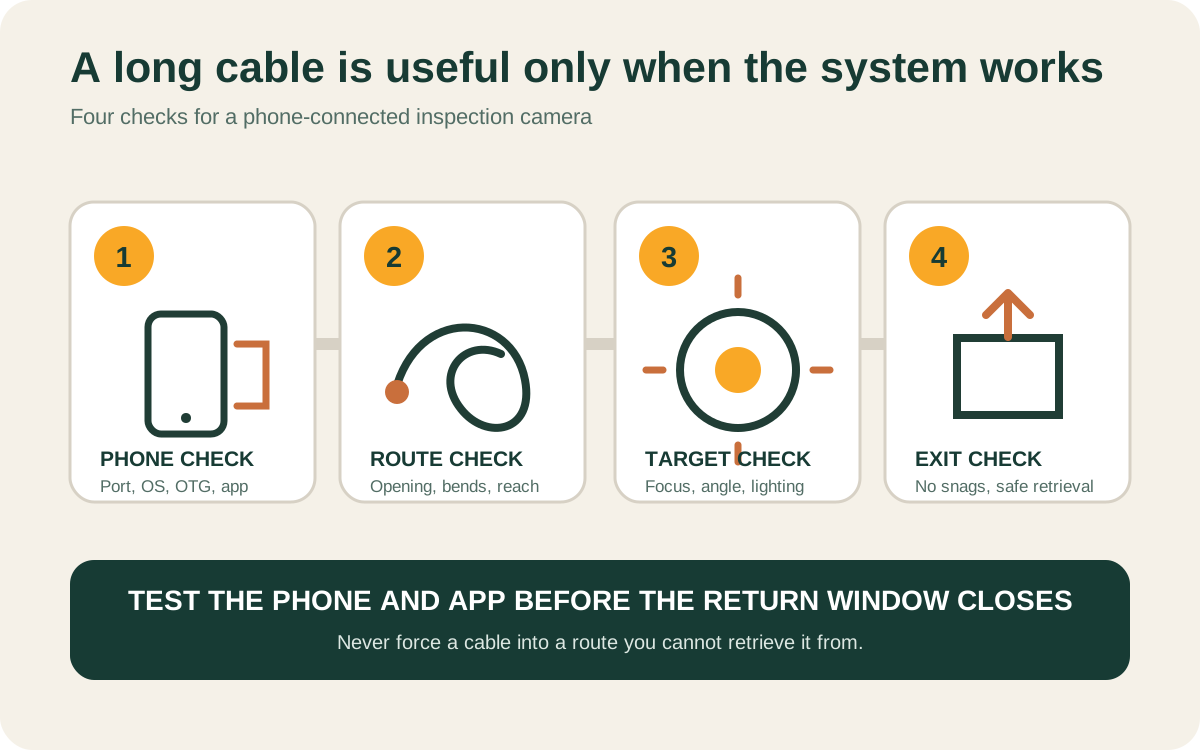
The compromise is that the camera is only half of the system. The exact phone port, operating system, USB accessory support, app version, cable route, and retrieval path all have to cooperate. The camera has no independent display or storage to fall back on if the UseePlus app stops connecting.
Our verdict: the C-E64 is a conditional budget pick for inspecting walls through an existing safe opening when you can test it immediately with the exact phone you will use. Its dual lenses and long cable are more useful than a single forward camera for known wall and vehicle routes. It is not the best wall camera for professional documentation, blind drilling, dense insulation, or anyone who wants dependable app-free operation.
Focused Gadgets has not physically tested this endoscope. This review compares the current exact retail listing, its model and variant data, a listing-derived manual mirror, current app-store records, and general borescope safety guidance. Image quality, waterproofing, cable behavior, app performance, and durability claims are not our measurements.
Quick verdict
- Buy it for occasional inspection through a known route. The forward and side lenses can reveal surfaces in more than one direction without attaching a mirror, while the long semi-rigid cable can reach across nearby cavities.
- Test the app before the return window closes. UseePlus is an essential part of the product, and current Apple and Google app-store feedback includes repeated connection and permissions complaints.
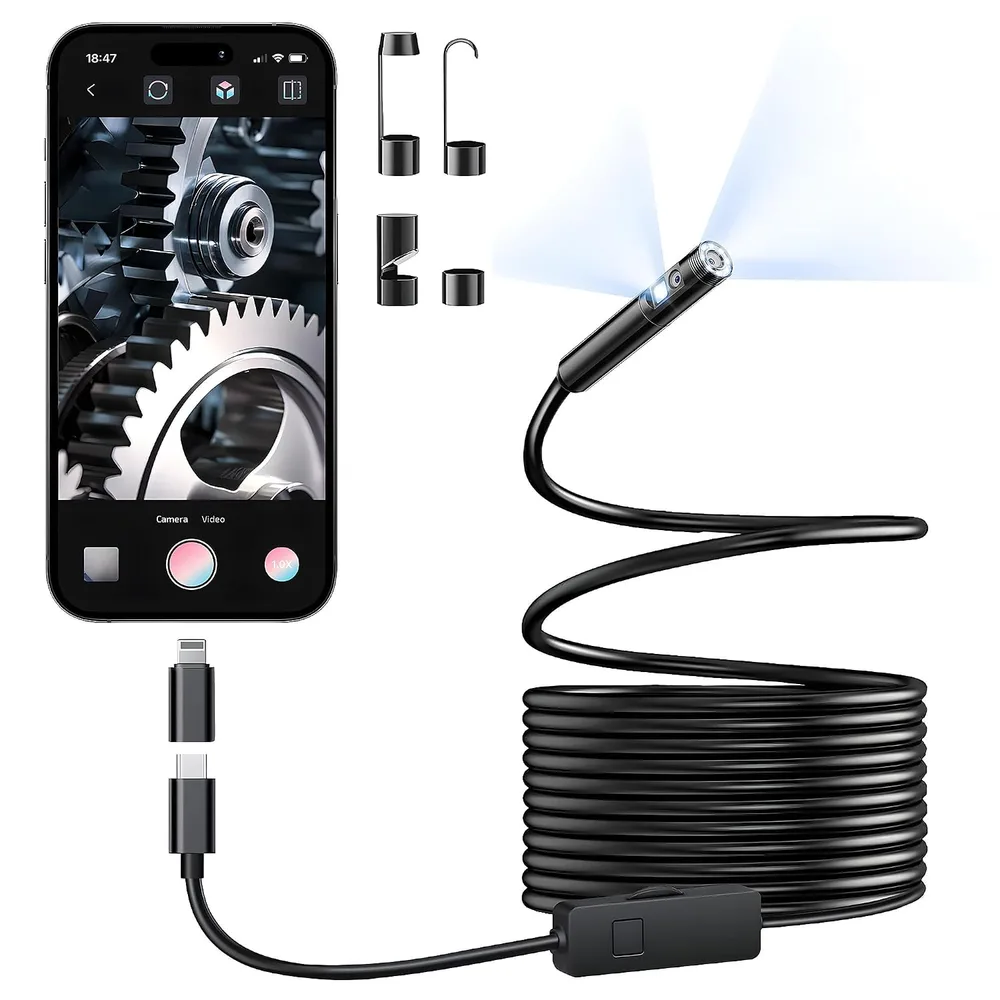
- Confirm the exact connector package. The live product page identifies the linked model as C-E64 and the selected option as a one-interface variant, while its gallery shows a combined Lightning and USB-C arrangement. Verify what the current offer includes for your phone.
- Do not buy it as a sewer camera. A semi-rigid phone-camera cable is not a drain-camera push rod, and it has no reel, locator, self-leveling head, or documented chemical resistance.
- Do not drill based on the camera alone. Establish a safe access point before inserting it; the camera cannot see a wire, pipe, or structural member before the drill reaches it.
| Question | Elecshion C-E64 answer | Buying consequence |
|---|---|---|
| Can it look forward and sideways? | Yes, the listing and manual describe two selectable lenses | Useful after the head reaches the target; it does not steer the tip |
| How far can it reach? | About 16.5 ft / 5 m of semi-rigid cable | Long on paper, but bends and friction can consume much of the controlled reach |
| Does it have its own screen? | No | The phone, connector, OS, permissions, and UseePlus app are required |
| Is it waterproof? | The probe is listed as IP67 | The phone, plug, inline control, and unspecified connection points must stay dry |
| Is it suitable for walls? | Conditionally | Strongest through an existing safe opening into a nearby, navigable cavity |
| Is it suitable for drains? | Only for a short, cool, accessible visual check | Not for clearing clogs, sanitary lines, chemicals, or deep multi-bend runs |
The exact product is now identifiable, but documentation is still thin
The current Amazon page identifies the brand and manufacturer as Elecshion and lists C-E64 as both the model and manufacturer part number. Its product title describes the dual-lens, roughly 16.5-foot Type-C variant, and the selected offer maps to that exact catalog product. The supplied affiliate link also redirects to the same product with the Focused Gadgets affiliate tag.
That resolves the earlier cross-listing concern that kept this camera from receiving a recommendation. It does not create a full first-party support library. We found no independent Elecshion product page with a permanent datasheet, downloadable firmware history, supported-phone list, or model-specific troubleshooting archive. The detailed manual available online is a retailer-derived mirror, not a manufacturer-hosted document.
This distinction shapes the verdict. The C-E64 can be judged as a low-cost tool whose current listing is internally consistent, but long-term app support, replacement parts, and warranty service are less traceable than they are for a documented inspection-camera brand. Buyers who depend on the tool for paid work should treat that gap as a feature difference, not paperwork trivia.
Phone compatibility is the first specification
The C-E64 cannot show an image without compatible host hardware and software. A USB-C plug fitting into a phone does not prove that the phone can power and communicate with a wired camera. On Android, USB On-The-Go or USB Video Class support, device settings, accessory permissions, and vendor restrictions can all affect the result.
The listing directs buyers to UseePlus. Its current Apple App Store entry requires iOS or iPadOS 11 or later, despite older product imagery advertising iOS 9 or later. That is a useful example of why the app store, not an image embedded years ago, is the better compatibility check. The Google Play listing describes USB-device photo and video control and was updated in August 2026.
Availability does not equal reliability. Recent reviews in both stores include users who cannot connect a camera, users who needed to adjust permissions or USB settings, and users whose setup works. Those reports cover more than one camera brand, so they do not prove a hardware defect in this exact model. They do show that app and phone combinations are a material buying risk.
Before ordering:
- Identify the exact phone or tablet, port, and operating-system version.
- Confirm wired USB camera support and OTG or UVC requirements where applicable.
- Find UseePlus in the official app store and review its current compatibility, permissions, privacy disclosure, and recent update history.
- Check the live offer’s selected connector variant and package images.
- After delivery, test live view, lens switching, brightness, photo capture, video recording, and file export before the return period ends.
An old spare phone can make a practical dedicated monitor, but only if the current app still supports its operating system. Do not assume an unused phone is compatible because it has the right-shaped port.
The connector description needs a final checkout check
The current listing combines several pieces of interface language. The title calls the product a Type-C option for iPhone, iPad, and Android. The gallery shows Lightning and USB-C ends, and the variant data distinguishes one-interface and two-interface choices. The C-E64 manual mirror likewise describes iOS and Type-C device support.
The safest interpretation is that the linked configuration is intended to cover recent USB-C devices and some Lightning devices through its connector arrangement, but the package should be confirmed on the live offer rather than inferred from the word “Type-C.” Apple moved newer iPhones to USB-C, while older iPhones and many iPads use Lightning. Android phones may share the USB-C shape while differing in host support.
Do not plan on adding an arbitrary adapter after purchase. Passive adapters can change the shape without providing the accessory authentication, power negotiation, or USB host behavior the camera expects. If the current seller cannot clearly confirm your exact device, choose a dedicated-screen borescope or a camera with an explicit compatibility list.
Dual lenses improve the view, not the navigation
The current material describes a forward camera and a side camera, with a long press on the inline button switching between them. The manual mirror lists viewing angles of 70 degrees for one lens and 45 degrees for the other. The title advertises eight forward LEDs plus a side-lens light, while gallery material also refers more generally to eight adjustable lights.
The useful part is direction. Once the head is next to a stud, pipe wall, duct seam, gear, or vehicle component, the side lens can show a surface that a forward-only camera would miss. It avoids relying on a tiny clip-on mirror, which adds diameter and another snag point.
Dual lens does not mean articulating. The head cannot bend on command. You can shape the semi-rigid cable before insertion and rotate it from outside, but contact and torsion along a long route make distant rotation imprecise. If the job requires aiming around a piston, valve, or obstacle after the camera is inserted, an articulating scope such as the model in our broader borescope guide is the more appropriate format.
The listing and mirrored manual use an approximately 7.9-to-8 mm head figure. Treat that rounding as an access limit, not a promise that it will pass every nominal 8 mm opening. The connector between head and cable, the bend behind the head, and any accessory can require more clearance than the lens diameter alone.
Sixteen feet is cable length, not controlled reach
A 16.5-foot cable sounds ideal for wall inspections. In an open, straight cavity it can provide reach that a short articulating scope cannot. Real routes contain insulation, blocking, corners, fasteners, pipe fittings, and friction.
Semi-rigid means the cable can hold a broad curve better than a limp wire. It does not mean the far end will follow the shape you formed while the rest of the cable rubs against several surfaces. Pushing from many feet away can make the cable bow outside the opening instead of advancing at the tip.
Feed the cable from close to the access point and uncoil only what the route requires. Keep the remaining coil controlled so it does not twist the phone connector or collect debris. If the head stops, withdraw and reassess rather than adding force. A long cable trapped behind insulation or around an obstruction can turn a cheap inspection into an expensive opening.
Accessories deserve the same caution. The hook and magnet may help retrieve a light object from a simple, visible path. Each increases the effective diameter and snag risk. The included mirror is largely redundant on a dual-lens model and can complicate retrieval. Attach nothing unless the entire path and exit are understood.
Is it the best budget inspection camera for walls?
This camera best matches the catalog’s “inspection camera for walls” intent when three conditions are met: a safe opening already exists, the target is within a navigable cavity, and the phone/app combination has been tested.
Use an existing outlet opening, service panel, grille, or other approved access point where practical. Before removing covers or working near wiring, de-energize and verify the circuit according to safe work practices. A borescope is not a detector for energized conductors, gas lines, water pipes, or structural hazards.
If a new hole is required, locate utilities and understand the assembly before drilling. The camera cannot protect against something immediately behind the finished surface because it only enters after the hole exists. Regulated materials, fire barriers, vapor control layers, and waterproofing can also make an apparently small hole consequential.
Inside the cavity, the dual views can help inspect a nearby stud face, pipe joint, duct surface, pest evidence, or visible staining. They cannot identify a material or prove why it is discolored. For a suspected leak, a thermal camera can help screen the wider surface pattern, while moisture measurement and source tracing are still needed to confirm what is wet and why.
Automotive use is possible, but the format is awkward for short targets
The roughly 8 mm head and close-focus optics may suit some vehicle ducts, door cavities, body panels, and sufficiently large engine access points. The side lens is helpful when the target lies along the wall rather than directly ahead.
The 16.5-foot cable becomes a handling burden when the target is only a few inches away. A shorter scope with an integrated screen can be easier to stabilize while keeping a personal phone away from grease, coolant, sharp edges, and a crowded engine bay. An articulating tip can also provide more deliberate aiming than rotating a long coil.
Allow the vehicle and components to cool, isolate moving parts, and keep the camera away from fuel, flammable vapor, live high-voltage systems, and any mechanism that could start or move. IP67 is not a heat rating. Never crank or start an engine with the probe inserted.
A visible deposit, scratch, liquid, or foreign object is an observation, not a diagnosis. The camera cannot establish compression, leak-down performance, electrical condition, crack depth, or the correct repair. Save useful images, note the access point and orientation, and confirm the finding with the appropriate measurement.
Plumbing use has narrow limits
The C-E64’s probe is advertised as IP67. The mirrored manual interprets that as up to about one meter of water for up to one hour. Even if the shipped unit matches that claim, the rating does not cover the phone, plug, inline control, or any connection point not explicitly included. It also says nothing about fuel, solvents, drain cleaner, sewage, pressurized water, or hot liquid.
For a short, cool, open pipe where the cable can enter and return without force, the camera may reveal a visible obstruction or surface. It should not be pushed through a clog, around an unknown trap, or down a sanitary line. A long semi-rigid cable lacks the reel, push behavior, abrasion protection, self-leveling head, skid, locator, and cleanable field design of a purpose-built drain camera.
The listing’s general plumbing imagery should not be read as compatibility with every drain. If the line is long, dirty, chemically exposed, or important enough to require location and repair decisions, use the appropriate plumbing inspection equipment.
“1920P” is not the reason to buy it
The product title emphasizes 1920P, while the manual mirror lists 1920 by 1440 capture and dual 2-megapixel cameras. Those labels do not fit neatly into one conventional resolution description, and they do not establish the resolution of the live preview, frame rate, compression, sensor size, lens quality, or low-light detail.
For inspection, focus and light dominate the result. The documentation places the best focus at roughly 0.8 to 4 inches, with slightly different lower limits across records. Press the lens against a surface and it will blur; point it across a large dark void and the LEDs may not illuminate the target.
Start with low light and raise it only as needed. Wet pipe, polished metal, pale plastic, and oil-coated parts can reflect the LEDs into the lens and erase texture. A lower setting or a small angle change can reveal more than maximum brightness.
Treat saved images as records of what was visible, not measurements. Without a scale and known orientation, a defect can look larger or smaller than it is. The app may also resize or compress files when exporting them.
What we like
- The exact current retail page now consistently identifies Elecshion and model C-E64.
- Forward and side lenses address a real viewing-direction problem without a clip-on mirror.
- The long semi-rigid cable is useful for reachable wall, cabinet, duct, and appliance cavities.
- The camera draws on a phone rather than adding another display and battery to maintain.
- The current offer includes basic retrieval accessories, though they should be used selectively.
What gives us pause
- UseePlus is a single point of failure, and current app-store feedback shows meaningful connection friction.
- Connector and variant language still requires confirmation for the exact phone and current package.
- No manufacturer-hosted model support library was found.
- Sixteen feet of cable is harder to control than its headline length suggests.
- The waterproof claim is narrow and does not make the system a drain or sewer camera.
- No independent image-quality, durability, chemical-resistance, or cable-control testing supports the listing claims.
Better alternatives for different jobs
Choose the Kinpthy phone endoscope discussed in our phone borescope comparison when documented support for several connector types is the deciding factor. It still depends on an app and semi-rigid cable, so it does not remove the category’s main limitations.
Choose the Teslong TD450S when a self-contained display and steerable tip matter more than long reach. Its short probe is a better fit for nearby automotive targets, but it is too short for many wall chases and is not a sewer camera.
Choose a purpose-built pipe camera when the job requires deep pushing, repeated bends, sanitary cleanup, head locating, a reel, or professional documentation. It costs substantially more because it solves a different mechanical problem.
Who should buy the Elecshion C-E64?
Buy it if you need an inexpensive occasional camera for an existing wall, cabinet, duct, appliance, or vehicle opening; both viewing directions are useful; and you can verify the live connector and test UseePlus on the exact phone immediately.
Skip it if you need predictable paid-work reliability, app-free operation, precise articulation, a replaceable probe, a manufacturer support system, chemical compatibility, deep drain access, or evidence that can support a high-consequence repair decision.
The low purchase price does not make compatibility troubleshooting free. A dedicated-screen model can be the better value when you need the tool infrequently but expect it to work after sitting in a drawer through several phone and app updates.
Frequently asked questions
Does the Elecshion C-E64 work with every USB-C phone?
No. The plug can fit while the phone lacks the required USB host, OTG, UVC, permission, power, or app support. Confirm the exact device and current UseePlus requirements before buying.
Does it work with an iPhone?
The current listing advertises iPhone and iPad compatibility and shows a Lightning/USB-C connector arrangement, while the selected variant is labeled as a one-interface option. Confirm the current package for the exact iPhone generation. The present App Store listing requires iOS 11 or later.
Can it inspect inside walls?
Yes, through a safe existing opening and a navigable nearby cavity. It cannot make blind drilling safe, steer around every obstruction, see through insulation, or identify the cause of visible damage.
Is the cable articulating?
No. It is semi-rigid and can hold broad curves, but the tip cannot be mechanically steered. Rotating the cable may rotate the view, although friction along a long route makes control less precise. Compare that behavior with a steerable dedicated-screen model in our articulating-versus-dual-lens borescope guide.
Can the whole camera be submerged?
No. The IP67 claim applies to the probe under stated limits. Keep the phone, connector, inline control, and all unspecified parts dry, and do not assume compatibility with chemicals, hot liquid, fuel, or pressure.
Is it suitable for a sewer line?
No. It lacks a drain-camera push rod, reel, locator, protected head, and documented sanitary or chemical cleaning design. Use it only for short accessible visual checks where safe retrieval is certain.
Bottom line
The Elecshion C-E64 is more credible than its previously inconsistent reseller trail suggested. The current exact listing consistently names the brand and model, the dual-lens layout is useful, and the long cable fits occasional wall and vehicle inspection better than a short workshop scope.
It remains a conditional recommendation. The phone and UseePlus app are inseparable from the hardware, cable length is not controlled reach, and the available documentation is retailer-led rather than a mature manufacturer support system. Confirm the connector, install the current official-store app, and test every function while the purchase can still be returned. If that sounds like too much uncertainty, buy a dedicated-screen borescope instead.
Models discussed
Use these as starting points for checking fit. We do not publish a price or claim hands-on testing.
Product reference
Elecshion C-E64 Dual-Lens Phone Endoscope
Best for: Occasional wall, cabinet, duct, and appliance inspections through a known route
Trade-off: App and connector compatibility must be verified; no independent screen or complete manufacturer support library
How this guide was researched
We compare documented product features against the job each buyer needs done. We have not physically tested these products. Check current specifications and availability with the manufacturer or merchant.
Affiliate disclosure: If you buy through a qualifying link, we may earn a commission at no extra cost to you.