
Material inspection • buying guide
Best Wood Moisture Meters: Match the Sensor to the Material
Compare pin and pinless moisture meters for firewood, home inspection, and woodworking—and learn where each reading can mislead you.
A moisture reading is useful only when the meter, material, and decision match. The tool that makes sense for checking a freshly split log is not automatically the right one for scanning painted drywall or deciding whether expensive hardwood is ready to become a tabletop.
That is the real choice here. The General Tools MMD4E uses pins to test a small point and is the straightforward option for firewood and basic spot checks. The Klein ET140 scans without making holes, which suits comparative checks across finished building materials. The Wagner Orion 950 is a much more elaborate pinless meter for woodworkers and flooring professionals who need species adjustment, two sensing depths, calibration, and recorded measurements.
This is a source-based comparison. Focused Gadgets has not physically tested these meters, and none of them can identify mold, locate a pipe, or explain why a material is wet.
Quick answer
- Choose the General Tools MMD4E for split firewood and inexpensive pin readings. Its short replaceable pins, separate wood and building-material modes, and simple display make sense when tiny test holes are acceptable. It lacks species correction and is not the meter we would choose for precision furniture or flooring decisions.
- Choose the Klein ET140 for non-destructive home inspection. Its broad sensor can scan drywall, masonry, hardwood, and softwood without puncturing the surface. Drywall and masonry readings are relative, so the useful result is a wetter pattern compared with a known-dry area—not an absolute moisture percentage.
- Choose the Wagner Orion 950 for serious woodworking and flooring. It adds wood-species settings, shallow and deep scan modes, field calibration, stored readings, Bluetooth, and environmental measurements. Those capabilities are wasted on an occasional pile of firewood.
| Model | Measurement approach | Best fit | Main compromise |
|---|---|---|---|
| General Tools MMD4E | Pin; 8mm contact points | Firewood and basic localized checks | Leaves small holes; no species setting |
| Klein Tools ET140 | Pinless; fixed 19mm sensing depth | Scanning finished building materials | Building-material values are relative and influenced by what lies beneath |
| Wagner Orion 950 | Pinless; 6.4mm and 19mm depth modes | Woodworking, flooring, and documented jobs | Requires a flat contact area and costs more capability than casual checks need |
The best meter depends on the question
Pin and pinless meters do not simply offer cheap and expensive versions of the same measurement.
A pin meter measures electrical resistance between two probes. It samples a small area, can reach a freshly exposed face, and leaves two punctures. Wood species and temperature can affect the relationship between resistance and moisture content. Short pins also say little about the center of a thick board or log.
A pinless meter sends an electromagnetic field into a wider area. It can scan quickly without marking the surface, but the reading depends on sensor contact, material density, selected mode, thickness, and whatever sits inside or behind the sensing field. Metal fasteners, pipes, backing material, and empty space can distort the result.
The consequence is simple: use readings as evidence, not a verdict. Repeat them, compare like with like, and investigate surprising results with another method.
General Tools MMD4E: the practical firewood pick
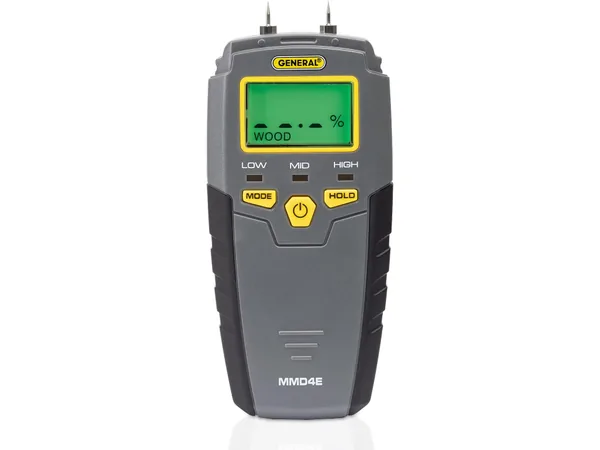
The MMD4E is a compact pin meter with separate curves for wood and building materials. General Tools specifies a 5% to 50% wood range, a 1.5% to 33% building-material range, 0.1% display resolution, and stated accuracy of ±2%. Its two 8mm pins are replaceable, and the protective cap doubles as a basic calibration check. A 9V battery powers the meter.
For firewood, the modest design is an advantage. The U.S. Environmental Protection Agency’s archived Burn Wise guidance recommends splitting a piece, testing the newly exposed face, inserting the probes parallel with the grain, and checking two or three locations. Its guidance identifies roughly 15% to 20% moisture content as the efficient-burning range. A reading from the dry outside of an unsplit log can be falsely reassuring.
The MMD4E is less convincing for fine woodworking. It has no wood-species selection, and its short pins sample close to the surface. A specialist independent evaluation from Moisture Meter Experts reported good repeatability but weaker accuracy outside the middle of the range and sensitivity to surface moisture. That is one test, not a universal verdict, but it reinforces the sensible role for this meter: affordable screening and comparison rather than a high-stakes flooring or joinery decision.
Use it when pinholes do not matter and when you can expose the material you actually need to test. Skip it for finished trim, broad moisture mapping, or expensive lumber where density correction and measurement depth matter.
Klein Tools ET140: scan first, confirm second
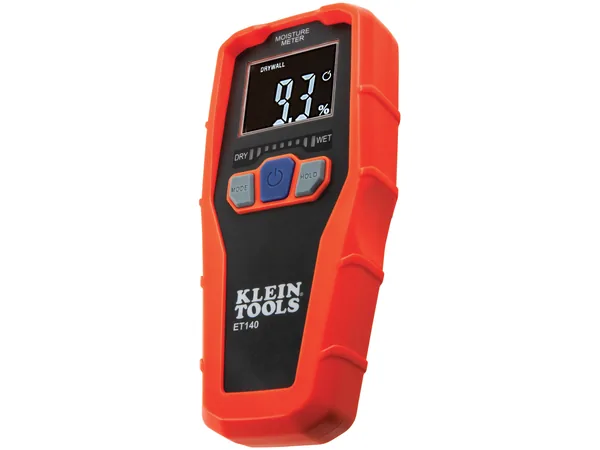
The ET140 is the better fit when making holes would be a problem. Klein says its electromagnetic sensor reads as deep as 3/4 inch (19mm) and is calibrated for drywall, masonry, hardwood, and softwood. The meter has dedicated modes for those materials, a nine-segment LED bar, a hold function, audible notification, a reverse-contrast display, and a stated 2m drop rating.
Its numbers need careful interpretation. Klein’s manual lists quantitative ranges of 0% to 35% for hardwood and 0% to 55% for softwood, with stated wood accuracy of ±4%. Drywall and masonry use a 0-to-100 relative scale. A display value of 60 on drywall does not mean the wall is 60% water; it means the meter detected a stronger response within its material-specific reference scale.
That makes the ET140 useful for mapping. Scan a known-dry section, then compare the same material around a stain, window, baseboard, or suspected leak. Move in a grid and look for a repeatable boundary. A high reading can justify a pin check, access from the other side, or professional investigation.
The fixed sensing depth is also a trade-off. On material thinner than 19mm, the reading can include adhesive, studs, insulation, air, or whatever is behind the surface. The manual warns that the tool is not insulated and must not be used on or near live electrical circuits. A moisture meter is not a safe way to explore an unknown wall cavity around energized wiring.
Wagner Orion 950: built for lumber decisions
The Orion 950 is not merely a more expensive leak finder. It is a wood-focused measurement system for buyers who need to compare boards, account for species, choose a sensing depth, document readings, and check the meter’s calibration in the field.
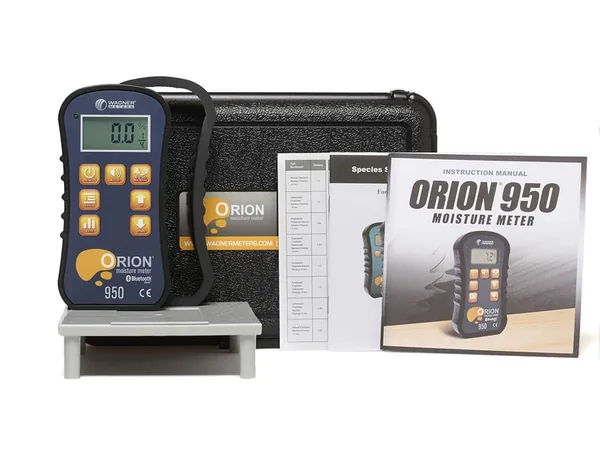
Wagner specifies a 4% to 32% moisture-content range for wood, with the exact range varying by species setting. The meter supports wood specific gravity from 0.20 to 1.0 and has 1/4-inch (6.4mm) and 3/4-inch (19mm) sensing modes. Its sensor covers a 2-by-2.5-inch area, so it needs a reasonably flat surface and full contact. The supplied On-Demand Calibrator allows the user to verify and recalibrate the matched meter.
The 950 can store up to 100 readings and calculate minimum, maximum, and average values. Bluetooth connects it to Wagner’s woodworking and flooring apps. It also measures ambient temperature, relative humidity, dew point, equilibrium moisture content, and absolute humidity. Those additions are valuable when lumber is acclimating to a shop or floor installation site; they are unnecessary if the only question is whether tonight’s logs are dry enough to burn.
Technique still matters. Wagner’s manual calls for an air gap beneath loose boards, warns that the wrong depth setting can underestimate moisture in thin stock, and recommends scanning from both sides when a thicker board needs fuller coverage. Pinless does not mean thoughtless.
Three workflows that produce better readings
Firewood
Split a representative piece and measure the freshly exposed face rather than the weathered exterior. Insert pin probes parallel with the grain and take several readings. Test more than one log from different parts of the stack. The General MMD4E is the sensible choice among these three because its pins can reach the new face and cosmetic damage is irrelevant.
Suspected water damage
Remove any standing water with equipment explicitly compatible with the liquid; our cordless transfer-pump guide explains why a water pump and a fuel pump are not interchangeable. Then compare the same material in dry and suspect areas. The Klein ET140 can map a pattern without turning a wall into a pincushion. A higher relative reading is a reason to investigate; it is not proof of a leak, mold, or structural damage. Our guide to thermal cameras versus moisture meters explains why a thermal anomaly and a material reading answer different questions, while the water-leak thermal-camera guide covers the broader search-and-confirm workflow. Buyers assembling a wider inspection kit can also compare formats in our home-inspection thermal-camera guide.
Furniture and flooring lumber
Measure multiple boards and multiple places on each board after the wood has had time to acclimate. Use the correct species or specific-gravity setting, choose a depth appropriate to the stock, and avoid readings over metal. The Orion 950’s calibration, depth selection, and data logging make sense here because a wrong decision can become a cupped floor, split panel, or failed joint.
What no moisture meter tells you
A meter does not identify the source of water. It cannot distinguish a plumbing leak from condensation, wind-driven rain, or moisture left from an old event. It does not test for mold, determine whether a structure is safe, or see through a wall. Even a stable percentage can be misleading when the wrong material mode or technique is used.
For building investigations, compare nearby readings, consider construction details, and confirm consequential findings. For flooring, restoration, or structural work, follow the material manufacturer’s standard and use qualified professional assessment where required.
Who should buy which meter?
Buy the General Tools MMD4E if you want a small pin meter for firewood, rough lumber, or localized building-material checks and can tolerate punctures. Its simple controls and replaceable pins are more useful here than a long feature list.
Buy the Klein Tools ET140 if you need to scan finished drywall, masonry, or wood for relative changes without damage. It is the most practical home-inspection tool in this group, provided you understand that its building-material scale is comparative.
Buy the Wagner Orion 950 if moisture measurement is part of a repeatable woodworking or flooring process. Its species settings, dual depth, calibration, environmental readings, storage, and app connection justify the complexity only when those measurements influence real material decisions.
Skip all three if you expect one reading to diagnose a hidden leak or certify a building. The instrument can narrow the question. It cannot replace the inspection.
Frequently asked questions
Is a pin or pinless moisture meter better?
Neither is universally better. Pins suit small-point checks, freshly split firewood, and situations where a puncture is harmless. Pinless meters scan larger areas without surface damage, but require correct material settings, good sensor contact, and careful interpretation of depth and hidden materials.
Can a wood moisture meter be used on drywall?
Only when the manufacturer provides a suitable mode or reference scale. The MMD4E includes a building-material mode, and the ET140 provides a relative drywall scale. Do not interpret a relative drywall value as a literal moisture-content percentage.
What moisture reading is suitable for firewood?
The EPA’s archived Burn Wise guidance identifies about 15% to 20% moisture content as the efficient-burning range. Test a freshly split face in several places and follow the meter’s temperature and technique instructions.
Can a moisture meter detect mold?
No. It can identify a material that reads wetter than expected, which may point to conditions that deserve investigation. It neither detects mold nor establishes why the material is damp.
Does a pinless meter read through walls?
It senses within a limited field and depth; it does not produce an image of the wall cavity. Studs, metal, backing materials, thickness, and air gaps can affect the reading.
Do wood species settings matter?
They matter when the decision requires accurate wood moisture content because electrical and density characteristics vary between species. For rough screening, repeatable comparisons may be enough. For furniture, flooring, and valuable stock, use the correction method specified by the meter manufacturer.
Models discussed
Use these as starting points for checking fit. We do not publish a price or claim hands-on testing.
| Model | Format | Best fit | Trade-off |
|---|---|---|---|
| General Tools MMD4E Digital Moisture Meter | Pin moisture meter | Freshly split firewood and basic spot checks | Leaves pinholes and has no wood-species setting |
| Klein Tools ET140 Pinless Moisture Meter | Pinless building-material scanner | Non-destructive comparative home inspection | Building-material readings are relative |
| Orion 950 Pinless Wood Moisture Meter by Wagner Meters | Dual-depth pinless wood meter | Species-aware woodworking and flooring checks | More capability than occasional checks require |
Product reference
General Tools MMD4E Digital Moisture Meter
Best for: Freshly split firewood and basic spot checks
Trade-off: Leaves pinholes and has no wood-species setting
Product reference
Klein Tools ET140 Pinless Moisture Meter
Best for: Non-destructive comparative home inspection
Trade-off: Building-material readings are relative
Product reference
Orion 950 Pinless Wood Moisture Meter by Wagner Meters
Best for: Species-aware woodworking and flooring checks
Trade-off: More capability than occasional checks require
How this guide was researched
We compare documented product features against the job each buyer needs done. We have not physically tested these products. Check current specifications and availability with the manufacturer or merchant.
Affiliate disclosure: If you buy through a qualifying link, we may earn a commission at no extra cost to you.