
Backup and off-grid power • buying guide
Best Portable Power Stations for Refrigerators and Backup Power
Compare Jackery and Anker power stations for refrigerators, outage essentials, and small loads, with an honest CPAP safety caveat.
A portable power station can keep a refrigerator cold through a short outage, recharge phones and lights, or run a compact 12-volt fridge away from an outlet. It cannot turn every appliance into an all-night load, and the capacity printed on the case is not the amount that reaches an AC plug.
For most refrigerator and outage buyers in this comparison, the Jackery Explorer 1000 v2 is the best-balanced option. Its 1,070Wh battery, 1,500W continuous AC rating, three AC outlets, and 23.8-pound weight give it useful capacity without making it awkward to move. The Anker SOLIX C1000 Gen 2 is the stronger choice when higher output and very fast wall charging matter more: Anker rates it at 1,024Wh and 2,000W, with a claimed 49-minute full charge in its fastest mode. The Jackery Explorer 300 is a different class of product. It is a 293Wh, 300W station for phones, laptops, lights, and carefully measured low-power loads—not the model to buy for substantial home backup.
CPAP users need a separate decision process. A consumer power station’s capacity and fast transfer claim do not establish medical-device compatibility. Jackery’s current guidance says its stations are not intended for medical devices or life-support applications. Anker markets the C1000 Gen 2 for CPAP use, but that still does not replace instructions from the maker of your exact therapy device. Confirm the approved cable or inverter, power requirements, humidifier and heated-tube impact, and backup procedure with the device manufacturer and your care provider before relying on any station.
Focused Gadgets has not physically tested these power stations. This guide compares exact manufacturer pages, manuals, and current retail destinations. Capacity, output, charging time, cycle life, transfer time, and solar-input figures are manufacturer claims, not our measurements.
Quick answer
- Choose the Jackery Explorer 1000 v2 for a practical refrigerator and portable-backup balance. It offers slightly more rated energy than the Anker, three AC outlets, a regulated 12V car port, and the lowest listed weight of the two 1kWh-class models.
- Choose the Anker SOLIX C1000 Gen 2 for higher-output appliances and faster grid recharging. Its 2,000W continuous output, 10ms UPS claim, 1,600W AC input, and 600W solar-input ceiling suit a faster-turnaround outage plan. It is not expandable.
- Choose the Jackery Explorer 300 only for modest, non-critical loads. At 293Wh and 300W, it is much easier to carry but has far less energy and inverter headroom.
- Do not choose any station by watt-hours alone. Measure the appliance’s average energy use and account for compressor startup, inverter losses, ambient temperature, battery reserve, and recharging opportunities.
- Do not make a CPAP plan from a runtime chart alone. Follow the medical-device manufacturer’s backup-power guidance and test the exact approved setup before it is needed.
| Model | Rated battery and AC output | Listed weight | Best fit | Main trade-off |
|---|---|---|---|---|
| Jackery Explorer 1000 v2 | 1,070Wh; 1,500W continuous, 3,000W surge | 23.8 lb | Refrigerators, camping appliances, and movable outage essentials | Slower transfer-time claim than the Anker; Jackery says not to use its stations for medical devices |
| Anker SOLIX C1000 Gen 2 | 1,024Wh; 2,000W continuous, 3,000W peak | 24.9 lb | Higher-output essentials and rapid wall or solar recharging | Slightly less rated energy; battery is not expandable |
| Jackery Explorer 300 | 293Wh; 300W continuous, 500W surge | 7.1 lb | Phones, laptops, lights, cameras, and measured low-power gear | Too little output and capacity for many refrigerators or a broad home-backup plan |
Start with the appliance, not the power station
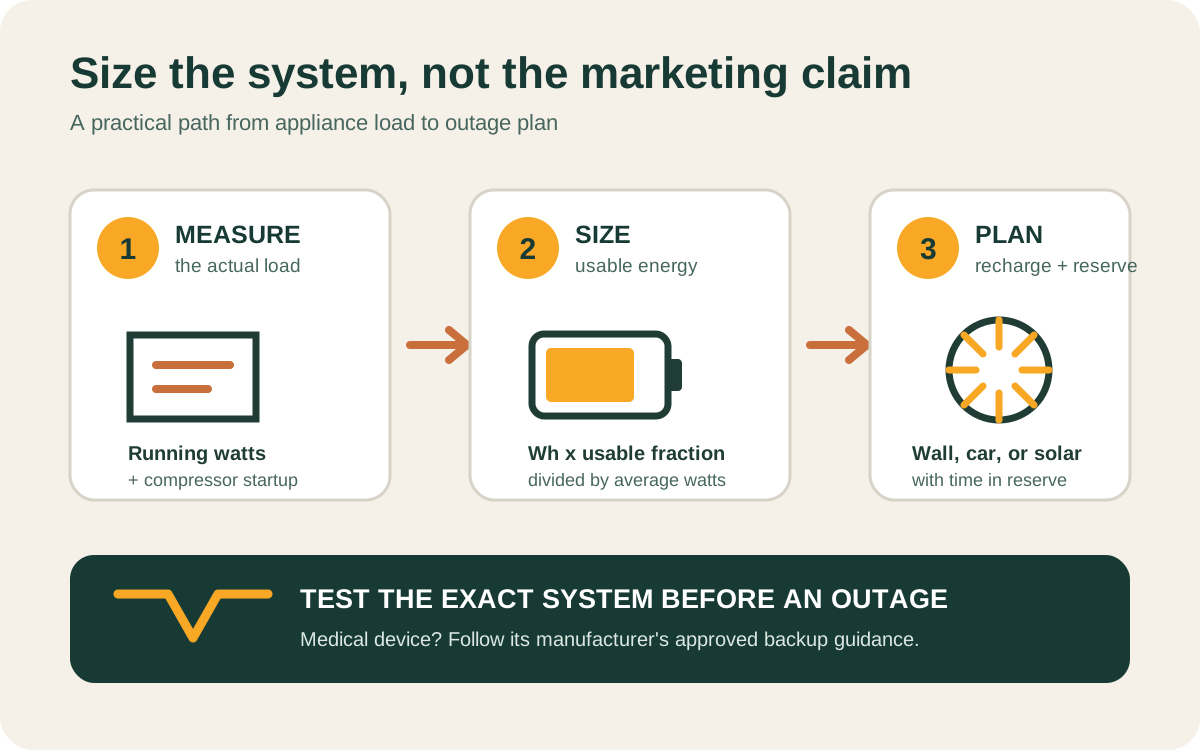
Two numbers decide whether a power station can run a load. Watts describe how much power the appliance asks for at a moment in time. Watt-hours describe how much energy it uses over time.
The station’s continuous AC rating must exceed the load while it is running. It also needs enough brief surge capacity for a refrigerator compressor or pump starting. A station can have plenty of battery energy yet shut down immediately if the load exceeds its inverter limit. Conversely, a high-output inverter does not make a small battery last longer.
For a refrigerator, the label wattage is only a starting point. The compressor cycles, defrost heaters may run, room temperature changes the duty cycle, and an older unit may behave very differently from an efficient recent model. A plug-in energy meter observed for at least 24 hours gives a much better estimate of daily consumption. If you are powering one of the compact models in our 12V refrigerator guide, check whether its direct DC input can avoid the extra conversion loss of running an AC adapter from the inverter.
Also list every load that will share the station. A refrigerator, router, lamp, and phone chargers may be individually modest, but their combined running power and energy use still count. Leave headroom rather than designing a plan that works only when every claim on the box is achieved.
A realistic runtime calculation
The simple planning equation is:
Estimated runtime = rated watt-hours x usable fraction / measured average watts
For an AC load, using 75% to 85% of the headline battery capacity is a reasonable planning range before you have model-specific efficiency data. That allowance is not a test result. It simply recognizes inverter loss, standby consumption, temperature, load level, and the reserve you should keep instead of planning to reach zero.
Suppose a refrigerator averages 70W over a full cycle. With a 1,070Wh station and an 80% planning factor, the estimate is about 12.2 hours: 1,070 x 0.80 / 70. If the same appliance averages 110W in a hot room, the estimate falls to about 7.8 hours. Neither calculation confirms that the inverter can handle compressor startup, and neither predicts how the battery will behave after years of use.
For a 293Wh station, the same 70W assumption yields roughly 3.3 hours at an 80% factor. That illustrates why the Explorer 300 belongs in a low-load category even if a particular efficient appliance starts successfully.
Do this calculation with measured average power, then reduce the result further if the consequences of running out are serious. Runtime widgets based on one fixed appliance wattage can look precise while hiding the variables that matter.
Refrigerator backup needs a recharge plan
A power station only bridges the time between charging opportunities. For a short interruption, one 1kWh battery may be enough to keep a measured refrigerator cycling while you preserve a sensible reserve. During a multi-day outage, the question quickly becomes how you will replenish it.
The Explorer 1000 v2 accepts up to 400W of DC/solar input according to Jackery. Anker specifies up to 600W of solar input for the C1000 Gen 2. Those are input ceilings, not guaranteed field harvests. Panel angle, shade, cloud, temperature, cable limits, and the hours of useful sun all lower real production. A panel array that briefly reaches its nameplate rating is not the same as receiving that output all day.
Wall charging is more predictable when grid power returns intermittently. Jackery lists about 1.58 hours for standard AC charging and a one-hour emergency mode that must be enabled in its app. Anker claims a 49-minute full charge for the C1000 Gen 2 in UltraFast mode. Fast charging can be valuable during a brief restoration, but confirm the circuit can support the input and follow the manufacturer’s thermal and ventilation instructions.
Vehicle charging is generally slower and must not be planned in a way that strands the vehicle or creates an exhaust hazard. Never run an engine in a garage or enclosed space. If a diesel heater is part of the same off-grid setup, size its electrical demand separately; our portable diesel heater guide explains why a heater’s startup draw and steady draw are different.
Jackery Explorer 1000 v2: best balance for refrigerators
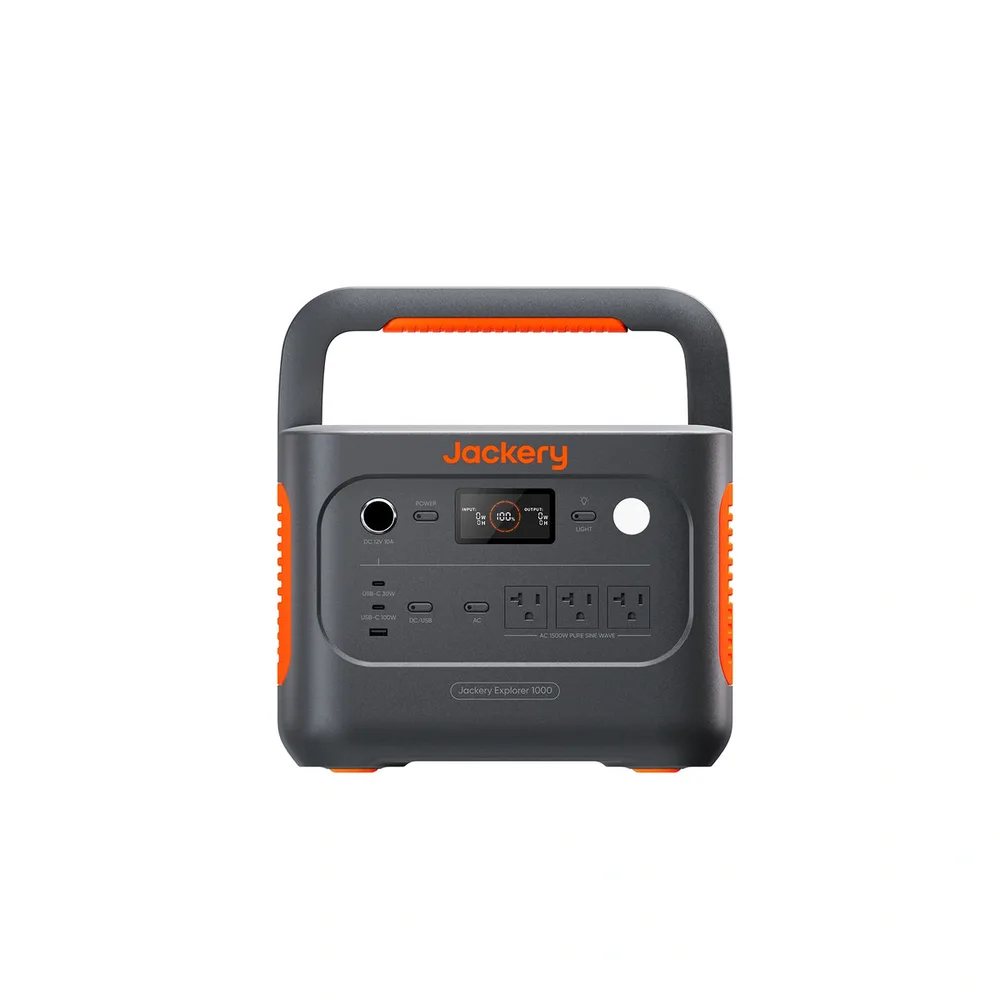
The Explorer 1000 v2 is the easiest all-around recommendation here for a buyer who has measured a refrigerator or similar portable appliance. Jackery rates it at 1,070Wh, 1,500W continuous output, and 3,000W surge. It provides three AC outlets, one 100W USB-C port, one 30W USB-C port, USB-A, and a 12V/10A car socket. Our Jackery Explorer 1000 v2 review goes deeper into refrigerator runtime, charging modes, solar limits, and long-term ownership.
Its physical balance is part of the appeal. Jackery lists dimensions of 12.87 by 8.82 by 9.72 inches and a weight of 23.8 pounds. That is still a substantial object, but it is a little lighter than the Anker while carrying slightly more rated energy. Jackery specifies a lithium iron phosphate battery with 4,000 cycles to at least 70% capacity, which favors frequent use over the older battery chemistry in the Explorer 300.
The station also has a claimed sub-20ms UPS function. Treat that as a convenience feature, not a promise that every connected device will ride through every interruption. Sensitive equipment can react differently to transfer time, waveform, grounding, and the way the station handles overloads.
The main limitation for this comparison is not refrigerator use; it is medical use. Jackery’s current product FAQ says the station is not recommended for medical devices, life-support equipment, or applications where interruption could cause harm. That excludes it from a responsible CPAP recommendation even when a capacity calculation suggests sufficient runtime.
Choose the Explorer 1000 v2 for a measured refrigerator, portable fridge, communications gear, lights, or similar non-critical loads that fit its output. Skip it when you need a 2,000W continuous inverter, more than 400W of solar input, battery expansion, or a manufacturer-approved medical backup.
Anker SOLIX C1000 Gen 2: best for output and fast recharging
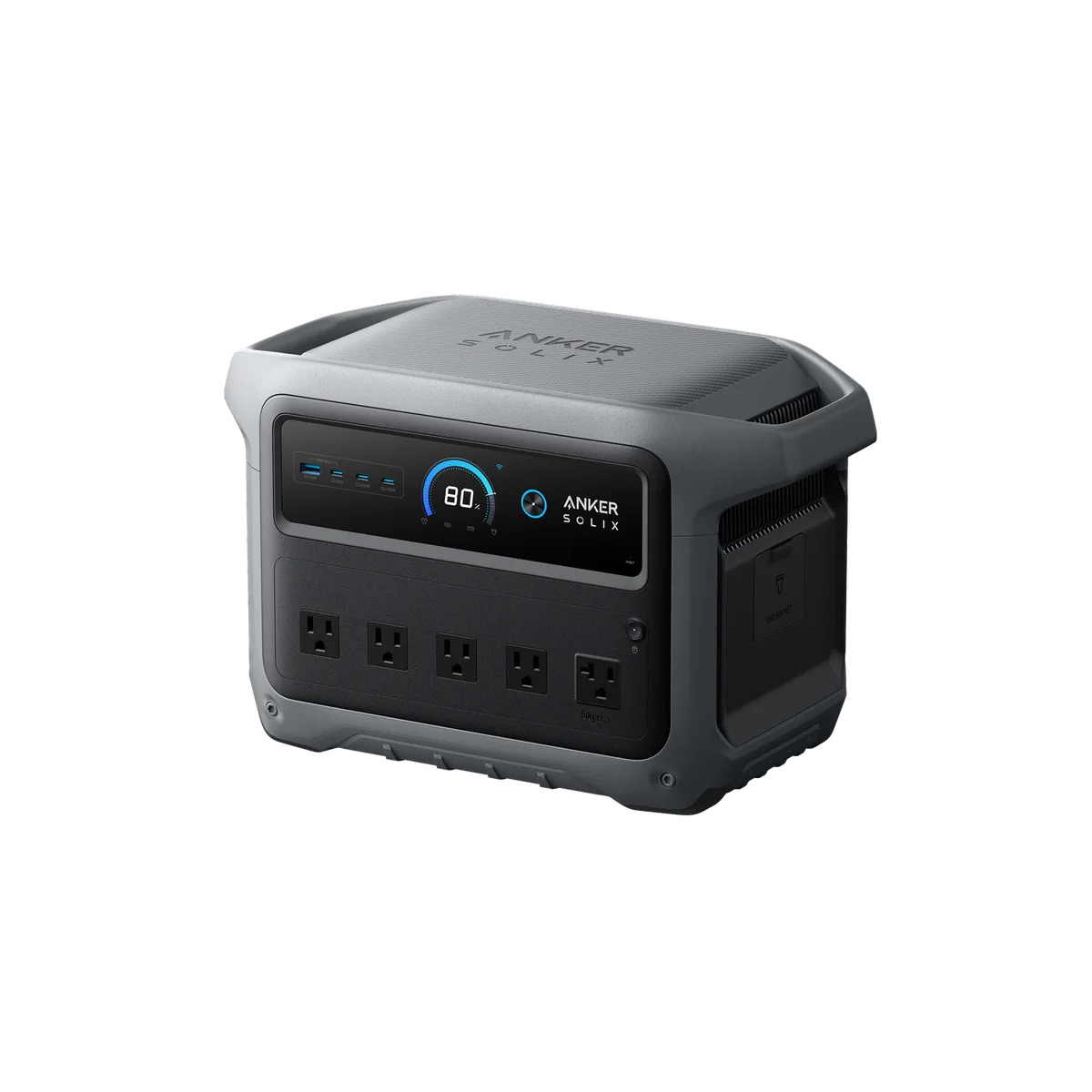
The C1000 Gen 2 trades a little rated energy for more inverter output and faster advertised charging. Anker lists a 1,024Wh lithium iron phosphate battery, 2,000W continuous AC output, and 3,000W peak output. Its 1,600W maximum wall input underpins the claimed 49-minute UltraFast charge, while its solar input is rated up to 600W.
That combination makes sense for an outage plan with higher-output but still compatible plug-in appliances, or for a user who expects short windows of grid or generator access. Anker also claims 4,000 battery cycles to 80% capacity and a 10ms UPS transfer. The unit weighs about 24.9 pounds and measures roughly 15.12 by 8.19 by 9.61 inches.
The C1000 Gen 2 supports app control and monitoring. That can help configure charging behavior and see remaining energy, but core access to backup power should not depend on a phone workflow you have never tested. Set up the app, firmware, charge limits, and any fast-charge option before storm season rather than during an outage.
Anker presents this model as suitable for CPAP machines. That is a marketing fit statement, not universal compatibility with every pressure setting, humidifier, heated tube, inverter, mask alarm, or clinical need. ResMed’s own battery guide, for example, is device-specific and strongly favors approved DC-to-DC conversion for the models it covers. The safe conclusion is narrower: the Anker is the only model in this comparison whose manufacturer currently positions it for that use, but the medical-device manufacturer and care team must still approve the exact setup.
Choose the C1000 Gen 2 when 2,000W output, fast wall charging, higher solar input, or the shorter claimed transfer time outweigh the Jackery’s small energy and weight advantage. Skip it if you expect to add expansion batteries later; Anker lists this model as non-expandable.
Our Anker SOLIX C1000 Gen 2 review examines measured usable energy, realistic refrigerator runtime, UltraFast charging conditions, fan noise, solar recovery, and the limits of its 10ms transfer mode.
Jackery Explorer 300: best for small, portable loads
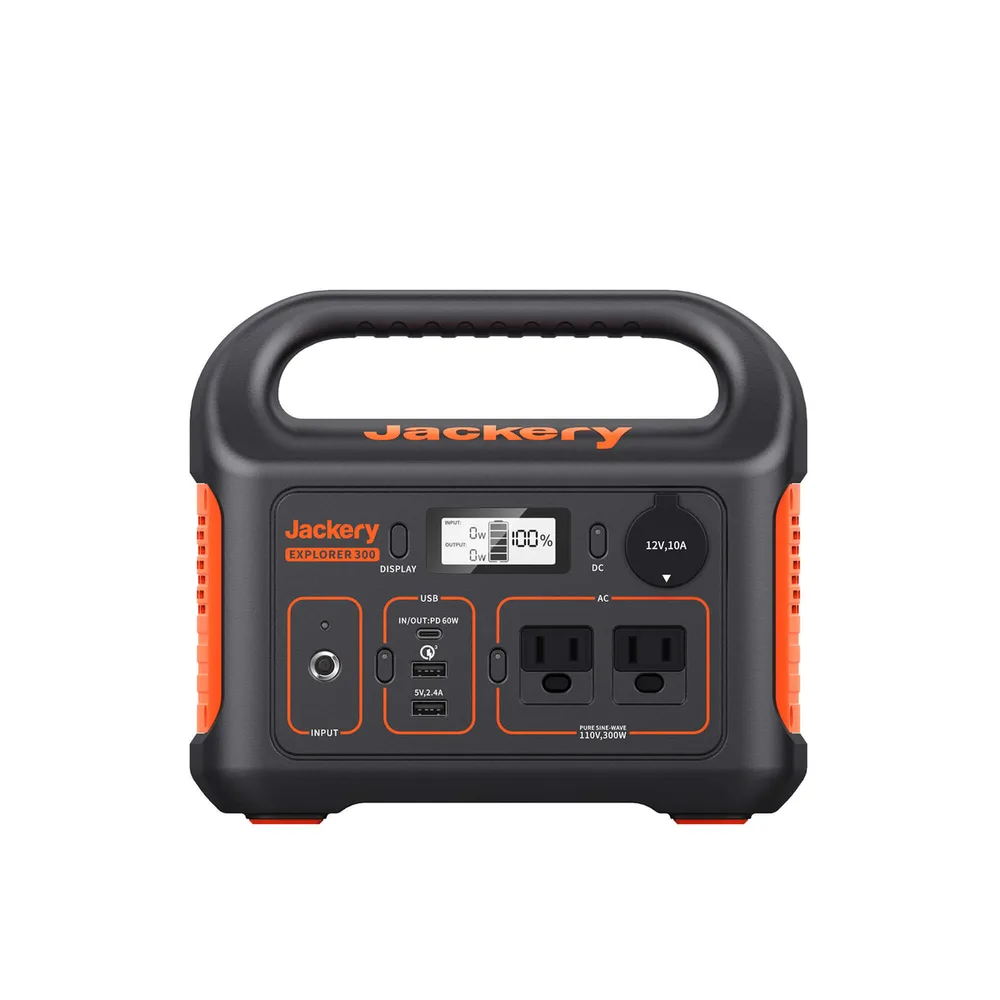
The Explorer 300 is useful precisely because it is not a 1kWh box. At about 7.1 pounds and 9.1 by 5.2 by 7.8 inches, it is far easier to carry to a picnic table, car, or remote camera position. Its 293Wh battery can support phones, a laptop, lights, camera batteries, a router, and other modest equipment without hauling an extra 17 pounds.
Jackery rates its pure-sine-wave inverter at 300W continuous and 500W surge. It has two AC outlets, a USB-C port with up to 60W output, USB-A connections, and a 12V/10A car port. The NCM lithium-ion battery is rated for 800 cycles to at least 80% capacity, well below the cycle claims for the two newer lithium iron phosphate models.
The 300W ceiling is the first constraint. Many household refrigerators can exceed it during compressor startup even when their running draw looks low. The 293Wh battery is the second: a load that runs successfully may still exhaust it too quickly to solve the outage problem. Use measured data rather than assuming that an outlet means appliance compatibility.
Jackery’s current Explorer 300 page also says the product is not designed or intended for medical or life-support use. It should not be selected as a CPAP backup on the strength of its small size or a third-party runtime estimate.
Choose the Explorer 300 for genuinely portable, non-critical electronics and low-power DC gear. Skip it for a full-size refrigerator, heaters, cooking appliances, broad home backup, or a medical-device plan.
The CPAP caveat deserves its own checklist
A CPAP is not just a wattage label. Pressure, treatment mode, mask leak, cellular modem, humidifier, heated tubing, ambient temperature, and the choice between DC and AC power can change energy use. Turning comfort features off may extend runtime, but therapy settings should not be changed without appropriate clinical guidance.
Before relying on backup power:
- Identify the exact CPAP or bilevel model and read its manufacturer’s backup-power instructions.
- Ask which DC converter, battery cable, or inverter is approved. A device-specific DC connection can be more efficient than converting battery DC to AC and back to DC.
- Confirm energy use with the humidifier and heated tube configured as they will actually be used.
- Ask the equipment provider or clinician what to do if therapy is interrupted and whether your health needs require a different level of backup.
- Test the fully charged setup for the required duration before an outage, without waiting for an emergency.
- Recheck it periodically as batteries age, settings change, or firmware and accessories are replaced.
The FDA advises medical-device users to contact the device manufacturer about battery or generator use and to verify settings after power is restored. A consumer station’s “UPS” label does not make it a medical UPS, and a successful overnight test does not certify the system for life-support use.
Home backup has boundaries
All three products are portable plug-in power sources. They are not whole-home batteries, and they should never be connected to home wiring by improvising a male-to-male cord or another backfeeding method. Hardwired loads, 240V equipment, central HVAC, electric water heating, ranges, and many well pumps require a different system and qualified installation.
Keep the station dry, allow the ventilation space specified by the manufacturer, and do not bury it under blankets or place it beside a heat source. Route extension cords where they will not be pinched, submerged, or create a trip hazard. Use cords rated for the load and environment.
Recharge timing matters as much as headline capacity. A household that only needs six quiet nighttime hours may benefit more from a predictable daytime recharge than from buying the largest battery it can find. A household that cannot recharge for several days needs a larger energy plan, load reduction, or another properly installed backup source—not optimistic arithmetic.
Which one should you buy?
Buy the Jackery Explorer 1000 v2 if your main goal is moving a roughly 1kWh station between a refrigerator, camping appliance, router, lights, and other measured non-critical loads. It offers the best capacity-to-weight balance of these three, but it is not the medical-device choice.
Buy the Anker SOLIX C1000 Gen 2 if higher continuous output and the shortest advertised recharge time are more useful than a small capacity advantage. It is the strongest of the three for a mixed set of outage essentials. For CPAP planning, consider it only after the maker of the exact therapy device confirms compatibility and the complete setup passes a realistic test.
Buy the Jackery Explorer 300 if portability matters more than refrigerator runtime. It is a compact source for personal electronics, lighting, cameras, and low-power DC equipment. Its 300W inverter and 293Wh battery make it a poor substitute for either 1kWh model.
If you cannot state the load’s startup power, average energy use, required runtime, and next recharge opportunity, do not buy yet. Measuring those four variables will improve the decision more than comparing another dozen feature lists.
Frequently asked questions
How large a power station do I need for a refrigerator?
Measure the refrigerator’s energy use over at least 24 hours and confirm its startup demand. Divide the station’s estimated usable watt-hours by the appliance’s measured average watts, then keep a reserve. Many buyers will land in the 1kWh class for meaningful short-outage coverage, but refrigerator size, age, room temperature, defrost behavior, and door opening can change the result substantially.
Is 1,000Wh the same as 1,000W?
No. Watt-hours measure stored energy; watts measure instantaneous power. A 1,000Wh battery might theoretically supply 100W for ten hours before losses, while a 1,500W inverter describes the maximum continuous AC load it can support. Both numbers must fit the appliance.
Can a portable power station run a CPAP all night?
Some combinations may have enough calculated energy, but runtime is not the only requirement. Use only the power method approved for your exact CPAP, account for humidification and heated tubing, follow medical guidance, and test the complete system. Jackery currently says the two Jackery stations here are not intended for medical devices; Anker’s CPAP marketing does not override the CPAP manufacturer’s instructions.
Is a 10ms or 20ms UPS claim enough for sensitive equipment?
Not necessarily. Transfer tolerance varies by device, and a portable station is not automatically a medical or data-center UPS. Check the connected equipment’s requirements and test the real setup. If interruption can cause harm or data loss, use a backup system specified for that application.
Can I use solar panels during a power outage?
Yes, when the panels, voltage range, connectors, weather, and station are compatible. Do not equate panel nameplate wattage with all-day energy. Shade, angle, season, temperature, and the station’s input limit determine actual charging.
Bottom line
The Jackery Explorer 1000 v2 is the best-balanced refrigerator and portable-backup choice in this group. The Anker SOLIX C1000 Gen 2 is the better tool when higher output and rapid recharging drive the decision. The Jackery Explorer 300 earns its place only as a much smaller station for light, non-critical loads.
The right purchase begins with a meter and a written outage plan. Measure the appliance, account for startup and conversion losses, decide how and when the battery will be recharged, and test the exact system. For a CPAP or any other medical device, the device manufacturer’s guidance—not a generic capacity chart—must make the final call.
Models discussed
Use these as starting points for checking fit. We do not publish a price or claim hands-on testing.
| Model | Format | Best fit | Trade-off |
|---|---|---|---|
| Jackery Explorer 1000 v2 | 1,070Wh lithium iron phosphate portable power station | Measured refrigerators and movable non-critical outage essentials | Lower continuous output and solar-input ceiling than the Anker; not recommended by Jackery for medical-device use |
| Anker SOLIX C1000 Gen 2 | 1,024Wh lithium iron phosphate portable power station | Higher-output outage essentials and rapid grid or solar recharging | Slightly less rated energy than the Jackery 1000 v2 and no expansion-battery path |
| Jackery Explorer 300 | 293Wh compact portable power station | Phones, laptops, lights, cameras, and measured low-power non-critical gear | Too little output and energy for many refrigerators or broad home backup; not intended by Jackery for medical-device use |
Product reference
Jackery Explorer 1000 v2
Best for: Measured refrigerators and movable non-critical outage essentials
Trade-off: Lower continuous output and solar-input ceiling than the Anker; not recommended by Jackery for medical-device use
Product reference
Anker SOLIX C1000 Gen 2
Best for: Higher-output outage essentials and rapid grid or solar recharging
Trade-off: Slightly less rated energy than the Jackery 1000 v2 and no expansion-battery path
Product reference
Jackery Explorer 300
Best for: Phones, laptops, lights, cameras, and measured low-power non-critical gear
Trade-off: Too little output and energy for many refrigerators or broad home backup; not intended by Jackery for medical-device use
How this guide was researched
We compare documented product features against the job each buyer needs done. We have not physically tested these products. Check current specifications and availability with the manufacturer or merchant.
Affiliate disclosure: If you buy through a qualifying link, we may earn a commission at no extra cost to you.