
Off-grid heating • buying guide
Best Portable Diesel Heaters: Safety Before Heat Output
Compare three VEVOR diesel heaters by installation format, altitude control, power needs, CO safeguards, fuel capacity, and exhaust routing.
A diesel air heater can make a van, workshop, or cold-weather camp setup far more usable without asking a battery to create all the heat. The bargain is not free, though. Diesel combustion produces hot exhaust and carbon monoxide, so the installation matters more than Bluetooth, tank size, or the number printed beside “kW.”
Of these three VEVOR heaters, the ZM8006 with CO alarm is the strongest portable-package candidate. It adds another layer of monitoring, accepts more than one power arrangement, and keeps the heater, tank, and controls together. The vertical all-in-one Bluetooth heater is much narrower and claims a higher altitude ceiling, but it lacks the ZM8006’s CO feature. The parking-heater installation kit makes more sense for a planned vehicle build because its separate 10-liter tank and compact heater body offer more freedom over where each component goes.
None is a heater to place loose inside an occupied tent or an unventilated garage. The combustion unit, intake, and exhaust must be arranged exactly as the applicable manual requires, with exhaust prevented from entering the heated space. An independent, correctly placed CO alarm remains essential even when the heater has a built-in sensor.
Focused Gadgets has not physically tested these heaters. This guide compares the exact Amazon listings, current VEVOR pages, VEVOR-branded manuals, and public safety guidance. Heat output, coverage, fuel use, noise, range, and altitude figures are manufacturer or seller claims, not our measurements.
Quick answer
- Choose the VEVOR ZM8006 when you want the most self-contained portable package. It combines a 5-liter tank, Bluetooth app, remote, display, AC/DC power options, and a separate CO sensor. That sensor is useful backup, not permission to run the combustion unit in occupied space.
- Choose the vertical all-in-one Bluetooth heater when a narrow footprint and claimed automatic altitude compensation up to 18,045 feet matter. It uses a 5-liter tank and 12-volt supply, and its tall case is easier to place beside a vehicle than a loose installation kit.
- Choose the parking-heater installation kit for a permanent van, truck, trailer, or boat layout. Its heater body is much smaller than either all-in-one case, while the separate 10-liter tank can be mounted where service access and weight distribution make sense.
- Skip all three if you cannot route combustion intake and exhaust safely. A cracked window, open garage door, or portable CO alarm does not turn a poor exhaust setup into a safe one.
- Do not size the electrical supply by the low running draw alone. The glow plug demands much more current during startup, and the heater needs uninterrupted power for its shutdown cooling cycle.
| Buyer question | Vertical all-in-one | ZM8006 with CO alarm | Parking-heater installation kit |
|---|---|---|---|
| Format | Tall portable all-in-one | Toolbox-style portable all-in-one | Separate heater, fuel tank, pump, and controls |
| Listing power label | 8 kW | 8 kW | 8 kW |
| Fuel tank | 5 L / 1.3 gal | 5 L / 1.3 gal | 10 L / 2.6 gal |
| Electrical input | 12 V | 12/24 V DC; adapter included in current listing | 12 V |
| Controls | LCD, remote, Bluetooth app | Display, remote, Bluetooth app | LCD, remote, Bluetooth app |
| Altitude claim | Automatic adjustment to 18,045 ft / 5,500 m | Current listing does not make the same 18,045-ft claim | Automatic adjustment to 18,045 ft / 5,500 m |
| CO feature | No built-in CO sensor documented | Separate CO sensor with alarm/shutoff behavior | No built-in CO sensor documented |
| Package size | 15 x 5.9 x 16.1 in; 20.1 lb listing weight | 15 x 10.4 x 12.6 in; 21.6 lb listing weight | Heater body 14.8 x 5.5 x 6.9 in; 15.8 lb kit listing weight |
| Best fit | Portable use where width is limited | Portable setup prioritizing added monitoring | Planned installation with flexible tank placement |
| Main trade-off | Tall case, 12-V-only listing, no documented CO sensor | Widest and heaviest all-in-one; lower documented altitude scope | More installation work and more possible leak or routing errors |
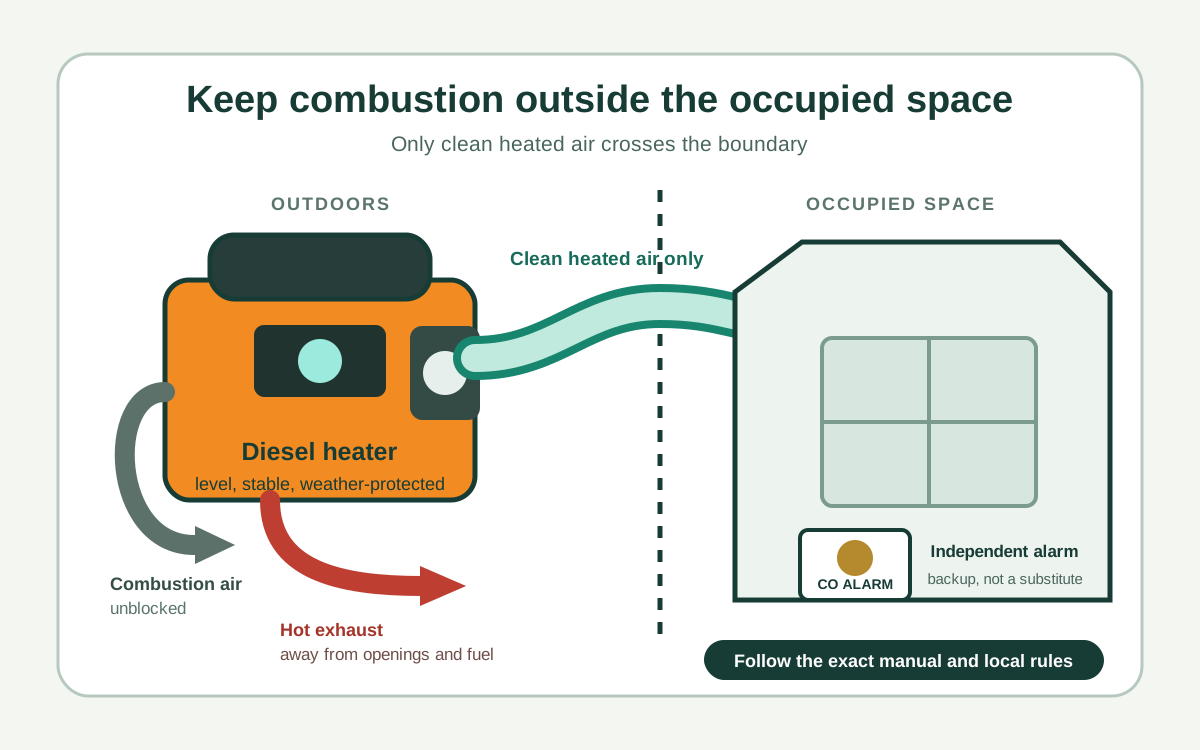
The word portable can be misleading
Both all-in-one models put the burner, fuel tank, pump, and controls into a carryable case. That reduces assembly, but it does not eliminate installation decisions. The combustion intake still needs clean air. The exhaust still becomes dangerously hot. Exhaust gases still need to terminate outside, away from doors, windows, vents, fuel, dry vegetation, and the heater’s clean-air inlet.
Wet boots and gloves should not be draped over the hot-air outlet or any exhaust component. Our boot-and-glove dryer guide compares purpose-built convection and forced-air options, including a no-heat airflow mode for gear whose manufacturer prohibits added heat.
For a tent or temporary shelter, the safer concept is simple: keep the combustion appliance and its exhaust outside the occupied enclosure, protect the heater from weather without obstructing airflow, and duct only heated clean air inside. A heater advertised for camping is not automatically suitable for sitting inside a zipped tent.
The U.S. Consumer Product Safety Commission warns against using fuel-burning portable heaters while sleeping in tents, campers, and vehicles. Its broader CO guidance says camping equipment should not be used in a home, garage, vehicle, or tent unless it is specifically designed and instructed for safe enclosed-space use. Follow the exact manual and local rules, not a marketplace lifestyle image.
The installed parking-heater kit has a different advantage. The smaller burner can be mounted so its combustion connections pass through a properly sealed plate to the exterior, while the warm-air circuit serves the cabin. That can produce a cleaner permanent layout, but only when the installer gets sealing, exhaust slope, clearances, fuel routing, electrical protection, and service access right.
Why a CO alarm does not fix an exhaust mistake
The ZM8006 listing and manual document a separate CO sensor. The manual describes an alert at 300 ppm and automatic heater shutdown at 500 ppm. That is a useful last line of defense, especially for a portable package whose hose and exhaust connections may be assembled repeatedly.
It is not the same thing as a listed residential or RV CO alarm installed according to its own instructions. It also cannot prevent every hazard before exposure begins. Sensor location, power, contamination, calibration, and response thresholds all matter. Use an independent alarm suitable for the occupied environment as well.
A 2023 UK product-safety report found that a VEVOR diesel air parking heater presented serious asphyxiation, fire, and burn risks because its installation information and warnings were inadequate. The report does not identify any of the three products covered here, so it should not be represented as a recall of them. It does show why a buyer should not treat low price, an included muffler, or a CO feature as a substitute for competent installation.
If an alarm sounds, shut down exposure, move everyone to fresh air, and follow emergency guidance. Do not silence the alarm and continue operating the heater to diagnose it from inside the space.
VEVOR ZM8006: best portable package with added monitoring
The ZM8006 is the clearest choice when the heater needs to move between a workshop, vehicle-adjacent camp setup, and emergency kit. The case integrates a 5-liter tank and adds three control methods: its display, a remote, and the AirHeaterCC Bluetooth app. The listing identifies 12/24-volt compatibility and an included adapter, making it less dependent on a single vehicle electrical layout than the other two.
VEVOR claims 0.18 to 0.35 liters per hour of diesel consumption and noise at or below 75 dB. Those are listing specifications, not independent results. Seventy-five decibels is not silent, and the fuel pump’s rhythmic tick may be more noticeable than a headline noise number suggests in a quiet camp.
Its most meaningful difference is the CO module, not its shared 8-kW label. The current manual shows the sensor on a two-meter extension lead, which allows it to be positioned away from the heater body. Placement should follow the manual; do not tuck it beside the exhaust or assume the warm-air outlet is automatically the right location.
The ZM8006 is also the widest and heaviest package here. Its box is roughly 15 by 10.4 by 12.6 inches and the listing gives a 21.6-pound weight before adding a full tank of diesel. That is manageable for occasional moves, but it is not backpack-portable and needs a stable, level, noncombustible operating location.
Choose it when added monitoring and power flexibility matter more than the smallest footprint. Skip it if you need a permanent under-seat installation or if the external CO module creates false confidence about using the whole heater inside an occupied enclosure.
VEVOR vertical all-in-one: best narrow option for higher elevations
This vertical model packages a 5-liter tank into a case about 15 inches long, 5.9 inches wide, and 16.1 inches high. The narrow width is useful beside a van or trailer where floor space is scarce, although the tall shape deserves careful stabilization before fuel is added.
The listing claims automatic altitude adjustment up to 18,045 feet, a temperature setting range of 46.4 to 96.8 degrees F, Bluetooth control to 98 feet, and fuel consumption between 0.16 and 0.62 liters per hour. Its 12-volt-only specification is simpler than the ZM8006’s power options but puts more responsibility on the buyer to provide a supply that can handle startup current.
The associated VEVOR manual warns against closed or unventilated use, directs the exhaust outlet outside, calls for a 12-volt supply capable of at least 15 amps during startup, and says not to cut power during operation. After shutdown is requested, the fan needs several minutes to cool the combustion chamber. Pulling the plug early can trap heat and soot inside the unit.
High-altitude compensation is the reason to choose this model over the ZM8006, but the 18,045-foot number remains a manufacturer claim. Thin air changes combustion, and correct fuel-air adjustment does not remove the elevated CO risk noted in public camping guidance. Treat the altitude feature as a control advantage, not a safety exemption.
Choose this one for a narrow portable case and documented automatic altitude adjustment. Skip it if a built-in CO feature, 24-volt input, or household adapter is more important.
VEVOR parking-heater kit: best for a planned vehicle installation
This model is not another suitcase-style heater. The kit separates a compact heater body from a 10-liter fuel tank, pump, LCD, remote, muffler, air filter, ducting, and mounting hardware. That layout creates more work at the start, but it also lets an installer choose where fuel weight, hot air, combustion intake, and exhaust belong.
The heater body measures about 14.8 by 5.5 by 6.9 inches. VEVOR claims the same 0.16-to-0.62-liter-per-hour fuel range and automatic altitude adjustment up to 18,045 feet as the vertical all-in-one. The larger tank is marketed for up to 16 hours of operation, but actual runtime depends on firing level, temperature, altitude, fuel condition, voltage, and cycling. Do not plan an overnight safety margin from the maximum claim alone.
Permanent installation can be the safer and neater choice because the combustion side can remain outside the occupied air path. It can also be the riskier choice when a DIY cutout leaves gaps, the exhaust points toward an opening, the fuel line chafes, or the muffler and hot pipe sit near combustible material. The VEVOR manual calls for sealing gaps between the mounting plate and vehicle body and for routing exhaust outside.
Choose this kit for a van, truck, trailer, or boat build where the mounting location and exhaust route have been planned before drilling. Skip it when you need a heater that can be set up temporarily without installing a separate tank and fuel pump.
Power is more than a steady wattage number
A diesel heater burns fuel for heat, but it still needs electricity for the glow plug, controller, fuel pump, and fans. Startup is the demanding phase. The manual associated with the installed kit calls for a 12-volt supply capable of at least 15 amps; the ZM8006 material calls for 12 amps or more. A power station can have plenty of stored watt-hours yet still trip its 12-volt outlet when the glow plug starts.
Check four things before relying on a battery or power station:
- The outlet’s continuous and surge current at the required voltage.
- Cable gauge, fuse size, connector rating, and voltage drop.
- Enough remaining capacity to complete the full shutdown cooling cycle.
- Whether the output stays active when the heater’s draw falls between cycles.
If the same off-grid system also powers food storage, our 12V refrigerator guide explains how compressor cycling, prechilling, ambient heat, and conversion losses change the energy budget. Add the heater and refrigerator loads together rather than sizing either appliance in isolation.
Never stop the heater by disconnecting its power source. Use the controller, wait for the fan to finish cooling, and only then isolate power if the manual permits it.
Our portable power station guide explains how to distinguish inverter output from regulated 12-volt output and calculate a realistic energy reserve. Running an AC adapter from an inverter adds conversion losses but may be necessary when the station’s DC port cannot provide the required startup current.
What to verify before buying
- Installation drawing: Confirm where combustion intake, exhaust, fuel line, hot-air duct, and electrical cable must go.
- Exact power supply: Check voltage and startup-current requirements for the precise model and included adapter.
- Fuel: These listings specify diesel. Do not substitute gasoline.
- Exhaust hardware: Verify pipe length, clamps, muffler, heat shielding, mounting plate, and replacement-part availability.
- Altitude mode: Confirm whether compensation is automatic and the exact claimed ceiling for the current variant.
- Shutdown behavior: Make sure everyone who may operate the heater knows not to cut power during cooldown.
- CO protection: Install an independent alarm appropriate to the vehicle, boat, workshop, or shelter even if the heater has its own sensor.
- Local rules and insurance: A vehicle, marine, residential, or workplace installation may be subject to codes, inspection requirements, and insurer conditions.
Who should skip these heaters
Skip a diesel heater if the plan depends on placing the burner or exhaust inside an occupied tent. Skip it if you cannot keep the exhaust away from openings and combustibles, or if the electrical source cannot supply startup current reliably. A simpler electric heater may be a better garage option when shore power is available and the circuit can safely carry the load.
Buyers living full-time in a van or boat should also compare professionally supported heaters from established vehicle-heating brands. The purchase price is much higher, but dealer installation, documented certifications, parts support, and a clearly specified low-output range can matter more than app control.
If the real problem is moving diesel between approved portable containers rather than producing heat, see our cordless transfer-pump guide. It separates fuel-rated equipment from water-only pumps and explains why fluid compatibility comes before flow rate.
FAQ
Can a portable diesel heater run inside a tent?
Do not place the combustion unit or exhaust inside an occupied tent. Public safety guidance warns against operating fuel-burning portable heaters while sleeping in enclosed tents, campers, and vehicles. For any temporary setup, follow the exact heater manual and keep combustion and exhaust outside so only heated clean air enters the shelter.
Is the built-in CO sensor on the ZM8006 enough?
No. It is useful additional protection, but it does not replace correct exhaust routing, maintenance, ventilation, or an independent CO alarm suited to the occupied environment.
Can these heaters run from a portable power station?
Possibly, but watt-hours alone do not answer the question. The 12-volt output must supply the glow plug’s startup current without excessive voltage drop and remain powered through the cooldown cycle. Check both manuals before connecting them.
Which model is best for high altitude?
Both the vertical all-in-one and the parking-heater installation kit claim automatic compensation up to 18,045 feet. The ZM8006 listing does not make that same claim. These are manufacturer figures, and high altitude increases the importance of combustion setup and CO precautions.
Can I use gasoline instead of diesel?
No. These models specify diesel fuel. Gasoline presents different vapor, ignition, and material-compatibility hazards.
Bottom line
The ZM8006 is the most convincing portable bundle because its CO module and broader power options address two real setup problems. The vertical all-in-one is the better portable fit where width and high-altitude compensation matter. The parking-heater kit earns its place only when the goal is a deliberate permanent installation with a separate tank.
The shared 8-kW label is the least useful way to choose among them. Start with where combustion happens, where exhaust goes, how power is supplied, and what happens if any one of those systems fails.
Models discussed
Use these as starting points for checking fit. We do not publish a price or claim hands-on testing.
| Model | Format | Best fit | Trade-off |
|---|---|---|---|
| VEVOR 8KW All-in-One Bluetooth Diesel Heater | 5-liter vertical all-in-one 12-volt diesel air heater | Narrow portable setups where automatic high-altitude adjustment matters | Tall case, 12-volt-only listing, and no documented built-in CO sensor |
| VEVOR 8KW Diesel Heater with CO Alarm | 5-liter toolbox-style all-in-one diesel heater with CO module | Portable setups prioritizing added CO monitoring and flexible power input | The widest and heaviest all-in-one here; its CO module cannot compensate for poor exhaust routing |
| VEVOR 8KW Parking Heater with Altitude Adjustment | Installed diesel air-heater kit with separate 10-liter fuel tank | Planned van, truck, trailer, or boat installations with flexible component placement | More installation work and more opportunities for exhaust, fuel-line, mounting, or wiring errors |
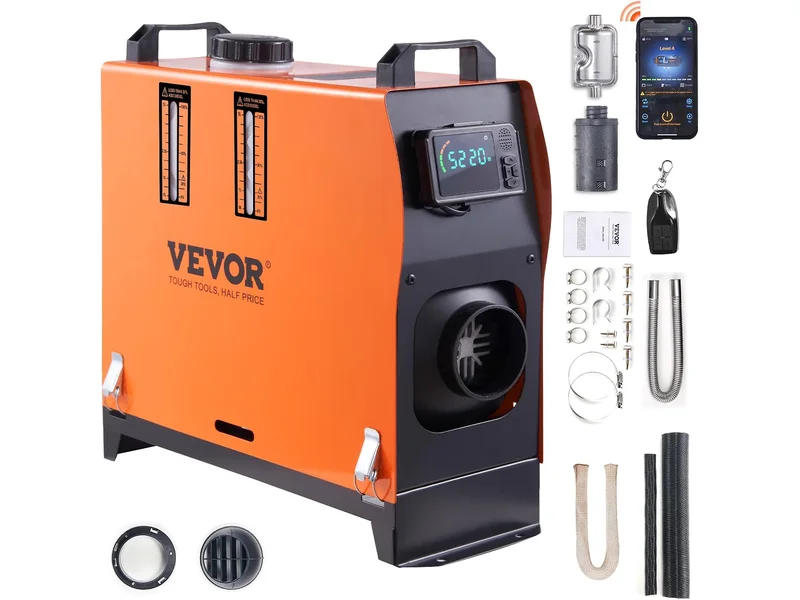
Product reference
VEVOR 8KW All-in-One Bluetooth Diesel Heater
Best for: Narrow portable setups where automatic high-altitude adjustment matters
Trade-off: Tall case, 12-volt-only listing, and no documented built-in CO sensor
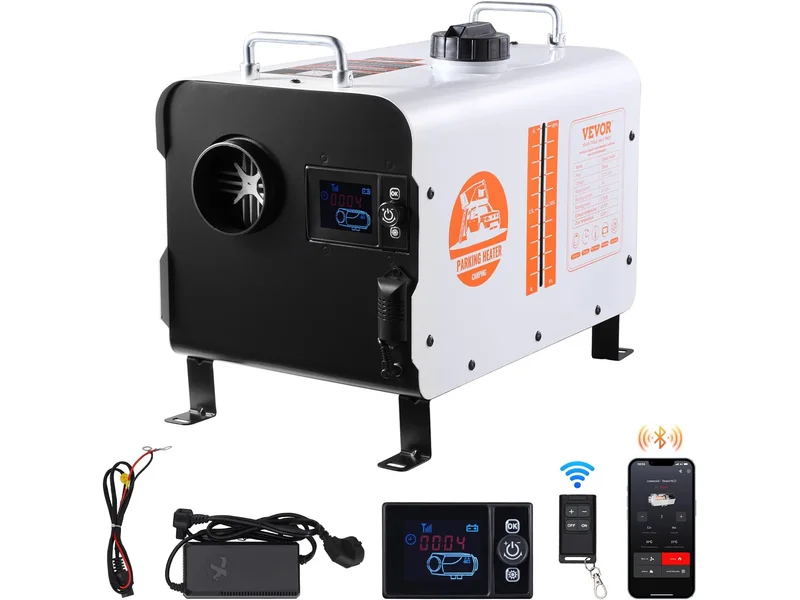
Product reference
VEVOR 8KW Diesel Heater with CO Alarm
Best for: Portable setups prioritizing added CO monitoring and flexible power input
Trade-off: The widest and heaviest all-in-one here; its CO module cannot compensate for poor exhaust routing
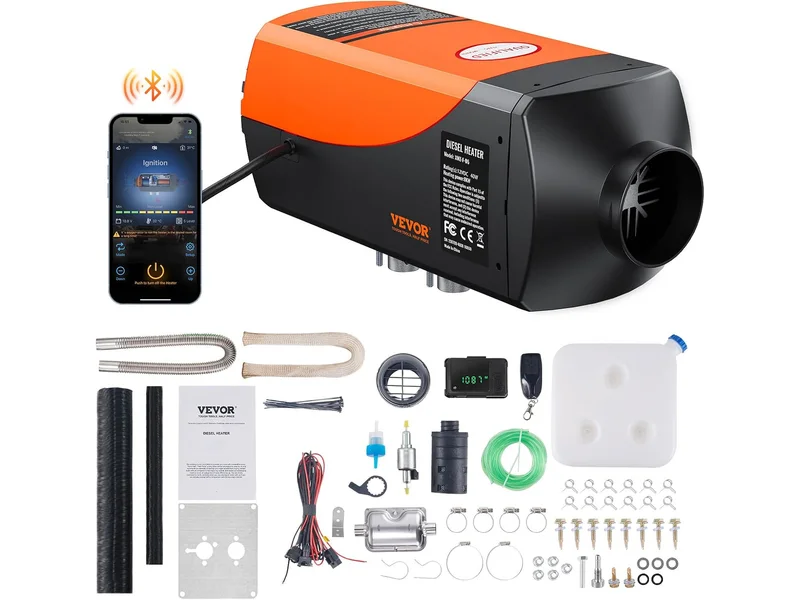
Product reference
VEVOR 8KW Parking Heater with Altitude Adjustment
Best for: Planned van, truck, trailer, or boat installations with flexible component placement
Trade-off: More installation work and more opportunities for exhaust, fuel-line, mounting, or wiring errors
How this guide was researched
We compare documented product features against the job each buyer needs done. We have not physically tested these products. Check current specifications and availability with the manufacturer or merchant.
Affiliate disclosure: If you buy through a qualifying link, we may earn a commission at no extra cost to you.