
Wet-gear care • buying guide
Best Boot and Glove Dryers: Quiet Overnight Heat or Faster Forced Air?
Compare PEET, JobSite, and DryGuy boot dryers by airflow, heat, capacity, noise, drying time, and suitability for work boots, gloves, and ski gear.
A good boot dryer is not necessarily the one that feels hottest. It is the one that moves enough air through your gear, fits the openings without crushing or stretching them, and finishes on the schedule you actually need. A quiet convection dryer can be an excellent overnight solution for one pair of work boots. A family trying to turn around two pairs of ski boots and gloves before morning has a different problem.
The Original PEET Dryer is our best fit for simple, quiet overnight drying. It has no fan, uses little power, and is backed by a long warranty when registered on time. The JobSite Silent Boot Dryer uses the same basic fanless approach and adds unusually clear documentation for operating temperature, expected drying windows, placement, and electrical certification. The DryGuy Force Dry DX is the better match when speed and four drying ports matter more than silence; its blower, timer, and heat-off setting make it more adaptable for ski weekends and multi-person households.
Focused Gadgets has not physically tested these dryers. This guide compares exact retail listings, manufacturer specifications and manuals, and footwear-care instructions. Drying times, temperatures, noise descriptions, and odor-control statements are manufacturer claims rather than our measurements.
Quick answer
- Choose the Original PEET for a single pair of work or outdoor boots that can dry overnight. Natural convection means no fan noise or moving parts, but the open-ended schedule is a poor fit for rapid turnarounds.
- Choose the JobSite Silent Dryer when you want a similar overnight design with more explicit operating guidance. Its manual lists a 98–110°F operating range and suggests roughly eight hours for damp footwear or twelve for wet footwear. Those are manufacturer estimates, not guaranteed results.
- Choose the DryGuy Force Dry DX when two pairs or a mix of boots and gloves need attention at once. Four ports, forced air, a three-hour timer, removable extensions, and a heat-off option make it the most versatile model here.
- Check the footwear label before applying heat. A dryer brand’s broad compatibility statement does not override instructions from the boot, liner, insole, or glove manufacturer.
- Do not expect a dryer to clean contaminated gear. Removing moisture can make odor-causing growth less hospitable, but drying is not washing, disinfection, or mold remediation.
| Model | Drying method | Capacity | Timing and controls | Best fit | Main trade-off |
|---|---|---|---|---|---|
| Original PEET Dryer | Warm-air natural convection; no fan | One pair | Always-on when plugged in; manufacturer recommends overnight drying | Quiet daily drying for work and outdoor boots | No timer, no heat-off mode, and slower than a blower-based dryer |
| JobSite Silent Boot Dryer | Warm-air natural convection; no fan | One pair | Manufacturer estimates 8 hours for damp and 12 hours for wet footwear | Buyers wanting simple overnight drying with detailed operating guidance | Gloves need separate attachments; tall footwear may need extensions |
| DryGuy Force Dry DX | Heated forced air with rotary blower | Four ports, normally two pairs | 3-hour timer; heat on/off; manufacturer claims most items dry in 1–2 hours | Ski gear, gloves, families, and quicker turnarounds | More mechanical complexity and audible airflow than a fanless design |
The drying method matters more than the marketing label
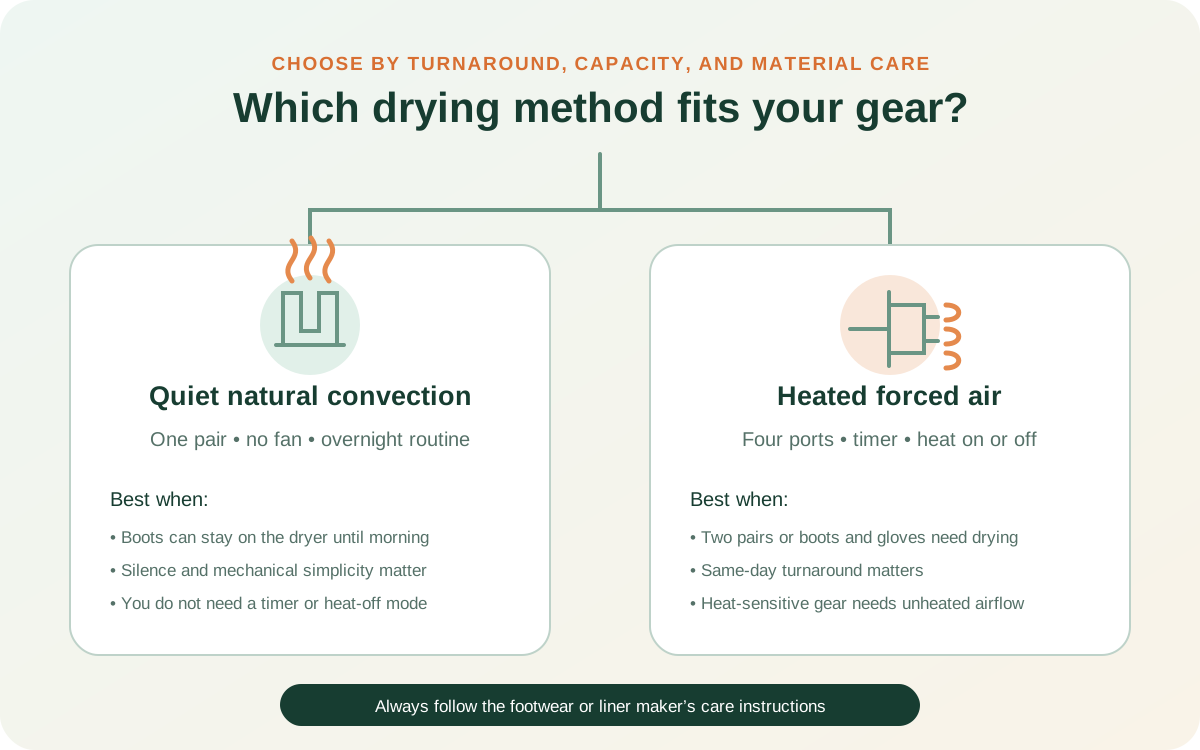
PEET and JobSite warm air at the base and let it rise naturally through inverted footwear. This is convection without a fan. The design is quiet, mechanically simple, and well suited to a routine in which boots go on the dryer at the end of the day and come off the next morning. Airflow is gentle, however, and the units do not promise a precise finish time for every material or degree of saturation.
DryGuy adds a powered blower. Forced air can exchange humid air inside a boot more quickly, and four ports let the unit handle two pairs at once. The Force Dry DX also lets you switch the heater off while keeping air moving, a valuable option when a footwear maker allows air drying but warns against added heat.
Neither method can be judged by wattage alone. The Original PEET and JobSite are both listed at 36 watts, but wattage is electrical input rather than a standardized measure of moisture removal. The Force Dry DX’s manufacturer timing is likewise not directly comparable with the overnight guidance from the fanless models because there is no shared test for footwear material, starting water load, room humidity, or boot construction.
Match the dryer to your turnaround window
For boots that are merely damp with perspiration, overnight convection is often the easiest routine: loosen the laces, open the tongue, place each boot upside down on a port, and leave adequate space around the unit. PEET says its dryer reaches operating warmth in about ten minutes and recommends overnight use. JobSite lists a roughly 15-minute warmup and gives estimates of eight hours for damp footwear and twelve hours for wet footwear.
Those numbers should be treated as planning guidance, not promises. A waterproof membrane, thick insulation, removable felt liner, narrow toe box, saturated footbed, or humid room can change the result. Water that has pooled inside a boot should be drained first. Removable insoles and liners may need to be taken out and dried according to their own care instructions.
DryGuy says the Force Dry DX dries most items in one to two hours, while its timer runs for up to three hours. That is a manufacturer claim under unspecified conditions. It does tell us the intended use: this is the model for a skier, hunter, commuter, or household that cannot always wait until morning. It does not establish that every soaked, insulated boot will be completely dry in two hours.
Capacity is about usable ports, not just the product name
The Original PEET and JobSite each have two upright ports, so their ordinary capacity is one pair of boots or shoes. PEET sells extensions for taller boots. JobSite likewise says tall boots and waders may need extenders, while gloves require or benefit from its separate glove attachments. A product called a boot and glove dryer is not automatically shaped to hold every cuff securely out of the box.
The Force Dry DX has four ports. In practice, that usually means two pairs of boots, two pairs of gloves, or a deliberate mix that fits the available tubes. Two removable extensions accommodate taller footwear up to the manufacturer’s stated 16-inch height. Check the shape and diameter of each opening: a small child’s glove, tight gaiter, or narrow liner can restrict airflow even when a port is technically available.
Four ports also do not guarantee four identical drying results. Long, insulated boots may create more resistance than short shoes. If one item blocks its outlet, the remaining ports may receive more useful airflow. Rotate gear if the manufacturer’s instructions allow it and check progress rather than assuming symmetry.
Heat-safe according to whom?
The gear maker should have the last word. Dryer manufacturers list broad material compatibility, but boots and gloves can contain several different materials joined by adhesives, laminated membranes, foam, leather treatments, heat-moldable liners, and custom footbeds.
SOREL, for example, tells owners to remove liners where applicable and air-dry them in a cool location away from a heat source or direct sunlight. Dynafit warns that high or direct heat can affect the shape and color of ski boots and advises removing liners and footbeds for drying in a warm, low-humidity location. Similar restrictions may apply to other brands even if the dryer itself operates at a temperature its manufacturer calls safe.
Use this order of authority:
- Follow the care label or manual for the exact boot, liner, insole, glove, or orthotic.
- If the instructions prohibit added heat, use unheated airflow only if the gear maker permits it—or air-dry the item separately.
- If the instructions are unclear, ask the gear manufacturer before using a heated dryer.
- Never improvise by placing gear directly on a radiator, space heater, stove, or exhaust-producing heater.
Our portable diesel-heater guide explains why combustion heating also requires deliberate exhaust routing and carbon-monoxide precautions. A diesel heater is not a boot-drying rack, and wet gear should never be draped over its hot-air outlet or exhaust components.
Original PEET Dryer: best for quiet overnight simplicity
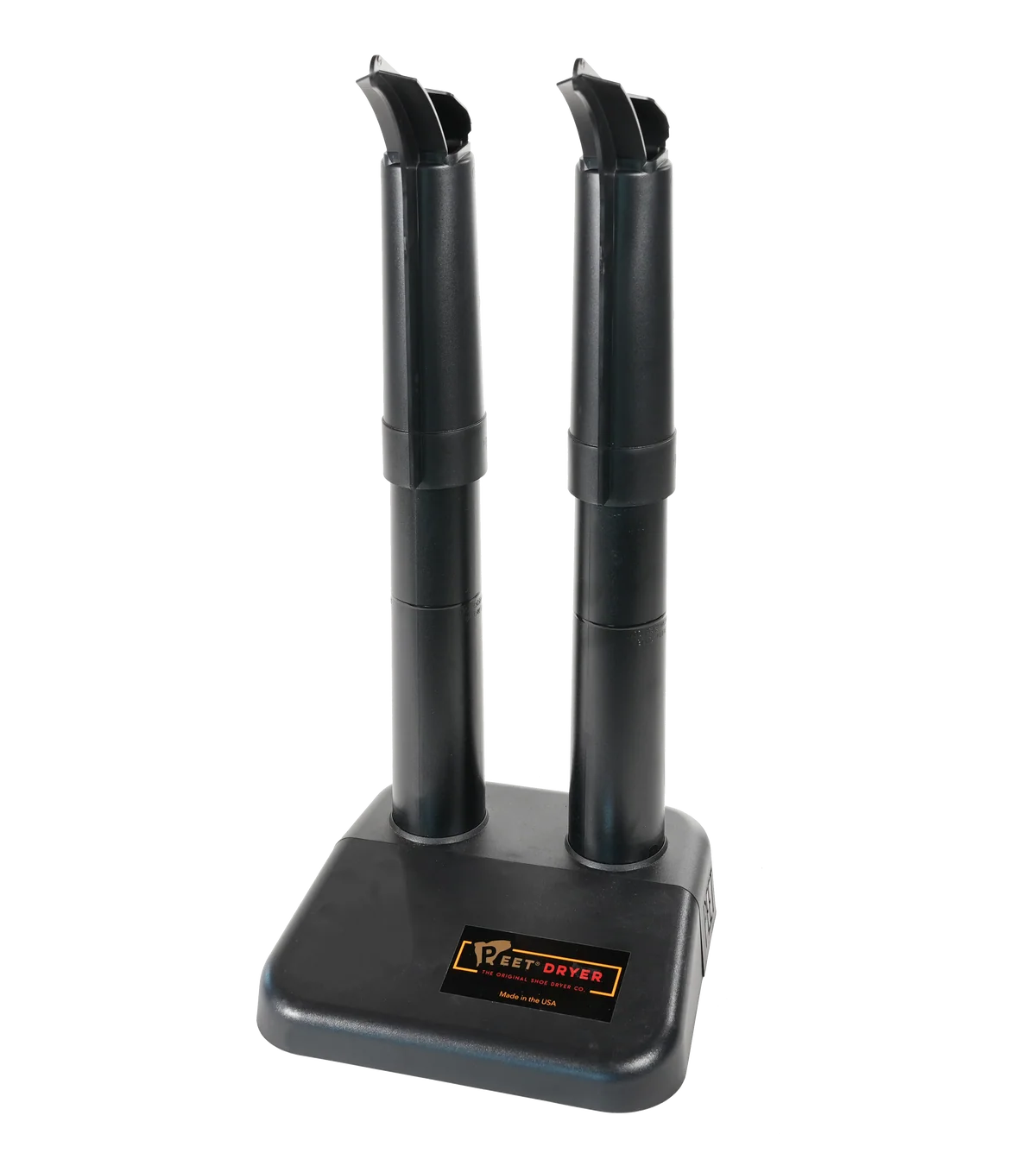
The Original PEET is the easiest model here to understand. Warm air rises through two hollow tubes and into one inverted pair of footwear. There is no blower, timer, display, or speed setting. PEET lists it at 36 watts, 22 inches high, with a 9.5-by-9.5-inch footprint and a weight of 2.5 pounds.
That simplicity makes sense for a worker who comes home at a predictable time and can leave one pair drying until morning. No fan means no fan noise beside a mudroom, entryway, or utility room, and fewer moving components can fail. PEET says the unit may remain plugged in continuously, although users should still follow the supplied instructions and applicable electrical-safety guidance.
The main limitation is control. There is no timer and no unheated-air setting. Drying time varies with saturation and material, so a buyer who needs ski boots ready between morning and evening sessions should prefer a blower-based model. Standard tubes also are not the right height for every tall boot; PEET specifies 12-inch extensions for footwear taller than 11 inches.
PEET advertises a 25-year warranty, but the product page ties that coverage to registration within ten days of purchase. That condition belongs in the buying decision. Save the receipt, inspect the registration terms, and do not assume the headline warranty applies automatically.
Best fit: one regularly used pair of work, hiking, hunting, or outdoor boots with an overnight drying window.
Skip it if: you need a countdown timer, heat-off operation, same-day turnaround, or capacity for two pairs.
JobSite Silent Boot Dryer: best documented fanless alternative
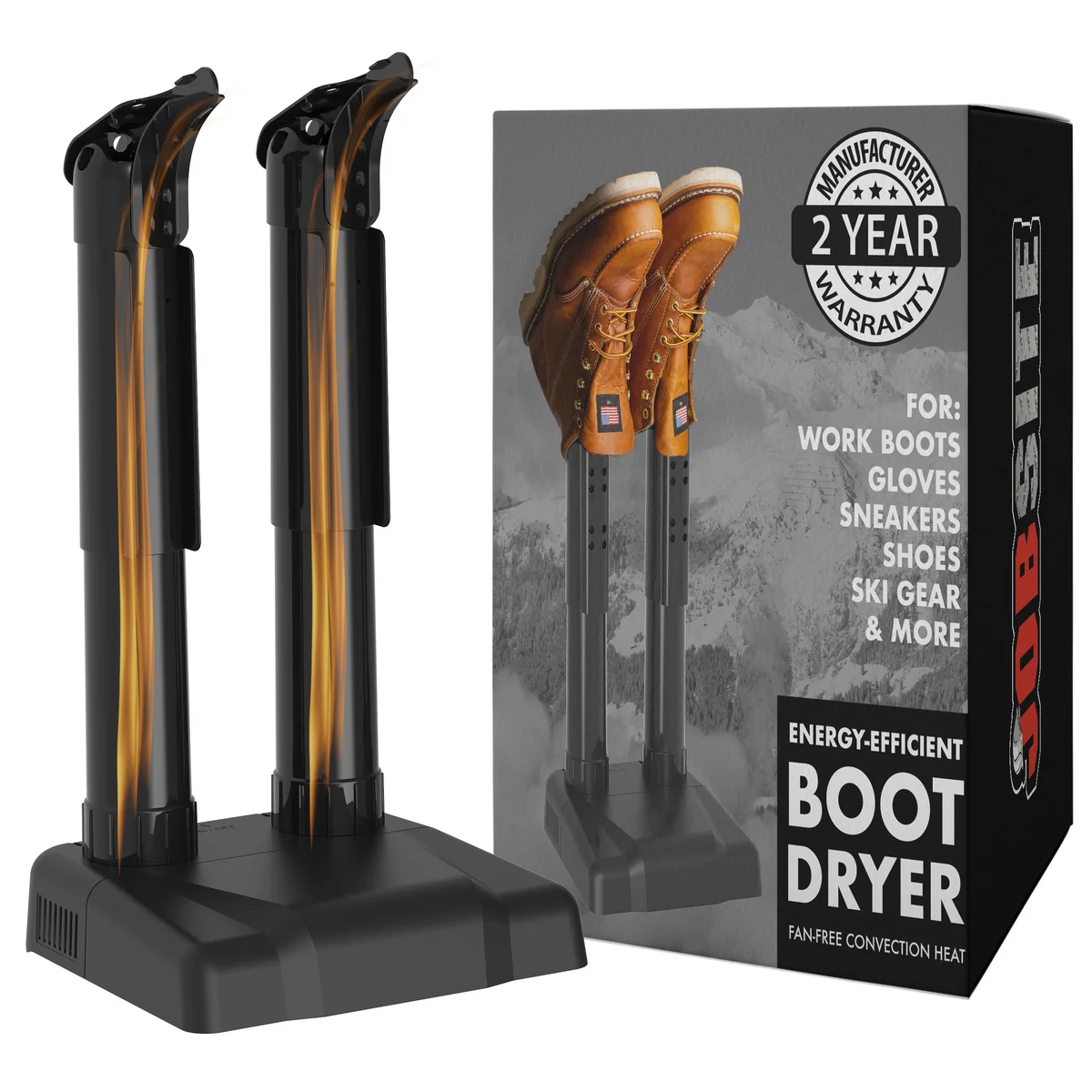
The JobSite Silent Boot Dryer uses the same broad strategy: a 36-watt heating element drives natural convection through two ports without a fan. JobSite lists the assembled size as 10 by 10 by 21 inches and the weight as 2.67 pounds. It is intended for one pair at a time.
Its clearest advantage is documentation. The current use-and-care manual lists 120-volt, 60-hertz operation, a 98–110°F range, a roughly 15-minute warmup, and estimated windows of eight hours for damp footwear or twelve for wet footwear. It also identifies ETL certification control number 5022832. Those details make the operating assumptions easier to evaluate, though they are not independent performance results.
The same manual contains placement rules worth following: use a hard, flat, dry surface; keep the air intake unobstructed; provide ventilation; do not place the unit on carpet or another heat-retaining surface; and maintain at least eight inches between the top of the boot and the base. JobSite also says to monitor items to avoid overdrying and unplug the unit when it is not in use. We would follow that manual language over broader marketing about around-the-clock convenience.
Out of the box, the JobSite is primarily a boot and shoe dryer. Gloves call for separately available attachments, and taller footwear may need extensions. The two-year warranty is much shorter than PEET’s registered coverage, but the JobSite may appeal to buyers who value the published temperature range and detailed care guidance.
Best fit: one pair of everyday boots or shoes, overnight drying, and a buyer who wants explicit setup and timing instructions.
Skip it if: you expect included glove adapters, need to dry two pairs together, or need a timer and faster forced airflow.
DryGuy Force Dry DX: best for faster, multi-item drying
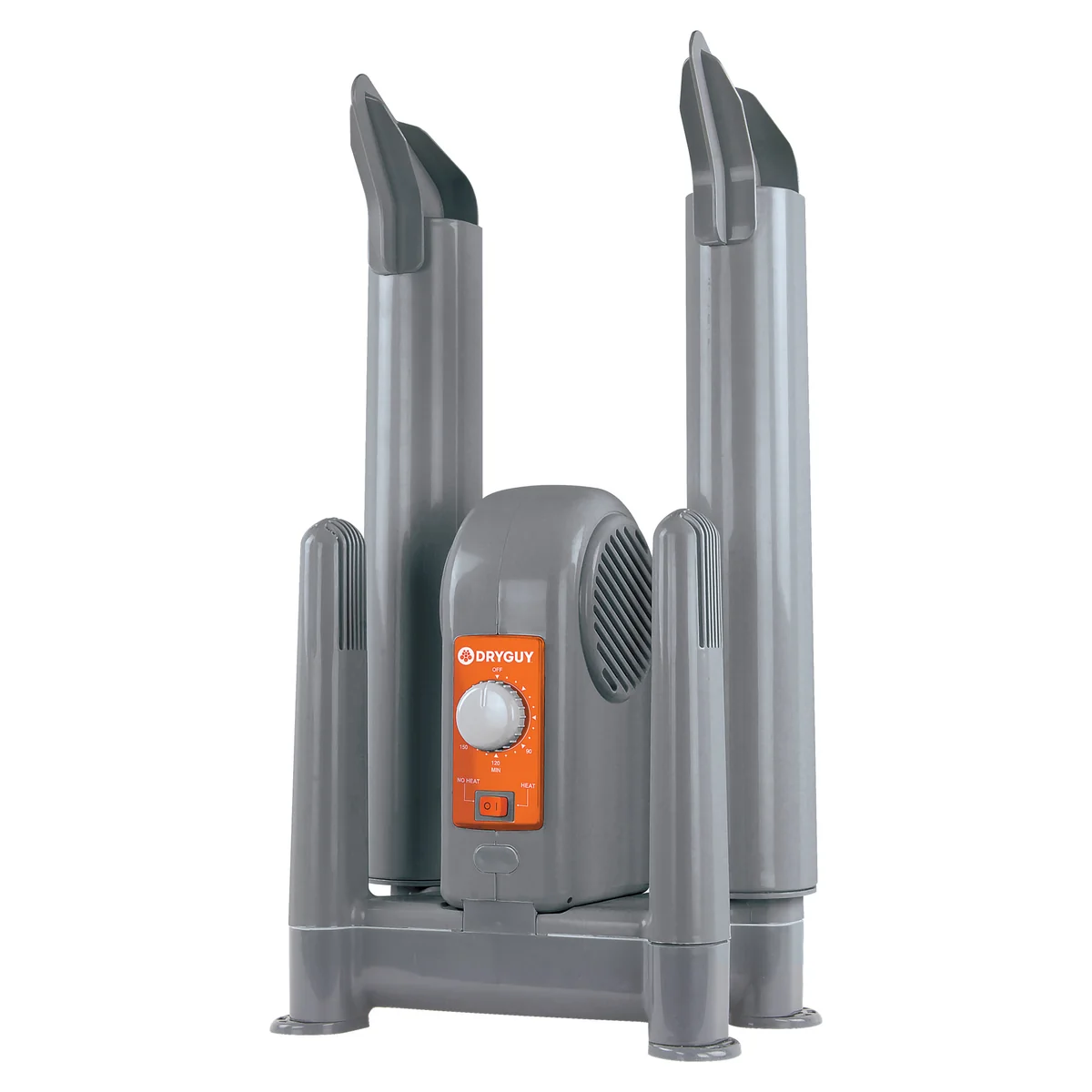
The Force Dry DX combines four ports with a rotary blower and air heated to a manufacturer-stated 105°F. A switch lets the blower run without heat, while a three-hour dial timer provides automatic shutoff. Two removable extensions are included for footwear up to 16 inches tall.
This is the most practical configuration here for a household returning from a wet ski day: two pairs of footwear can use the four ports, or some ports can be assigned to gloves when their openings fit. DryGuy lists the unit at 15.08 by 7.6 by 12.44 inches, so it is wider but shorter than the upright fanless towers.
Forced air introduces trade-offs. DryGuy calls its blower whisper quiet, but it cannot be silent in the literal fanless sense. There are more mechanical parts than in a convection stand, and the product warranty is one year. More importantly, the heat switch is not permission to ignore a liner’s care label. Select no-heat airflow whenever the exact gear instructions require it, or use a different drying method if powered airflow is not approved.
The company’s one-to-two-hour statement describes most items, not every soaked boot. Use the timer as a limit and check progress. Do not keep adding heated cycles solely to meet a promised time if the material is becoming excessively warm or dry.
Best fit: ski trips, families, two-pair households, wet gloves, and situations where overnight-only drying is too slow.
Skip it if: near-silent operation and the simplest possible mechanism matter more than speed and capacity.
Placement and routine matter with every dryer
Set the dryer on a stable, dry surface where its intake and outlets remain open. Keep it away from sinks, standing water, shower spray, flammable materials, and places where children or pets can knock it over. Use the voltage and outlet arrangement specified for the exact model, and do not route cords where wet footwear can drip onto a connection.
Before mounting the gear:
- drain standing water and remove loose mud;
- loosen laces, straps, and tongues so air can escape;
- remove liners, insoles, batteries, electronics, or heated-footwear packs when their instructions require it;
- check that the boot does not seal against or collapse around the air outlet;
- follow minimum clearances in the product manual;
- inspect the cord, housing, and ports before use.
After a dirty job, drying alone is not enough. Sewage, chemicals, oils, allergens, biological material, road salt, and heavy mold require cleaning or disposal appropriate to the contaminant and the gear. A warm dryer should not be used to aerosolize an unknown substance in a living space.
Will a boot dryer remove odor?
Moisture creates conditions in which odor-producing microbes can persist, so drying gear promptly can help prevent the damp environment they prefer. That is different from deodorizing a boot that already contains sweat residue or from sanitizing it.
Clean washable components according to their labels, let all parts dry fully, and address recurring foot-health issues with an appropriate professional. Avoid spraying an electrical dryer or soaking components that are not designed to be washed. Be cautious with fragrances that mask odor without removing its source.
Who should skip a heated boot dryer?
A heated model may be the wrong tool when the exact footwear instructions require cool air drying, when removable heat-molded liners have their own controlled drying process, or when no safe ventilated placement is available. It also will not solve water entering through failed seams or a damaged waterproof membrane. Repair or replace the gear rather than treating daily saturation as normal.
Occasional users with a full day between outings may need only removable insoles, good room ventilation, and a non-heated drying rack. Conversely, a guide, ski family, or worker rotating several soaked pairs may need a larger commercial rack rather than trying to overload a two- or four-port household unit.
Frequently asked questions
Is a boot dryer safe for leather boots?
Only when the exact boot maker permits the drying method. Dryer brands may list leather among compatible materials, but leather construction, finishes, adhesives, and liners vary. Use the lowest-risk approved method, avoid direct high heat, and condition leather only as its manufacturer recommends.
Can I leave a boot dryer on overnight?
PEET and JobSite design their fanless models around overnight drying, but follow the exact manual, keep the unit clear and stable, and inspect it before use. JobSite’s manual says to unplug the unit when not in use. A timer or switched outlet must not exceed the dryer’s electrical requirements or bypass product instructions.
Do boot dryers use much electricity?
PEET and JobSite each list 36 watts, so their electrical draw is modest compared with many household heaters. Actual energy use depends on run time. Wattage does not predict drying speed and should not be used to compare the forced-air DryGuy directly without a standardized moisture-removal test.
Can the DryGuy Force Dry DX dry boots and gloves at the same time?
It has four ports, so a compatible mix can be arranged. Whether a specific boot-and-glove combination fits depends on cuff size, tube arrangement, and whether extensions are installed. Do not constrict an item merely to occupy every port.
Should ski-boot liners stay inside the shell?
Follow the boot manufacturer’s instructions. Some makers direct owners to remove liners and footbeds so each component can dry separately, while heat-moldable liners may have strict temperature limits. The DryGuy’s no-heat airflow can be useful only when the gear maker allows that method.
Bottom line
Choose by schedule first. The Original PEET is a compelling one-pair overnight dryer for buyers who value silence, simplicity, and long registered warranty coverage. The JobSite is a similarly quiet option with unusually specific temperature, timing, placement, and certification information. The DryGuy Force Dry DX earns the speed-and-capacity recommendation because four ports, forced air, a timer, extensions, and a heat-off mode solve a broader range of wet-gear problems.
Whichever model fits, the safe temperature is the one permitted by the gear maker. Open the footwear, preserve airflow, check progress, and treat drying as moisture management—not cleaning, sterilization, or a repair for leaking boots.
Models discussed
Use these as starting points for checking fit. We do not publish a price or claim hands-on testing.
| Model | Format | Best fit | Trade-off |
|---|---|---|---|
| The Original PEET Shoe & Boot Dryer | Fanless 36-watt convection dryer for one pair of shoes or boots | Quiet overnight drying for one regularly used pair of work or outdoor boots | No timer, heat-off mode, forced-air speed, or capacity for two pairs |
| JobSite Silent Boot Dryer | Fanless 36-watt convection dryer with documented operating guidance | One-pair overnight drying with explicit temperature, timing, and placement instructions | Glove attachments and tall-boot extensions are separate, with no timer or forced-air mode |
| DryGuy Force Dry DX | Four-port forced-air dryer with a timer and heated or unheated airflow | Two-pair households, ski trips, gloves, and faster wet-gear turnaround | The blower is not literally silent, and the one-year warranty is shorter than the fanless alternatives |
Product reference
The Original PEET Shoe & Boot Dryer
Best for: Quiet overnight drying for one regularly used pair of work or outdoor boots
Trade-off: No timer, heat-off mode, forced-air speed, or capacity for two pairs
Product reference
JobSite Silent Boot Dryer
Best for: One-pair overnight drying with explicit temperature, timing, and placement instructions
Trade-off: Glove attachments and tall-boot extensions are separate, with no timer or forced-air mode
Product reference
DryGuy Force Dry DX
Best for: Two-pair households, ski trips, gloves, and faster wet-gear turnaround
Trade-off: The blower is not literally silent, and the one-year warranty is shorter than the fanless alternatives
How this guide was researched
We compare documented product features against the job each buyer needs done. We have not physically tested these products. Check current specifications and availability with the manufacturer or merchant.
Affiliate disclosure: If you buy through a qualifying link, we may earn a commission at no extra cost to you.