
Vehicle and campsite cooling • buying guide
Best 12V Refrigerators for Camping and Road Trips: Capacity Is Only Half the Fit
Compare BougeRV and EUHOMY 12V refrigerators by capacity, dimensions, power, controls, vehicle fit, and safe food-temperature monitoring.
A 12V refrigerator earns its place in a vehicle by fitting the space, the power system, and the trip - not simply by holding the most quarts. A larger cabinet can reduce grocery stops, but it also needs more clearance, weighs more when loaded, and may spend longer drawing power after someone fills it with warm food. A compact model is easier to place behind a seat, yet its usable storage disappears quickly once containers and an appliance thermometer are inside.
The BougeRV CR22 23-Quart is our best-balanced choice for most camping and road-trip setups. It has a narrow footprint, enough capacity for a couple or short family trip, and straightforward controls without an app. The EUHOMY 19QT is the better fit when vertical clearance is tight or phone control is genuinely useful. The BougeRV 30-Quart is the capacity pick for a truck, van, or base camp that can accommodate a taller cabinet.
Focused Gadgets has not physically tested these refrigerators. We compared exact retail listings, current manufacturer pages, published dimensions and electrical specifications, and USDA food-safety guidance. Cooling speed, noise, and consumption figures are manufacturer claims rather than our measurements. None of these single-zone units can refrigerate one compartment while freezing another at the same time.
Quick answer
- Choose the BougeRV CR22 23-Quart for the most balanced vehicle fit. Its 22.7-by-12.6-inch floor footprint is narrow enough for many trunks and cargo areas, while 23 quarts is less restrictive than a personal-size cooler.
- Choose the EUHOMY 19QT when cabinet height or app control decides the purchase. At about 11.4 inches high, it is the lowest model here. The trade-off is the smallest capacity and a phone feature that should remain a convenience, not a food-safety monitor.
- Choose the BougeRV 30-Quart when added storage matters more than height. It uses roughly the same length and width as the 23-quart model but rises to 15.5 inches. That extra vertical space must fit under shelves, tonneau covers, drawer systems, and the open lid.
- Measure the entire installation before buying. Leave room for the lid, handles, power plug, cable bend, and compressor ventilation - not just the published cabinet dimensions.
- Use a separate appliance thermometer. A display or app reports the refrigerator’s sensor, not necessarily the warmest package of food. USDA guidance is to keep a refrigerator at 40 degrees F or below.
| Model | Published capacity | Exterior dimensions | Listed weight | Published input | Controls | Best fit | Main trade-off |
|---|---|---|---|---|---|---|---|
| BougeRV CR22 23-Quart | 23 qt / 22 L | 22.7 x 12.6 x 13.0 in | About 21.2 lb | ECO 45 W; MAX 60 W in the current specification block | On-unit panel | Balanced capacity and a narrow vehicle footprint | No app or interior light; one temperature zone |
| EUHOMY 19QT | 19 qt / 18 L | 22.44 x 12.6 x 11.42 in | About 21.4 lb | Manufacturer materials show 45 W ECO and 60 W MAX | On-unit panel and app | Tight vertical spaces and out-of-reach placement | Smallest capacity; app is not an independent thermometer |
| BougeRV 30-Quart | 30 qt / 28 L | 22.7 x 12.6 x 15.5 in | About 23.8 lb | ECO 45 W; MAX 60 W | On-unit panel | Trucks, vans, and longer base-camp stays | Tallest cabinet and higher listed maximum input |
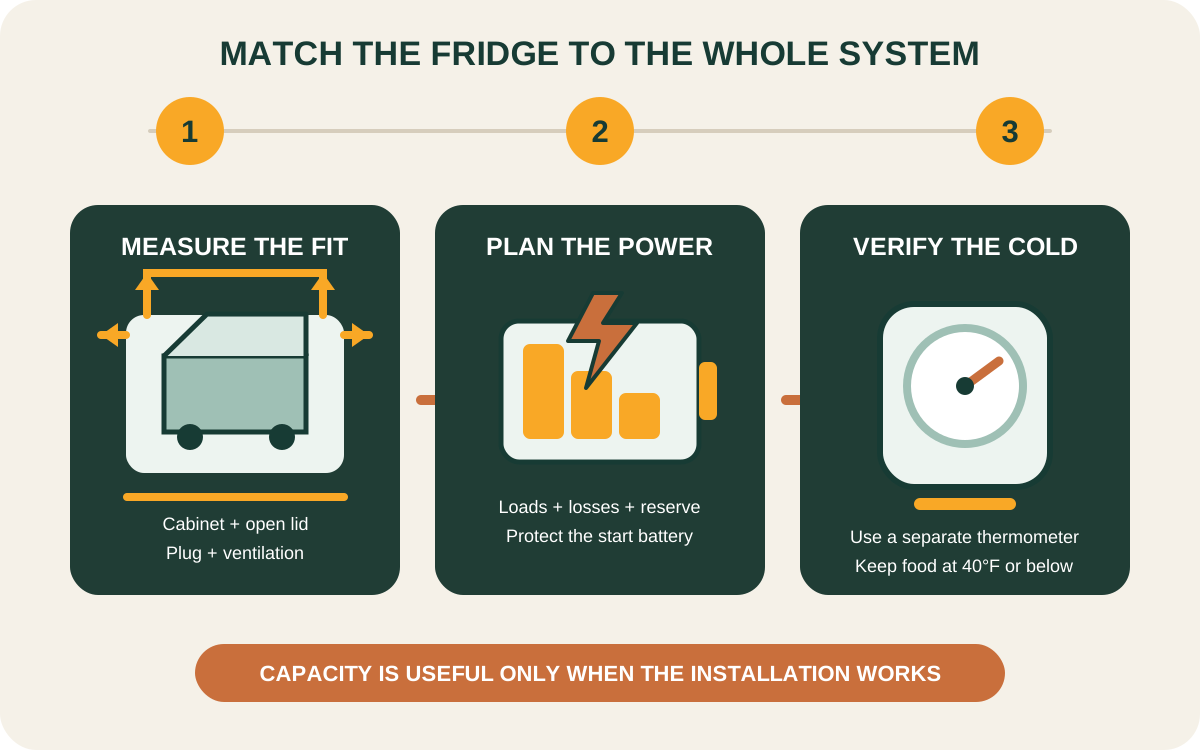
Start with the parking space, not the quart number
The three refrigerators are surprisingly similar in length and width. All are roughly 22.5 to 22.7 inches long and 12.6 inches wide. Height creates the more meaningful installation difference: approximately 11.4 inches for the EUHOMY, 13 inches for the BougeRV 23-quart, and 15.5 inches for the BougeRV 30-quart.
Those cabinet numbers are only the first measurement. A chest-style lid needs room to swing open. A rear or side power connection needs space for the plug and a relaxed cable bend. Compressor vents cannot be pressed against luggage or a vehicle panel. The carry handle may also require lateral clearance even if it folds away after loading.
Make a cardboard footprint and height gauge before ordering. Place it where the refrigerator will ride, open the hatch and nearby drawers, slide the seats through their full travel, and check whether a passenger can still reach an exit. Then add the manufacturer’s required ventilation clearance and enough room to lift food out without moving the whole unit.
Do not plan to stack luggage on the lid. Even if the cabinet fits under a cargo shelf, every opening would require unloading the stack. Soft bags can also settle against a ventilation grille during a rough drive. A refrigerator that technically fits but cannot breathe or open is the wrong size.
Capacity is useful only when the packing shape works
Quarts and liters provide a common starting point, but they do not describe usable geometry. Compressor hardware and insulation occupy space. A tall bottle may fit upright in one section but not another. Rigid food containers can leave more dead space than flexible bags, and an appliance thermometer needs a representative location rather than being buried against a cold wall.
The 19-quart EUHOMY makes sense for one or two people, day trips, hotel-to-vehicle use, or a compact car where every inch matters. The BougeRV 23-quart offers a little more flexibility without increasing the floor footprint significantly. The 30-quart model is better for several days of food, bulkier containers, or a base camp where fewer resupply stops matter.
None is a dual-zone refrigerator. Each cabinet operates as a refrigerator or a freezer at one setpoint. It cannot safely keep fresh food near refrigerator temperature while holding ice cream frozen in a separate independently controlled section. If the trip requires both, use two appliances, a genuine dual-zone model, or a carefully planned combination of powered refrigeration and another suitable storage method.
Power ratings do not predict a full-trip runtime
Current specification blocks and product imagery list 45-watt ECO and 60-watt MAX settings for all three models. BougeRV’s CR22 page also contains an FAQ with a lower ECO figure, so the page is internally inconsistent. For circuit and power-source planning, use the higher current specification and confirm the supplied manual for the exact unit. These figures help size wiring and a power source, but they are not the same as continuous energy use over 24 hours.
A compressor cycles. Its duty cycle changes with ambient temperature, setpoint, insulation, ventilation, how often the lid opens, and whether the contents were already cold. A refrigerator placed in a hot parked vehicle and loaded with room-temperature drinks may run far more often than a prechilled unit in the shade. Freezer operation also creates a heavier workload than holding food safely chilled.
For a rough planning estimate, divide a battery’s usable watt-hours by an estimated average load, then allow for conversion losses, cable losses, battery limits, and reserve capacity. Do not substitute the product’s maximum wattage for a measured trip average and call the result guaranteed runtime. Until you have logged the exact refrigerator in your own conditions, the calculation is only a range.
Direct 12V DC operation can avoid the losses of converting battery power to household AC and back through the refrigerator’s adapter. Use only the supported voltage, supplied or manufacturer-approved cables, and an outlet and fuse sized for the load. Long, undersized extension leads create voltage drop and heat. Never bypass a fuse or modify the plug to make an unsuitable circuit work.
All-day use also needs a deliberate charging plan. A portable power station or auxiliary battery should be sized around the refrigerator plus every other load, not the fridge in isolation. Our portable power station guide explains how to measure the load, allow for conversion losses, and plan the next recharge; the Jackery Explorer 1000 v2 review applies that method to a compact 1 kWh station. The portable diesel-heater guide makes the same point for cold-weather setups: a device’s electrical demand continues even when its main energy source is fuel. Separate heat, refrigeration, lighting, communications, and charging into one realistic energy budget.
Low-voltage protection is not a promise that the vehicle will start
Portable refrigerators often offer selectable battery-protection levels that stop the compressor when supply voltage falls. That is useful, but voltage at the refrigerator can differ from voltage at the battery because of cable length, connector resistance, temperature, and other loads. A cutoff also cannot assess the health or true remaining capacity of an aging starter battery.
Treat low-voltage protection as a backstop. Do not rely on a vehicle’s starter battery for overnight refrigeration unless the vehicle and appliance manufacturers explicitly support that use and you understand the reserve required to restart. An isolated auxiliary battery or appropriately sized portable power station is a more controllable arrangement.
Check whether the vehicle’s 12V socket remains powered with the ignition off. Some shut down immediately; others can drain the starter battery. Secure every power source against movement, keep lithium batteries within their permitted temperature range, and do not leave charging equipment in a dangerously hot cabin.
Food safety needs a second measurement
USDA guidance calls for a refrigerator temperature of 40 degrees F or below and recommends using an appliance thermometer. That thermometer matters because the control display reflects a sensor at one location. Air and food elsewhere in the cabinet can be warmer, especially after loading, opening the lid, or losing power.
Prechill the refrigerator and food at home when practical. Put cold items together, minimize empty air without blocking necessary circulation, keep raw meat contained so it cannot leak, and open the lid briefly. At camp, place the unit in a ventilated, shaded location allowed by its manual rather than in direct sun or beside a heat source.
If perishable food has been above 40 degrees F for more than two hours, USDA guidance is to discard it; the window shortens to one hour when the surrounding temperature is above 90 degrees F. Do not judge safety by smell or appearance. A refrigerator that lost power should be checked with a thermometer and a time record, not optimism.
These consumer units should not be assumed suitable for medication, vaccines, laboratory samples, or other temperature-critical material. Those uses can require tighter uniformity, calibration, logging, alarms, and validated transport procedures. Confirm requirements with the medical-device or product manufacturer and use equipment designed for them.
BougeRV CR22 23-Quart: best balanced camping fit
The CR22 occupies the middle ground. BougeRV lists a 23-quart or 22-liter capacity in a cabinet measuring 22.7 by 12.6 by 13 inches and weighing about 21.2 pounds. The current specification block lists 45-watt ECO and 60-watt MAX modes, 12/24V DC input, and an included household AC adapter. A lower ECO figure elsewhere on the same page is why the exact manual should be checked before sizing around anything below the 60-watt maximum.
This is the most broadly useful shape of the three. It adds capacity over the EUHOMY without reaching the 30-quart model’s height. For a couple, small family, or weekend camper who can measure a 13-inch-high installation, it is a sensible starting point.
The CR22 is intentionally basic. BougeRV’s comparison table does not list an app, interior light, or battery slot. That means fewer features to configure, but it is less convenient when the cabinet is mounted where the control panel is hard to reach. Add a small independent thermometer with a display you can see easily rather than treating the setpoint as proof of food temperature.
BougeRV publishes a broad subfreezing-to-refrigeration adjustment range, but this remains one zone. Use it as a fridge or a freezer, not both. The two-year warranty is stronger than EUHOMY’s current one-year general product warranty, although buyers should confirm the exact seller and current terms at checkout.
Best fit: couples, weekend campers, SUVs, and buyers who want a practical capacity without app dependence.
Skip it if: the space is less than 13 inches high, you need independent fridge and freezer zones, or remote control is central to the installation.
EUHOMY 19QT: best for low-clearance placement and app control
EUHOMY’s 19-quart model is the smallest cabinet here at 18 liters, approximately 22.44 by 12.6 by 11.42 inches, and about 21.4 pounds. It accepts 12/24V DC power and a 110-240V AC adapter. The current manufacturer page identifies compressor cooling, a magnetic lid seal, and phone control.
Its approximately 11.4-inch height is the real reason to choose it. In a sedan, hatchback, or drawer-based build, a difference of 1.6 inches from the CR22 and more than four inches from the 30-quart BougeRV can decide whether the lid opens properly. Verify the exact retail variant’s dimensions before purchase because manufacturer pages can combine multiple capacity options.
App control is useful when the physical panel faces a wall or sits behind a seat. It is not a substitute for an independent thermometer or an alarm system designed for temperature-critical goods. Bluetooth range, phone permissions, app availability, and operating-system support can change. Make sure the refrigerator remains fully controllable from its own panel if the phone is absent.
EUHOMY claims rapid pull-down cooling and low-noise operation, but neither is independently tested here and neither predicts performance in a sun-heated vehicle full of warm food. Prechilling is still the sensible routine. The current EUHOMY page describes a one-year warranty for purchases through official channels, so confirm that the Amazon seller qualifies.
Best fit: solo travelers, couples, compact cars, low cargo shelves, and installations where app adjustment is genuinely convenient.
Skip it if: 19 quarts will force overpacking, you want a larger warranty window, or you prefer a device with no app component.
BougeRV 30-Quart: best for added capacity in a truck or van
The 30-quart BougeRV grows upward rather than outward. Its published exterior dimensions are 22.7 by 12.6 by 15.5 inches, almost the same floor footprint as the CR22 but 2.5 inches taller. BougeRV lists a 28-liter capacity, a weight of about 23.8 pounds, and 45-watt ECO and 60-watt MAX modes.
That geometry suits a truck bed, van, or open cargo area where vertical clearance is available and the narrow width remains helpful. The extra seven quarts can matter on a longer trip, but the loaded weight and lifting height also increase. Secure the cabinet to suitable vehicle anchor points without blocking vents or placing straps across controls and seals.
The manufacturer says the unit includes both the DC cord and AC adapter, uses three-stage vehicle battery protection, and should stand level for more than six hours after unpacking before first use. BougeRV also warns against connecting it directly to a solar panel; a regulated battery or power station belongs between an intermittent solar source and the refrigerator.
Like the CR22, the 30-quart version is a simple one-zone box without app control or an interior light on the current comparison page. Its larger cabinet and higher listed maximum input make power planning and prechilling even more important. The capacity advantage is wasted if the lid cannot clear a bed cover or the compressor grille sits against camping gear.
Best fit: trucks, vans, longer trips, and base camps where the 15.5-inch cabinet and open lid have adequate clearance.
Skip it if: you are fitting the refrigerator below a cargo shelf, lifting a loaded 30-quart box will be difficult, or the smaller models already cover the trip.
Installation checklist before checkout
- Measure length, width, cabinet height, open-lid height, handles, plug clearance, and the manufacturer’s ventilation space.
- Confirm the refrigerator can be secured without blocking vents, pinching the cable, or interfering with seats, airbags, doors, or emergency exits.
- Check the outlet voltage, current rating, fuse, ignition behavior, and maximum permitted cable length.
- Size the battery from usable watt-hours and a realistic duty-cycle range, including every other load and a reserve.
- Decide whether 19, 23, or 30 quarts matches actual containers rather than an abstract capacity number.
- Buy an appliance thermometer and test the packed refrigerator before a long trip.
- Confirm that a one-zone refrigerator is acceptable; do not plan simultaneous fresh and frozen storage.
- Recheck the exact model, included AC and DC cables, warranty channel, and return terms at the current listing.
Frequently asked questions
Can a 12V refrigerator run overnight from a car battery?
It may run, but that does not mean the vehicle will restart. Runtime depends on battery health and capacity, temperature, wiring losses, other loads, and compressor duty cycle. Use an isolated auxiliary source or suitable power station when possible, and treat the refrigerator’s low-voltage cutoff as a backup rather than a guarantee.
Is a 12V refrigerator more efficient than using its AC adapter?
When the source is already a battery, direct supported DC operation usually avoids inverter and adapter conversion losses. The actual difference depends on the equipment. Use the correct cable and voltage, and never improvise a direct connection to solar panels or an unfused battery.
Can these refrigerators freeze food?
Their published temperature ranges extend below freezing, but each has one controlled compartment. Running it as a freezer means it is not simultaneously maintaining a separate refrigerator zone. Actual cabinet temperature should be verified rather than inferred from the setpoint.
Does app control make the EUHOMY safer for food?
No. It makes settings easier to reach. It does not independently measure the warmest food, replace an appliance thermometer, or guarantee an alert when the phone is out of Bluetooth range or the app is unavailable.
How large a power station do I need?
There is no honest answer from quart capacity alone. Estimate the refrigerator’s average energy use in your ambient conditions, multiply by the hours between charges, add conversion losses and other loads, then preserve a reserve. Test the complete system before relying on it away from mains power.
Bottom line
The BougeRV CR22 23-Quart is the strongest general recommendation because its capacity and 13-inch height sit between the two alternatives. The EUHOMY 19QT wins when low clearance or app access matters more than storage. The BougeRV 30-Quart is the sensible upgrade when a truck or van can accommodate the taller cabinet and the trip genuinely needs more food space.
Whichever size fits, plan the installation and energy system together. Prechill the cabinet and food, preserve ventilation, secure the load, monitor actual food temperature with a separate thermometer, and keep the refrigerator at 40 degrees F or below.
Models discussed
Use these as starting points for checking fit. We do not publish a price or claim hands-on testing.
| Model | Format | Best fit | Trade-off |
|---|---|---|---|
| BougeRV CR22 23-Quart 12V Refrigerator | 23-quart single-zone compressor refrigerator | Balanced capacity and fit for camping and road trips | No app or interior light, and the manufacturer page contains conflicting ECO power figures |
| EUHOMY 19QT 12V Refrigerator with App Control | 19-quart single-zone compressor refrigerator with app control | Low-clearance vehicle installations and app-based adjustment | Smallest capacity here, and app control is not independent food-temperature monitoring |
| BougeRV 30-Quart 12V Refrigerator | 30-quart single-zone compressor refrigerator | Truck, van, and base-camp setups needing more vertical capacity | Taller cabinet needs more lid clearance and becomes heavier when loaded |
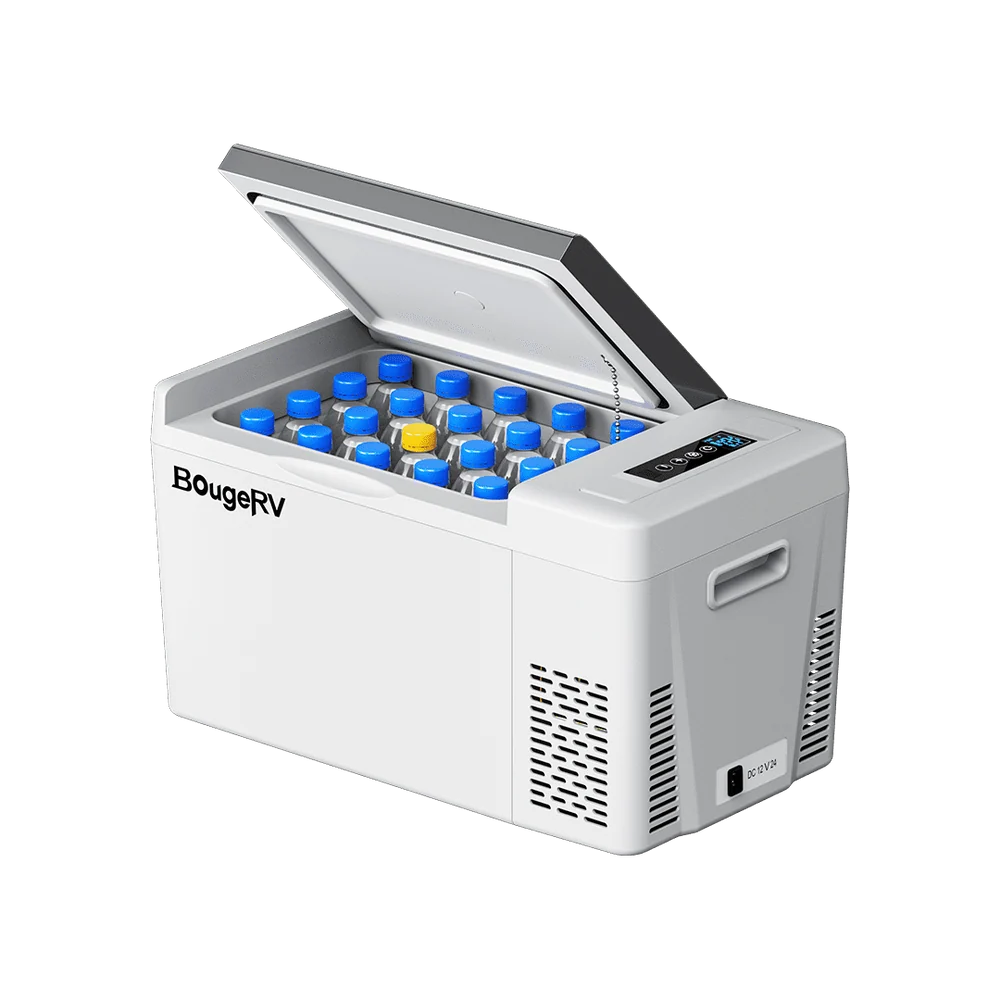
Product reference
BougeRV CR22 23-Quart 12V Refrigerator
Best for: Balanced capacity and fit for camping and road trips
Trade-off: No app or interior light, and the manufacturer page contains conflicting ECO power figures
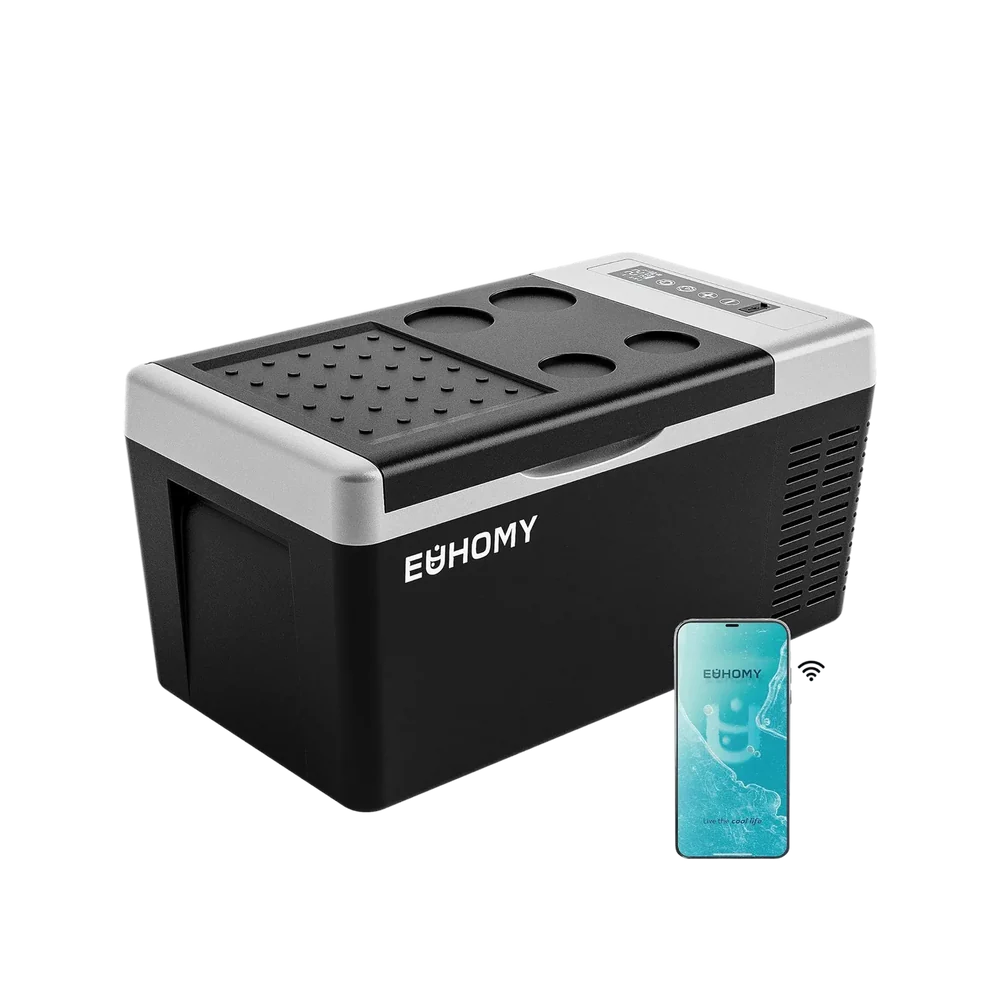
Product reference
EUHOMY 19QT 12V Refrigerator with App Control
Best for: Low-clearance vehicle installations and app-based adjustment
Trade-off: Smallest capacity here, and app control is not independent food-temperature monitoring
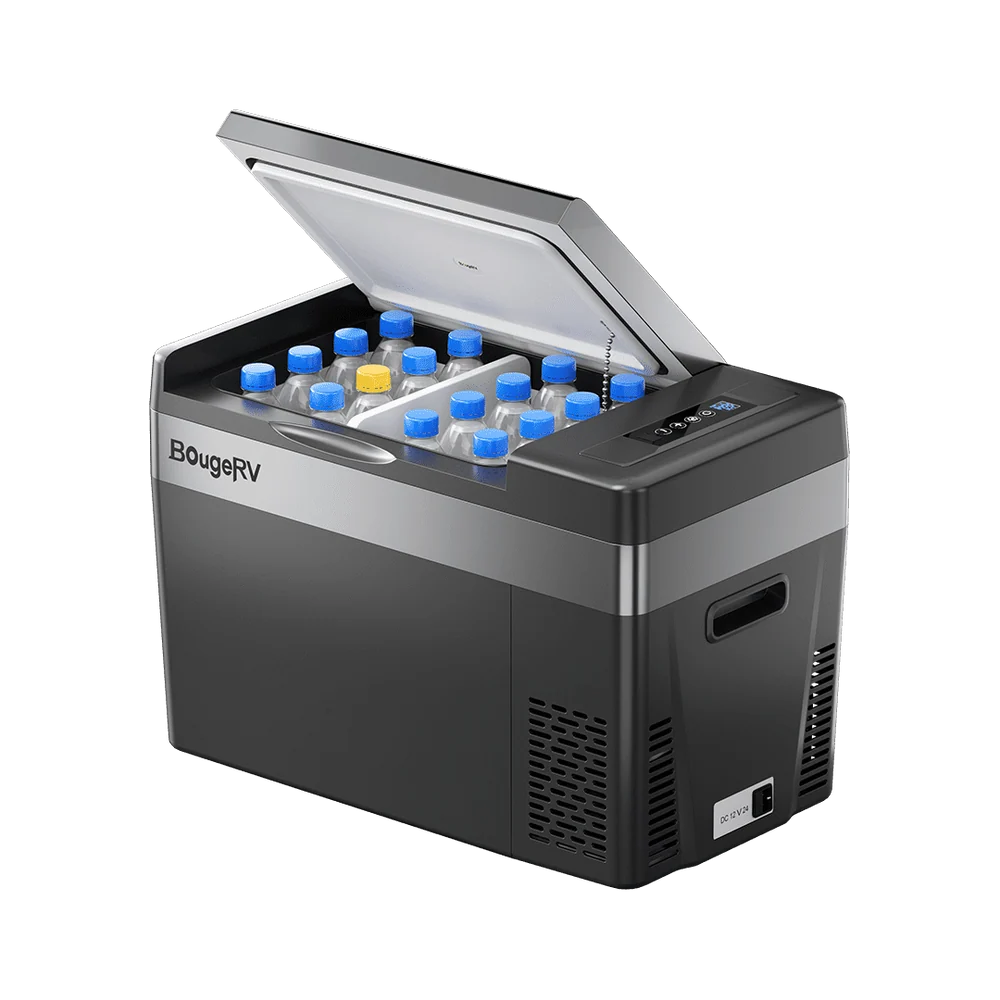
Product reference
BougeRV 30-Quart 12V Refrigerator
Best for: Truck, van, and base-camp setups needing more vertical capacity
Trade-off: Taller cabinet needs more lid clearance and becomes heavier when loaded
How this guide was researched
We compare documented product features against the job each buyer needs done. We have not physically tested these products. Check current specifications and availability with the manufacturer or merchant.
Affiliate disclosure: If you buy through a qualifying link, we may earn a commission at no extra cost to you.