
Workshop & hobbies • product review
Elikliv EDM4 Review: Is It the Best Budget Coin Microscope?
Is the Elikliv EDM4 the best budget coin microscope? See where its built-in screen helps, where the 1000x claim misleads, and who should skip it.
The Elikliv EDM4 is a sensible budget coin microscope when the main job is inspecting dates, mint marks, lettering, edges, scratches, and other small surface details without opening a laptop. Its 4.3-inch screen, adjustable LED ring, stand, and local photo/video capture make it more self-contained than a basic USB microscope.
It is not the best tool for photographing an entire coin, judging color or luster, assigning a grade, or proving that a suspected error is genuine. The advertised 1000x figure is also a poor reason to buy it: apparent digital magnification depends on lens distance and display size, while the manual documents only 720p video and photo settings up to 3 megapixels.
Our verdict: buy the EDM4 if you want an inexpensive, all-in-one viewer for close inspection and easy sharing at a desk. Skip it if you need repeatable whole-coin photography, a rigid precision stand, dependable Mac compatibility, natural stereo depth, or evidence suitable for professional attribution and grading.
Focused Gadgets has not physically tested this microscope. This review evaluates the exact current retail listing, the available model manual, product architecture, and the practical requirements of coin inspection. Image quality, stand vibration, battery runtime, and build quality are not our measurements.
Quick verdict
- Best fit: a collector who wants to inspect small coin details on a built-in screen without connecting another device.
- Main advantage: screen, lighting, stand, and capture are combined in one inexpensive setup.
- Main compromise: the short stand and close-focus design favor details rather than consistently framing an entire larger coin.
- Important warning: magnification labels do not tell you how much genuine detail the sensor and optics resolve.
- Compatibility caveat: the current listing advertises Windows and MacBook viewing, but the available EDM4/DM-04 manual explicitly says Mac computers are not supported.
| Buying question | Elikliv EDM4 answer | Why it matters |
|---|---|---|
| Can it work without a computer? | Yes, it has a 4.3-inch LCD | Faster for casual inspection and easier to share across a table |
| Can it save images and video? | Yes, with a memory card up to 32GB according to the manual | The card is not included, and capture resolution is modest |
| Will it show a whole coin? | Sometimes, depending on coin size and stand height | The strongest use is examining a selected detail, not catalog photography |
| Is 1000x useful? | Not as a buying metric | Field of view, focus, lighting, sensor resolution, and stability matter more |
| Does it connect to a computer? | The manual documents a Windows USB camera/disk workflow | Mac support is inconsistent across current sales material and the manual |
The built-in screen is the real reason to choose it
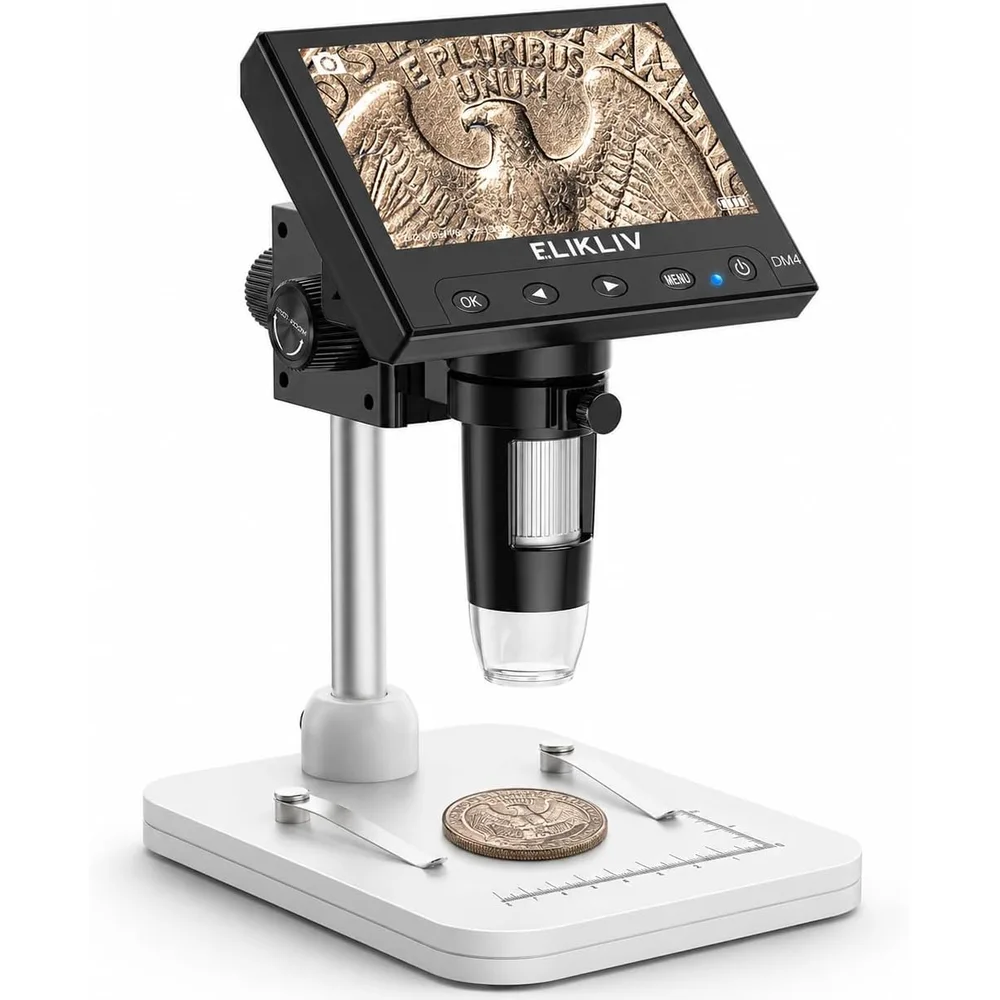
The EDM4’s useful distinction is not extreme magnification. It is the ability to place a coin on the base, lower the camera, focus manually, adjust the light, and view the result on a dedicated 4.3-inch display. There is no phone clamp, app account, driver installation, or laptop taking up bench space for basic use.
That simplicity suits quick questions: Is the mint mark damaged or doubled? Is there a scratch across a letter? Does an edge show a seam? Is debris hiding a date? More than one person can also look at the display without taking turns at an eyepiece.
The screen is still small compared with a computer monitor, and the manual identifies the camera system as 720p. A large-looking detail is not automatically a high-resolution detail. If you need to compare fine die markers against a reference, save the image and review it at a sensible size rather than assuming the live enlarged view contains information the sensor never captured.
Do not buy it for the 1000x claim
The product name and manual use magnification figures up to 1000x. Even the current listing concedes that actual magnification changes with the screen size and distance between the camera and the object. That is how this category works: moving the lens closer narrows the field, and displaying the result on a larger screen makes it appear larger again.
There is no set of calibrated 50x, 100x, and 1000x optical objectives here. The manual describes manual focusing, a 10-to-40mm focusing range, a 16-degree perspective, and a small image sensor. Those specifications are more useful than the largest number printed in the title.
For coin work, start with the widest view that clearly shows the feature. Higher apparent magnification makes vibration, focus error, glare, and compression more visible. It does not necessarily reveal another layer of genuine detail.
Specifications that matter
| Specification | Documented EDM4 information | Buying interpretation |
|---|---|---|
| Display | 4.3-inch LCD; 720p imaging claim | Convenient standalone viewing, not a high-resolution grading monitor |
| Photo settings | VGA, 1.3MP, 2MP, and 3MP | Adequate for records and sharing; modest for detailed catalog photography |
| Video settings | VGA or 720p | Useful for showing an area, not a substitute for high-resolution stills |
| Lighting | Eight LEDs with adjustable brightness | Convenient, but coaxial light can flatten relief or reflect from slabs |
| Focus | Manual; documented range of about 10-40mm | Close inspection with limited working room at stronger magnification |
| Storage | Memory card up to 32GB | Required for onboard photo/video storage; current listing says it is not included |
| Computer mode | USB 2.0 camera and disk modes | Manual documents Windows; current listing and manual conflict on Mac support |
| Power | Built-in/rechargeable arrangement in current listing; manual refers to an 18650 battery | Useful away from an outlet, but the claimed runtime is not independently verified |
| Stand/base | Height-adjustable bracket and plastic base | Easier than hand-holding, but not designed as a precision copy stand |
The current product page identifies the exact unit as the EDM4 and lists the microscope, adjustable bracket, plastic base, USB cable, and manual in the package. Check the live offer before buying because product revisions can occur while retaining the same model name.
Coin lighting matters more than another magnification step
The eight LEDs surround the lens, so their reflections return from roughly the same direction as the camera. That arrangement is compact and convenient. It can also create a bright ring on a slab, wash out shiny fields, and make low relief look flatter than it does under angled light.
Begin below maximum brightness. Rotate the coin and adjust the light while watching whether scratches, raised features, and texture appear or disappear. For difficult surfaces, switch off the built-in LEDs and try a diffused lamp from the side. A small change in angle can reveal more than moving the camera closer.
Lighting can also change the apparent color of toning. Automatic exposure and white balance may brighten dark areas or shift color between frames. Use the microscope to locate and document features, not to make a color designation or market-value judgment from one image.
If the coin is slabbed, you are viewing through another reflective and potentially scratched surface. Clean only the slab exterior with an appropriate method. Never clean or polish a collectible coin to make it look better under the microscope.
Will the EDM4 show an entire coin?
It may show a small coin at the highest available stand position, but whole-coin framing is not the format’s strength. The manual’s close focusing range and the current short-column design prioritize close details. Larger coins need more camera-to-subject distance, and the supplied stand may run out of height before the complete diameter fits comfortably.
Even when the whole coin fits, focus may soften toward the edge if the camera and coin are not parallel. Touching the focus wheel can shift the frame. The built-in light may also produce an uneven or circular reflection across a broad polished surface.
For a consistent catalog image, a recent phone or camera on a rigid copy stand with separate diffused lights is usually the better starting point. Use the EDM4 for the mint mark, date, edge, die crack, surface disturbance, or other small area that benefits from a live enlarged view. Our broader digital microscope guide for coins explains why a USB microscope and a camera setup solve different parts of the job.
The stand is convenient, not a measurement instrument
The base gives you a repeatable place to put a coin and keeps the camera steadier than hand-holding. Height adjustment changes both the field of view and the focus range. That is enough for visual inspection.
It is not a calibrated measurement stage. The printed scale visible on the base does not automatically calibrate the captured image, and perspective changes when the camera or coin is tilted. If dimensions matter, place a suitable scale in the same plane as the feature and use calibrated software or dedicated metrology equipment.
Minimize vibration by placing the base on a solid surface, framing the subject before fine focus, and using the lightest possible touch on the controls. Saved images can move slightly when a button is pressed. Capture more than one frame and keep the clearest rather than trusting the first one.
Saving images and connecting a computer
The manual says a memory card is required to save onboard files and supports cards up to 32GB. Photo choices run from VGA to 3MP, while video is VGA or 720p. Those are file settings, not proof that every pixel represents independently resolved optical detail.
USB has two documented modes. Disk mode exposes saved files to the computer. PC Camera mode sends a live feed as a general UVC camera, with the manual describing 640 x 480 or 1280 x 720 at 26 frames per second. In that mode, most controls on the microscope are unavailable apart from power and lighting.
Compatibility needs caution. The current Amazon title and bullet copy advertise Windows or MacBook viewing. The available model manual explicitly says Mac computers do not support the USB function and provides Windows-only instructions. Treat Windows as the documented path. If Mac viewing is essential, ask the seller to confirm the exact current hardware revision and return policy before ordering.
The computer connection does not turn the EDM4 into a higher-resolution microscope. It gives you a larger view and a file workflow, which may be useful for teaching, comparing details, and organizing records.
What the EDM4 can and cannot tell you about a coin
The microscope can help you see a line, depression, raised feature, seam, scratch, plating bubble, or repeated die marker. It cannot decide by itself whether that feature is mint-made damage, post-mint damage, a known variety, a counterfeit indicator, or ordinary wear.
Attribution requires the right reference and an understanding of how the feature should appear on that date, mint, denomination, and die. Authentication and grading also depend on the complete coin, edge, weight, dimensions, metal, strike, luster, alteration, and provenance. A dramatic close-up can remove that context.
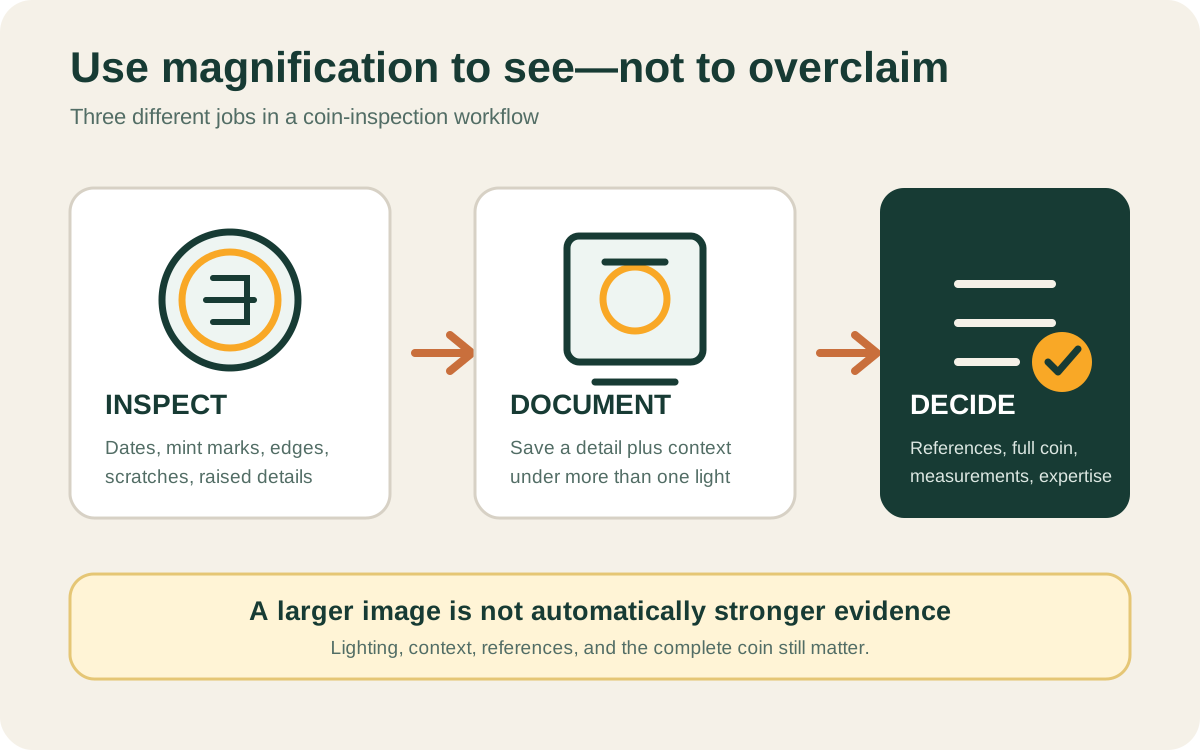
Use a repeatable workflow:
- Examine the complete obverse, reverse, and edge at low apparent magnification.
- Note the feature’s location and orientation before moving closer.
- Capture the area with more than one light angle.
- Save a wider context image as well as the close-up.
- Compare against a reputable variety or error reference.
- Seek a recognized authentication or grading service when value depends on the conclusion.
Is it useful for soldering?
The EDM4 can inspect a connector, solder bridge, corroded pad, or component marking. The built-in screen keeps a laptop off the bench, and the short-focus camera can reveal details the naked eye misses.
Active soldering is more demanding. At close focus, the lens and LED housing occupy space directly above the board. The stand provides less working clearance than a taller bench microscope, and the flat screen view does not provide binocular depth. Heat, fumes, hands, and tools can also block the ring light.
Choose it for occasional inspection rather than as the center of a microsoldering station. Our digital microscope guide for soldering compares a taller dedicated-screen model with a computer-connected alternative, while the digital-versus-stereo microscope guide explains the depth and tool-clearance trade-off.
What we like
- The built-in screen makes casual inspection quick and self-contained.
- Adjustable lighting and a stand are included rather than left as immediate add-ons.
- Local photo and video capture can document a feature without keeping a computer beside the collection.
- The exact current retail page and model name now match the catalog entry.
- USB camera and disk modes add a larger-screen workflow for a documented Windows setup.
What gives us pause
- The 1000x headline is not a calibrated optical setting or a measure of resolved detail.
- The supplied stand is better suited to small areas than repeatable whole-coin photography.
- The retailer and manual conflict on Mac compatibility.
- The available documentation is a manual mirror rather than a current manufacturer-hosted EDM4 support page.
- Photo and video specifications are modest compared with the numbers used in current marketing.
- There is no independent Focused Gadgets measurement of image quality, stability, battery runtime, or durability.
Better choices for different buyers
Choose the Plugable 250x from our coin-microscope guide if broad computer compatibility, a standard UVC workflow, and documented manufacturer support matter more than an integrated display. Its flexible stand is still a compromise, and its video resolution is modest.
Choose a rigid phone or camera copy stand if the priority is a sharp, evenly lit photograph of the complete coin. It gives you more distance for lighting and a larger field of view, although it is less convenient for rapidly scanning tiny details.
Choose a stereo microscope if direct depth perception, natural hand-eye coordination, and three-dimensional surface inspection matter more than easy recording. It is the stronger bench tool, but it costs more and needs a separate camera arrangement for documentation.
Who should buy the Elikliv EDM4?
Buy it if you want an affordable desktop viewer for dates, mint marks, edges, lettering, and suspected surface features; you value a built-in screen; and your expectations are closer to inspection and sharing than professional imaging.
Skip it if your goal is to photograph entire coins for a catalog, make color-sensitive images, measure defects, authenticate high-value pieces, perform sustained precision soldering, or guarantee Mac compatibility. In those cases, a more specialized setup is worth the extra space and cost.
Frequently asked questions
Is the Elikliv EDM4 a real 1000x microscope?
The product uses a 1000x marketing figure, but apparent magnification changes with lens distance and display size. It does not have a calibrated set of 1000x optical objectives. Judge it by field of view, resolved detail, lighting, and stability instead.
Can it photograph a whole coin?
Possibly for smaller coins with the camera at maximum practical height, but the supplied stand is optimized for closer detail. A rigid camera or phone copy stand is usually better for complete-coin photographs.
Does it need a computer?
No. The built-in screen handles live viewing, and a compatible memory card allows onboard photo and video storage. A Windows computer can provide a larger live view or file access over USB.
Does it work with a Mac?
The current retail listing says Windows or MacBook, while the available EDM4/DM-04 manual says Mac is unsupported. Because the sources conflict, confirm the exact current revision with the seller if Mac support is required.
Can it authenticate or grade coins?
No. It can reveal and document visible details, but authentication and grading require broader evidence, appropriate references, and expert judgment. Lighting and digital processing can also change how surfaces appear.
Is a memory card included?
The current listing says a memory card is not included. The manual documents support up to 32GB. Confirm the required card format in the current package instructions.
Bottom line
The Elikliv EDM4 makes a coherent budget purchase when you want a coin-detail viewer that works at the desk without a phone or computer. The built-in screen, stand, adjustable LEDs, and capture controls are the value proposition.
Buy it for convenient inspection, not the 1000x label. Its modest capture specifications, lighting geometry, short stand, and compatibility uncertainty keep it from replacing a copy stand, stereo microscope, or professional authentication process. For the right collector, those limits are acceptable; for whole-coin imaging or consequential decisions, they are reasons to choose a more specialized tool.
Models discussed
Use these as starting points for checking fit. We do not publish a price or claim hands-on testing.
Product reference
Elikliv LCD Digital Coin Microscope EDM4
Best for: Budget close inspection of coin details without a computer
Trade-off: Short stand and modest capture resolution limit whole-coin imaging
How this guide was researched
We compare documented product features against the job each buyer needs done. We have not physically tested these products. Check current specifications and availability with the manufacturer or merchant.
Affiliate disclosure: If you buy through a qualifying link, we may earn a commission at no extra cost to you.