
Indoor environment • product review
LifeBasis 11-in-1 Review: Best Budget Air Quality Monitor With CO2?
Can the LifeBasis 11-in-1 be a useful budget air monitor? We examine its CO2 and particle sensors, display, calibration, and serious limits.
A long sensor list is tempting when you want one inexpensive screen to explain the air in a room. The LifeBasis 11-in-1 Indoor Air Quality Monitor promises carbon dioxide, several particle readings, formaldehyde, total volatile organic compounds, temperature, humidity, and an overall air-quality score in a rechargeable handheld device.
The useful part is narrower than that headline. LifeBasis documents an NDIR carbon-dioxide sensor and a laser particle sensor, which can make the monitor helpful for spotting ventilation and particle trends. But its own manual says detection is qualitative rather than quantitative. The formaldehyde and TVOC numbers should therefore prompt investigation, not settle an exposure question.
Our verdict: the LifeBasis is a conditional budget choice for someone who wants local CO2 and particle trends without an app. Skip it if you need logged history, remote alerts, an independently evaluated instrument, or a number you can use for a health, workplace, rental, or remediation decision.
Focused Gadgets has not physically tested or calibrated this monitor. This review is based on the exact current product listing, LifeBasis’s HAQ66 manual and product documentation, and current guidance on low-cost indoor-air sensors.
Quick verdict
- Best fit: checking how CO2 and particle readings change as a bedroom, office, kitchen, or workshop is occupied and ventilated.
- Main advantage: a local color display combines CO2, particulate matter, temperature, humidity, and gas-sensor readings without requiring an account or phone.
- Main compromise: there is no documented app, data export, or long-term history, so the buyer has to observe and record patterns manually.
- Biggest caution: the manual describes the readings as qualitative. Do not use the HCHO or TVOC value as proof that a room is safe or unsafe.
- Naming oddity: the exact Amazon listing says 11-in-1, while LifeBasis’s product page and manual call this format 10-in-1 and list ten displayed indexes.
| Buying question | LifeBasis answer | Practical consequence |
|---|---|---|
| Does it measure CO2 directly? | LifeBasis documents an NDIR CO2 sensor | Useful for occupied-room ventilation trends after correct calibration |
| Does it detect particles? | A laser particle sensor reports PM1.0, PM2.5, PM10, and a particle value | Several display numbers do not mean several independent particle sensors |
| Can it identify formaldehyde? | It displays HCHO and TVOC values | Treat changes as clues; confirm a consequential concern with an appropriate method |
| Does it save history? | No logging, app, or export is documented | You must watch the display or record readings yourself |
| Is it portable? | 2500mAh battery and USB-C power | LifeBasis claims 11-12 hours per charge; continuous monitoring favors plug-in use |
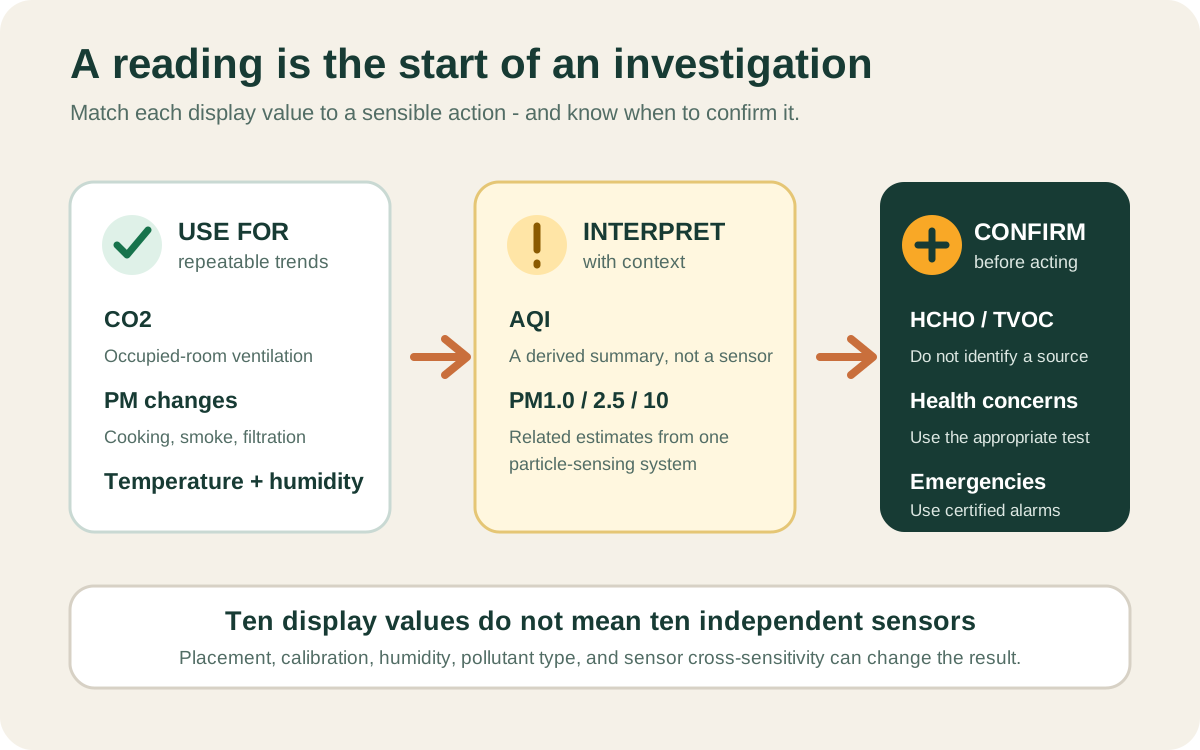
The best reason to buy it is CO2 plus particles on one screen
LifeBasis documents five sensor types inside the HAQ66: an NDIR infrared CO2 sensor, a laser particle sensor, semiconductor and photoelectric sensors, and temperature/humidity sensing. The monitor shows CO2, PM1.0, PM2.5, PM10, a particle count, HCHO, TVOC, temperature, humidity, and AQI.
For most homes, CO2 and PM2.5 are the most actionable pair. CO2 can show how occupancy and ventilation interact. A closed bedroom may climb overnight; opening the door or increasing suitable outdoor-air ventilation should change the trend. Particle readings can expose a cooking event, smoke intrusion, a dusty task, or whether a suitable air cleaner is reducing an elevated level.
That combination is unusual at the budget end because many inexpensive CO2 displays omit particles, while some smart air monitors measure particles and VOC trends but omit CO2. The LifeBasis puts both on the device itself. You do not have to reach for a phone to see the current values.
The trade-off is memory. A screen tells you what is happening now, but a graph tells you whether the bedroom repeatedly peaks before dawn or whether filtration cleared cooking particles in twenty minutes or two hours. LifeBasis does not document an app, Wi-Fi, Bluetooth, onboard history, or data export for this model. If trends across days matter, a connected monitor is more useful.
“11-in-1” does not mean eleven independent sensors
The arithmetic in the product name deserves scrutiny. The U.S. Amazon listing calls the black model 11-in-1, but it names ten indexes. LifeBasis’s own page and HAQ66 manual call the device 10-in-1 and show the same ten values. Nothing in the first-party documentation explains an eleventh measurement.
More importantly, ten display values are not ten physical sensors. AQI is a summary calculated from measurements. PM1.0, PM2.5, PM10, and the particle value come from the monitor’s particle-sensing system rather than four separate laboratory instruments. The gas readings also depend on a much smaller set of sensing elements than the headline count suggests.
This is not automatically a flaw. One optical system can estimate several particle-size fractions, and a derived status can make a busy display easier to scan. It does mean that sensor count is the wrong buying metric. Buy for a specific question that the device can help answer, not for the largest number in the title.
Specifications that matter
| Specification | Documented information | What it means for the buyer |
|---|---|---|
| Model family | LifeBasis HAQ66 format | The exact retail page uses a different 11-in-1 label for the black version |
| CO2 method | NDIR infrared; 400-5000 ppm range | A real CO2 measurement method, subject to calibration and placement |
| CO2 accuracy claim | Plus or minus 50 ppm plus 5% of reading | A manufacturer specification, not an independent result from our testing |
| Particle method | Laser particle sensor | Best used to compare changes; composition and humidity can affect optical estimates |
| Particle accuracy claim | Plus or minus 10 micrograms per cubic meter from 0-100; plus or minus 10% from 100-500 | Manufacturer-stated performance, not third-party validation of this exact model |
| Gas ranges | HCHO 0-1.999 mg/m3; TVOC 0-9.999 mg/m3 | A displayed range does not establish selectivity or exposure-grade accuracy |
| Temperature / humidity | 0-50 C and 0-99% RH; claimed plus or minus 1 C and 5% RH | Useful context for comfort and sensor behavior |
| Power | USB-C 5V/2A; 2500mAh battery | Portable for spot checks; plug in for longer observation |
| Size | 74.2 x 160 x 24 mm | Handheld body with a fold-out desk stand |
The manual also includes adjustable brightness, switchable sound, temperature-unit selection, and a five-minute auto-shutdown option. Auto shutdown can be disabled. For a bedside monitor, the dimming and sound controls are more consequential than another marketing metric.
Calibration is not optional
The manual instructs the owner to power the monitor in a well-ventilated location or near an open window with good circulation for at least ten minutes, then run the CO2 calibration routine. That process assumes the reference location represents outdoor-like background air. Calibrating beside a person’s breath, a combustion source, a crowded doorway, or stagnant indoor air can shift every later interpretation.
Do not hold the unit near your face while judging CO2. Exhaled breath can drive the reading upward. The EPA advises placing indoor monitors in the breathing zone with open airflow, away from immediate pollutant sources, drafts, windows, and supply vents unless that source or airflow is the question being investigated.
Give the device time to settle after moving it. Then compare like with like: the same room, similar occupancy, similar door position, and similar activity. A repeatable rise and fall is often more informative than one isolated number.
How much confidence should you place in the readings?
LifeBasis publishes ranges and accuracy claims, but the manual’s caution section says the product’s detection is qualitative rather than quantitative. That wording should govern how it is used.
CO2 has the clearest job. The NDIR method is designed to respond to carbon dioxide, and a properly calibrated trend can help you investigate ventilation. Even so, the EPA says indoor CO2 needs careful interpretation; it is not a complete score for ventilation or health, and a low number does not rule out other pollutants.
Particle readings are also useful for changes. Berkeley Lab research on consumer monitors—not this exact LifeBasis model—found that some low-cost optical monitors detected household particle events well enough to guide ventilation or filtration, while absolute readings varied by product and pollution source. PM10 was generally more variable than PM2.5. Steam, humidity, particle size, and composition can influence light-scattering estimates.
HCHO and TVOC deserve the most restraint. A broad gas sensor can respond to mixtures and interfering compounds. A rise after painting, cleaning, applying fragrance, or bringing in new furnishings may tell you that something changed. It does not identify the compound, its source, or the exposure risk. The LifeBasis screen should never be the sole evidence for a formaldehyde remediation decision.
The monitor does not measure carbon monoxide or radon. It is not a smoke alarm, CO alarm, mold detector, or complete assessment of indoor air.
The display is useful, but the alarm thresholds are not universal safety limits
The HAQ66 uses color bands and an audible warning. Its manual lists default alarm values, including 1,500 ppm for CO2 and 75 micrograms per cubic meter for PM2.5. Those are manufacturer settings, not universal lines between safe and unsafe air.
The EPA notes that widely accepted indoor concentration limits do not exist for many pollutants, so consumer-monitor alerts are often defined by the manufacturer. Treat the alarm as a prompt to check the individual value, identify the recent activity, and take an appropriate action. Do not wait for the unit to turn red before responding to smoke, symptoms, a certified alarm, or an obvious hazardous source.
The single-screen design also asks you to switch views. One page emphasizes CO2 and particle information; another shows HCHO, PM1.0, PM10, particle, and TVOC values. That is manageable for spot checks, but less convenient than a dashboard that graphs everything automatically.
Battery life favors room-to-room checks, not unattended logging
LifeBasis claims up to 11-12 hours from the 2500mAh battery. We have not verified that runtime, and brightness, alarms, battery age, and sensor activity can affect it. The manual recommends using the power adapter during long operation to avoid a short battery service life.
That makes the battery most useful for carrying the monitor between rooms or checking a temporary activity. For an overnight bedroom pattern or an extended filtration experiment, USB-C power is the more dependable arrangement. Because the device does not log data, keeping it running unattended has limited value unless someone periodically records the readings.
A practical way to use it
Start with one question rather than scanning every number:
- Calibrate CO2 exactly as the manual describes in suitable fresh air.
- Put the monitor in an occupied part of the room, away from direct breath, windows, vents, steam, and the immediate source.
- Record a baseline after the reading settles.
- Change one condition: open a door, use suitable ventilation, switch on a correctly sized particle filter, or stop the suspected source.
- Watch the direction and timing of the response rather than declaring success from one “good” color.
- Repeat under similar conditions. Confirm any consequential result with a method designed for that pollutant and decision.
For a wider explanation of sensor choices and actions, see our indoor air quality monitor buying guide. If radon is the concern, use a purpose-built device and follow the longer measurement logic in our continuous radon detector guide.
Better alternatives for different buyers
Choose the Airthings View Plus 2960 if you want CO2, PM2.5, radon, VOC, temperature, humidity, and pressure with Wi-Fi history and readings on an e-ink display. It is the stronger fit for long-term pattern tracking and radon, but it costs substantially more in normal market positioning and does not measure carbon monoxide.
Choose the Amazon Smart Air Quality Monitor if Alexa notifications and automations matter more than a numerical screen. It tracks PM2.5, VOC, carbon monoxide, temperature, and humidity, but omits CO2 and radon. Amazon also states that it is not a certified carbon-monoxide alarm.
Choose a purpose-specific meter or professional assessment if the result will drive a health, workplace, tenancy, legal, or remediation decision. A narrower instrument with documented selectivity and an appropriate sampling method is more valuable than a longer list of estimates.
Who should buy the LifeBasis monitor?
Buy it if you want an affordable, portable display for CO2 and particle trends; you are comfortable calibrating it and recording observations manually; and you will treat the gas readings as investigative clues rather than laboratory results.
Skip it if you want automatic history, remote notifications, smart-home control, radon or carbon-monoxide detection, independent validation of this exact model, or exposure-grade formaldehyde measurements. A buyer who mainly cares about one pollutant may be better served by a simpler device that documents that measurement more thoroughly.
Frequently asked questions
Is the LifeBasis really an 11-in-1 monitor?
The exact Amazon listing says 11-in-1, while LifeBasis’s own page and HAQ66 manual call the format 10-in-1. Both list ten displayed indexes. Those values come from fewer physical sensor systems, and AQI is a derived summary rather than a separate sensor.
Does the LifeBasis use a real CO2 sensor?
LifeBasis documents an NDIR infrared sensor with a 400-5000 ppm range. That is a CO2-specific measurement method, but correct fresh-air calibration, placement, and cautious interpretation still matter. We have not independently tested its accuracy.
Can it detect mold?
No. Temperature and humidity can help you investigate conditions that support dampness, but the monitor cannot identify mold or prove that a room is mold-free. Mold assessment begins with moisture and physical inspection.
Can I trust its formaldehyde reading?
Use the HCHO value only as a clue that deserves investigation. The manual describes detection as qualitative, and gas sensors can respond to interfering compounds. Confirm a consequential formaldehyde concern using an appropriate sampling method or qualified professional.
Does it connect to an app?
LifeBasis does not document an app, wireless connection, data export, or historical logging for this model. Its strength is immediate local viewing, not trend storage.
Can it replace a smoke or carbon-monoxide alarm?
No. It does not measure carbon monoxide and is not a certified life-safety alarm. Keep correctly installed, working smoke and CO alarms regardless of what this display shows.
Bottom line
The LifeBasis earns consideration as a budget CO2-and-particle trend monitor with a bright local display. NDIR CO2, optical particle sensing, adjustable alarms, USB-C power, and a rechargeable battery make it more useful than a vague one-number air-quality gadget.
Its limits are equally important. The 11-in-1 name overstates the independence of its measurements, the official material disagrees on the count, the manual calls detection qualitative, and there is no documented history or app. Buy it to notice repeatable changes and test simple interventions. Do not buy it to certify that your air is safe.
Models discussed
Use these as starting points for checking fit. We do not publish a price or claim hands-on testing.
| Model | Format | Best fit | Trade-off |
|---|---|---|---|
| LifeBasis 11-in-1 Indoor Air Quality Monitor | Rechargeable local-display monitor for CO2, particles, gases, temperature, and humidity | Budget CO2 and particle trend checks without an app | No history or remote alerts; formaldehyde and TVOC readings are qualitative clues |
| Airthings 2960 View Plus | Wi-Fi display monitor with seven measurements | CO2, PM2.5, radon, and long-term connected trends | Higher cost and more setup; no carbon-monoxide sensor |
| Amazon Smart Air Quality Monitor | Plug-in Alexa-connected monitor with status LED | Alexa alerts and PM2.5 or VOC trend automations | No CO2, radon, or numerical display; not a certified CO alarm |
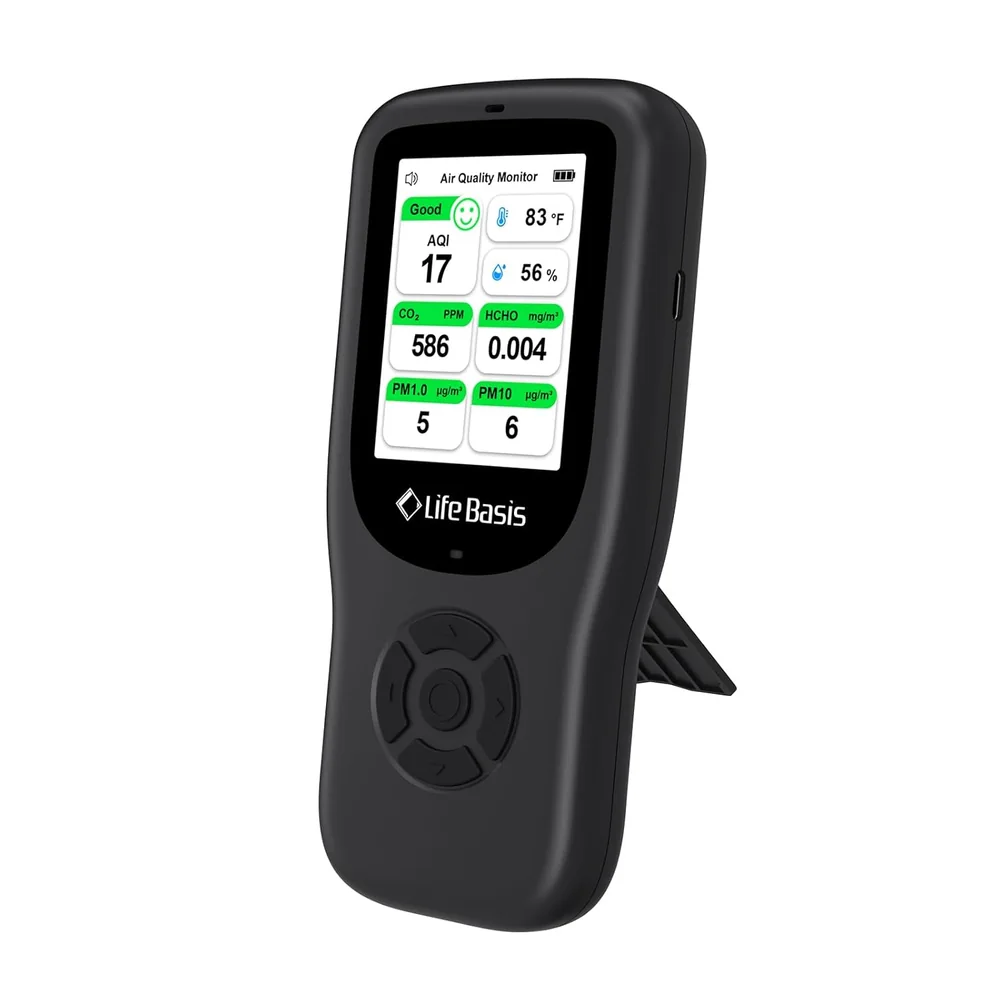
Product reference
LifeBasis 11-in-1 Indoor Air Quality Monitor
Best for: Budget CO2 and particle trend checks without an app
Trade-off: No history or remote alerts; formaldehyde and TVOC readings are qualitative clues
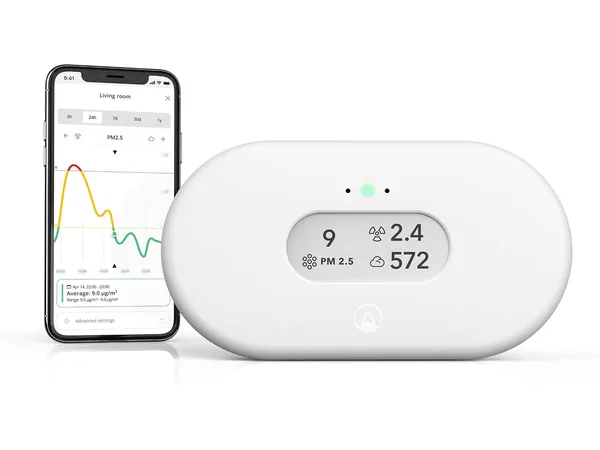
Product reference
Airthings 2960 View Plus
Best for: CO2, PM2.5, radon, and long-term connected trends
Trade-off: Higher cost and more setup; no carbon-monoxide sensor
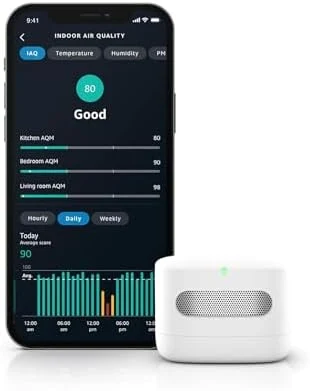
Product reference
Amazon Smart Air Quality Monitor
Best for: Alexa alerts and PM2.5 or VOC trend automations
Trade-off: No CO2, radon, or numerical display; not a certified CO alarm
How this guide was researched
We compare documented product features against the job each buyer needs done. We have not physically tested these products. Check current specifications and availability with the manufacturer or merchant.
Affiliate disclosure: If you buy through a qualifying link, we may earn a commission at no extra cost to you.