
Indoor environment • buying guide
Best Indoor Air Quality Monitors: Know What They Actually Measure
Compare indoor air monitors by the pollutants they detect, the actions their readings support, and the important hazards they cannot identify.
The most useful indoor air quality monitor is not necessarily the one with the longest sensor list. It is the one that measures the problem you can act on. A monitor without carbon dioxide cannot tell you much about ventilation. A device without a particle sensor cannot show what cooking smoke or wildfire haze is doing indoors. A VOC reading cannot identify a particular chemical, and no general air-quality score proves that a room is safe.
That makes this a two-product guide rather than an artificial top three. The Airthings View Plus 2960 measures CO2, PM2.5, radon, VOCs, temperature, humidity, and air pressure, with a display and Wi-Fi history. The Amazon Smart Air Quality Monitor P3A7EN measures PM2.5, VOCs, carbon monoxide, temperature, and humidity, then puts its detailed readings in the Alexa app. The Amazon model costs less in normal market positioning and suits an Alexa-centered home, but its missing CO2 and radon sensors fundamentally change what it can tell you.
Focused Gadgets has not physically tested or calibrated either device. This comparison is based on exact-model documentation, current support material, public-health guidance, and verified merchant destinations. Consumer monitors are trend and awareness tools. They do not identify every pollutant, diagnose a health condition, or replace certified smoke and carbon-monoxide alarms.
Quick answer
- Choose the Airthings View Plus 2960 for the broadest useful picture. It is the better fit when ventilation, particles, and radon all matter, or when you want readings on the device as well as remote history. The trade-off is a higher purchase cost and a larger connected ecosystem than a simple monitor requires.
- Choose the Amazon Smart Air Quality Monitor P3A7EN for Alexa-based alerts and routines. It covers PM2.5, VOC trends, carbon monoxide, temperature, and humidity in a compact plug-in unit. It is not the right choice when CO2 or radon is the reason you are shopping, and its CO sensing does not make it a certified CO alarm.
- Do not buy by sensor count alone. Decide which source or condition you need to notice, what action a reading would trigger, and whether you need a local number when the internet or app is unavailable.
| Monitor | Measurements | Local information | Connection and power | Best fit | Important omission |
|---|---|---|---|---|---|
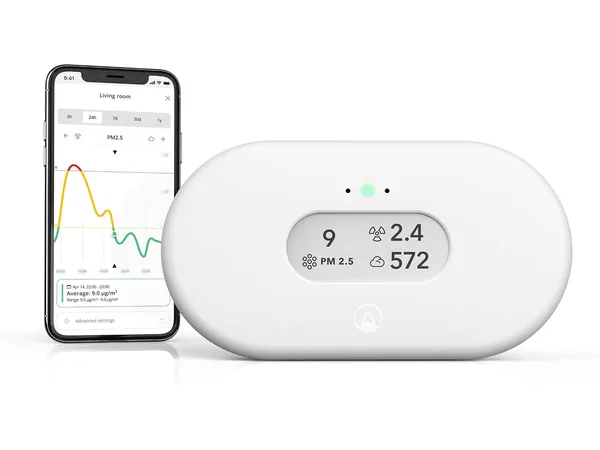
| Airthings View Plus 2960 | Radon, PM2.5, CO2, VOC, temperature, humidity, air pressure | 2.9-inch e-ink display and status indicator | 2.4GHz Wi-Fi; Bluetooth setup; 6 AA batteries or USB-C | Ventilation, particle, radon, and long-term trend monitoring | Does not measure carbon monoxide |
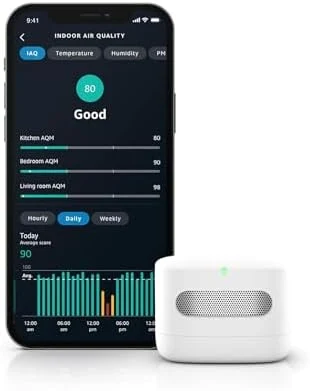
| Amazon Smart Air Quality Monitor P3A7EN | PM2.5, VOC, carbon monoxide, temperature, humidity | Color status LED; detailed values require the Alexa app | Wi-Fi; continuous 5V/1A power | Alexa households wanting alerts, routines, and basic pollutant trends | Does not measure CO2 or radon |
Match the sensor to a decision
An indoor monitor becomes useful when a reading leads to a sensible next step. The U.S. Environmental Protection Agency cautions that low-cost monitors only detect their designed pollutants, and that placement, temperature, humidity, time in use, and other contaminants can affect performance. Most consumer monitors lack broadly accepted indoor performance criteria.
Use the sensor list as a map of possible decisions:
- PM2.5 represents fine airborne particles. Cooking, smoke, candles, and outdoor pollution can raise the reading. A trend can tell you when to stop the source, ventilate if outdoor air is cleaner, or run an appropriate particle filter. It does not identify the source by itself.
- CO2 can help reveal how ventilation changes as people occupy a room. It is especially useful in a closed bedroom, home office, or gathering space. EPA guidance says indoor CO2 needs careful interpretation; one number is not a complete measure of ventilation or general air quality.
- VOC or TVOC is a broad response to a changing mixture of gases. Paint, cleaners, fragrances, furnishings, cooking, and many other sources can affect it. A consumer VOC trend may help you investigate a time or activity, but it cannot tell you that a particular chemical, formaldehyde, or mold is present.
- Carbon monoxide is an acute combustion hazard. A general monitor may add awareness, but the Amazon device is explicitly not a substitute for a certified CO alarm. Follow current placement guidance for dedicated alarms on every level and outside sleeping areas.
- Radon is a long-term exposure problem that requires time and appropriate test conditions. A connected trend is useful, but a real-estate transaction or formal mitigation decision may require a qualified professional or approved procedure. Our continuous radon detector guide covers that decision in depth.
- Temperature and humidity provide useful context for comfort, condensation risk, and sensor behavior. They do not prove that mold is or is not present.
If you cannot name the action a sensor reading would prompt, extra sensors may add anxiety rather than insight.
Airthings View Plus 2960: best for CO2, particles, and radon together
The View Plus is the more complete environmental monitor of these two. Its seven measurements cover three distinct household questions: whether fine particles are rising, whether an occupied room may need more ventilation, and how radon is trending over a much longer period. Temperature, humidity, VOC, and pressure data add context rather than turning the device into a laboratory.
Airthings identifies the U.S. unit as model 2960. The 2.9-inch e-ink screen can show selected readings without opening an app, and the status indicator gives a quick signal when a measured condition moves outside the configured range. Wi-Fi sends history to the Airthings app and web dashboard. Bluetooth is used during setup, while the device can also act as a SmartLink hub for compatible Airthings sensors.
The product sheet documents a non-dispersive infrared CO2 sensor with a 400 to 5,000 ppm range. Its stated accuracy is plus or minus 50 ppm plus 3% after the specified self-calibration period and under the manufacturer’s test conditions. That manufacturer specification is not an independent guarantee. Occupancy, room volume, outdoor conditions, and monitor location still affect interpretation.
For PM2.5, View Plus uses laser scattering. This is the measurement to watch when frying food, using a fireplace, or deciding whether outdoor smoke is reaching a room. A rapid change can support a source-control or filtration decision. It cannot determine the particle’s composition, and it should not be treated as regulatory-grade sampling.
The VOC sensor is a metal-oxide device that establishes a baseline over time. That makes stable placement important. A spike after cleaning or painting can be informative, but the number does not identify the gas or quantify a specific toxic compound. Investigate the activity, product, or ventilation change that coincided with the trend instead of treating the index as a chemical analysis.
Power choice affects convenience. Airthings specifies six AA batteries with up to two years of operation under its stated conditions, or USB-C power. Wi-Fi requires a 2.4GHz network, and the app account is part of the remote-history experience. The unit is approximately 6.7 by 3.5 by 1.3 inches and weighs about 12.7 ounces with batteries, so it needs more wall or shelf space than the Amazon monitor.
The major omission is carbon monoxide. View Plus should sit alongside certified smoke and CO alarms, not replace them. It is also excessive for someone who only wants a local humidity number or a single radon average. Choose it when the combination of CO2, particles, radon, and remote history justifies the added cost and setup.
Amazon Smart Air Quality Monitor P3A7EN: best for an Alexa-centered home
Amazon’s monitor is a different proposition. It measures PM2.5, VOCs, carbon monoxide, temperature, and humidity, then organizes detailed readings, notifications, and routines in the Alexa app. A colored LED on the device gives a general local status, but there is no numerical display.
The exact model attached to ASIN B08W8KS8D3 is P3A7EN. Amazon’s current safety information specifies 5V/1A power and indoor operation from 32 to 95 degrees Fahrenheit. It must remain plugged in. The monitor itself does not have a microphone, speaker, or Alexa voice service built in; a separate compatible Echo device is needed if you want spoken status, announcements, or the fuller voice-controlled experience.
Its strongest use case is a household already using Alexa. A PM2.5 or VOC change can trigger a notification or supported routine, and Amazon documents integration with the Amazon Smart Thermostat as a temperature sensor. The device can therefore turn an observation into an automation more readily than a stand-alone display can.
The limitation is what it leaves out. There is no CO2 sensor, so it cannot answer whether an occupied bedroom or office is accumulating exhaled air. There is no radon sensor, so it cannot contribute to a long-term radon plan. Calling it an all-purpose air-quality monitor would overstate its scope.
Its carbon-monoxide measurement also needs unusually clear boundaries. Amazon says the product is not certified as a carbon-monoxide alarm and is not a substitute for one. A household still needs correctly placed, working CO alarms that meet the applicable safety standard. Do not use an Alexa notification as the only warning for a combustion hazard, and do not delay leaving or contacting emergency services because a general monitor shows a reassuring color.
Choose the Amazon monitor if PM2.5 and VOC trends are the main questions, you value Alexa notifications or routines, and you already have the required life-safety alarms. Skip it if ventilation or radon is central to the purchase, or if you want exact readings visible without a phone.
Why LifeBasis remains a conditional alternative
LifeBasis now provides first-party specifications and an HAQ66 manual for its inexpensive local-display monitor. The documentation confirms NDIR carbon-dioxide sensing, laser particle sensing, manual calibration, USB-C power, and the important limitation that detection is qualitative rather than quantitative.
That makes it a plausible budget tool for observing CO2 and particle trends, but not a third primary recommendation for buyers who need automatic history, remote alerts, radon coverage, or exposure-grade formaldehyde information. Our LifeBasis 11-in-1 review explains the unusual 10-versus-11 naming, the lack of logging, and which readings deserve the most caution.
Place the monitor where the question is
A monitor beside an open kitchen window may describe that one airflow path rather than the living area. One next to a shower, purifier outlet, stove, candle, humidifier, or direct sunlight can be dominated by a local source. Start with the manufacturer’s spacing instructions, then choose a stable location in the room whose occupants and activities you want to understand.
For a bedroom ventilation question, place the CO2 monitor in the occupied zone, away from a person’s direct breath and away from a supply vent. For cooking particles, a nearby living area may show how pollution spreads without exposing the device to grease or heat. For radon, follow the separate radon placement and duration instructions; do not move the same unit between rooms while interpreting one continuous average.
Allow baseline-driven sensors time to settle after setup or relocation. Compare patterns across similar days before reacting to a single colored indicator. If two devices disagree, check their averaging periods, units, placement, warm-up time, and stated accuracy before assuming one has failed.
Turn readings into a response plan
A simple written plan makes an air monitor more valuable:
- Name the trigger. Decide whether you are watching a repeated trend, a manufacturer threshold, or a public-health guideline. Do not invent a universal pass/fail score from different pollutants.
- Control the source first. Stop smoke-producing cooking, extinguish a candle, close a container, or take a product outside when it is safe to do so.
- Ventilate selectively. Open windows or increase mechanical ventilation when outdoor air is suitable. During wildfire smoke or heavy outdoor pollution, unfiltered outdoor air may make PM2.5 worse.
- Use the right filtration. Particle filters address particles; they do not automatically remove gases. A filter or sorbent should be selected for the contaminant and sized for the room.
- Escalate the hazard. Leave and follow emergency guidance for a CO alarm, smoke, strong unexplained odors, or acute symptoms. Persistent radon, dampness, combustion, or ventilation concerns may require a qualified professional and purpose-specific instruments.
The monitor is the prompt, not the remedy.
Which indoor air quality monitor should you buy?
Buy the Airthings View Plus 2960 if you want one connected device to track CO2, PM2.5, radon, VOCs, temperature, humidity, and pressure. It offers the strongest sensor coverage here and keeps useful values on its own display. Its cost and connected setup make sense only if those additional measurements will guide real decisions.
Buy the Amazon Smart Air Quality Monitor P3A7EN if your priorities are PM2.5 and VOC trends, you already use Alexa, and app alerts or routines matter more than an on-device number. Accept that it cannot help with CO2 or radon, and keep certified CO alarms installed regardless of its carbon-monoxide reading.
Before ordering, confirm the exact ASIN, current specifications, app requirements, warranty, and price at the manufacturer or merchant. Prices, bundles, and availability can change. The product cards below are buying references, not evidence of hands-on testing.
Frequently asked questions
Does one air-quality score tell me whether a room is safe?
No. A score combines only the sensors and rules built into that device. It cannot account for pollutants the monitor does not measure, and different manufacturers may calculate scores differently. Look at the individual measurement, its trend, and the action it supports.
Do I need a CO2 sensor?
A CO2 sensor is useful when your question is how occupancy and ventilation interact in a bedroom, office, classroom, or gathering space. It is not a direct detector for every pollutant, infection risk, or ventilation defect. Of these two models, only View Plus measures CO2.
Can a VOC monitor detect mold or formaldehyde?
Not specifically. A general VOC sensor responds to a mixture of gases and cannot identify the compound that caused a change. Mold assessment requires inspection and moisture investigation; a formaldehyde decision requires a method designed for formaldehyde.
Can the Amazon Smart Air Quality Monitor replace a CO alarm?
No. Amazon explicitly says it is not certified as a carbon-monoxide alarm and is not a substitute for one. Maintain certified alarms on every level and outside sleeping areas according to current local and manufacturer guidance.
Does an air purifier improve every reading?
No. A suitable particle filter can reduce airborne particles, but that does not mean it removes CO2, radon, carbon monoxide, or every gas. Source control, ventilation, filtration, and professional remediation solve different problems.
How often should I move an indoor air monitor?
Keep it stable long enough to build a comparable trend. Move it only when you are starting a clearly separate room investigation, then allow the sensors their specified settling or calibration time. Radon averages in particular should not be blended across locations.
Models discussed
Use these as starting points for checking fit. We do not publish a price or claim hands-on testing.
| Model | Format | Best fit | Trade-off |
|---|---|---|---|
| Airthings 2960 View Plus | Wi-Fi display monitor with seven measurements | CO2, PM2.5, radon, and long-term connected trends | Higher cost and more setup; no carbon-monoxide sensor |
| Amazon Smart Air Quality Monitor | Plug-in Alexa-connected monitor with status LED | Alexa alerts and PM2.5 or VOC trend automations | No CO2, radon, or numerical display; not a certified CO alarm |
Product reference
Airthings 2960 View Plus
Best for: CO2, PM2.5, radon, and long-term connected trends
Trade-off: Higher cost and more setup; no carbon-monoxide sensor
Product reference
Amazon Smart Air Quality Monitor
Best for: Alexa alerts and PM2.5 or VOC trend automations
Trade-off: No CO2, radon, or numerical display; not a certified CO alarm
How this guide was researched
We compare documented product features against the job each buyer needs done. We have not physically tested these products. Check current specifications and availability with the manufacturer or merchant.
Affiliate disclosure: If you buy through a qualifying link, we may earn a commission at no extra cost to you.