
Measurement tools • buying guide
Best Laser Distance Meters: Match the Tool to the Measuring Workflow
Compare a dual-laser app model with two Bosch BLAZE meters for simple indoor work, brighter targeting, and tougher jobsites.
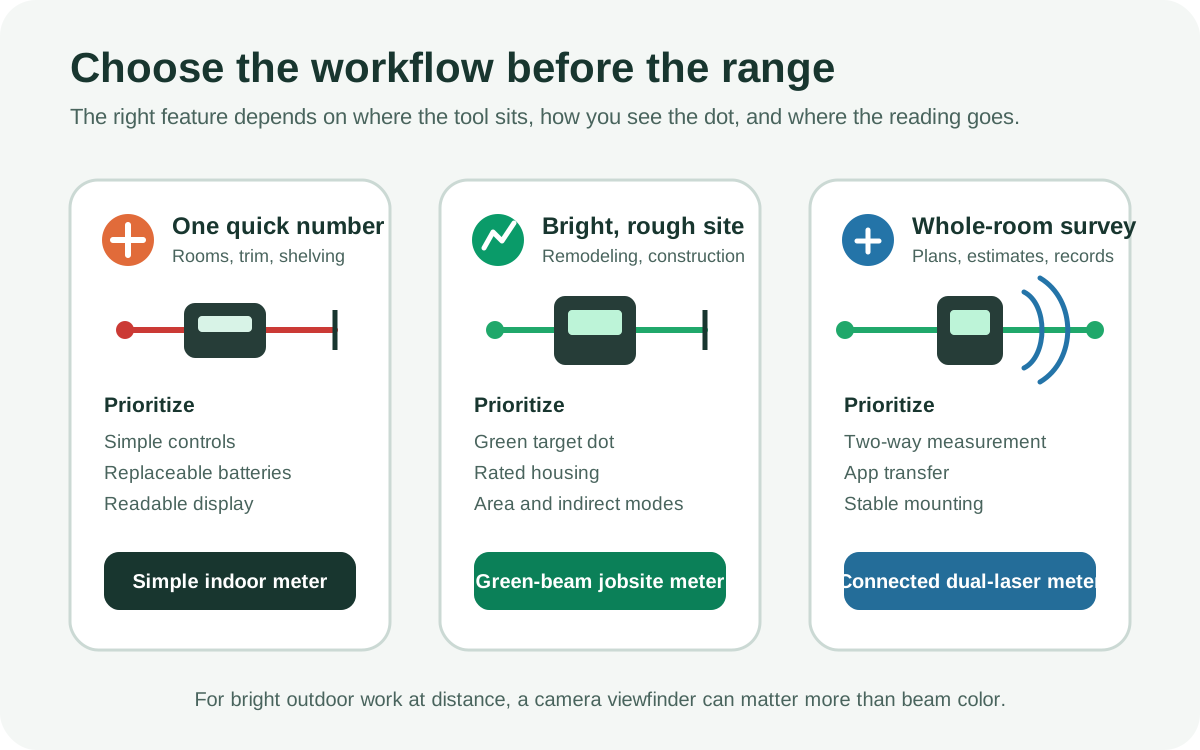
A laser distance meter is most useful when it removes a specific frustration: stretching a tape across a room alone, recording dozens of dimensions without transcription errors, or finding a laser dot on a bright jobsite. Those are three different problems, and the longest range on the box is rarely the deciding specification.
The Bosch GLM100-23 is the sensible choice for quick indoor measurements. It is compact, runs on replaceable batteries, and keeps the interface deliberately simple. The Bosch GLM165-25G is the better jobsite tool because its green beam is easier to see, its housing has an IP65 rating, and it adds area, volume, and indirect-measurement functions. The Huepar 395-foot dual-laser meter is the specialist option: it can measure in two directions from one position and send measurements to an app, which can speed up room surveys and layout work.
None of these is a true outdoor long-range instrument with a camera viewfinder. A brighter green dot helps, but sunlight, target color, distance, hand movement, and the angle to the surface still determine whether you can aim reliably.
Focused Gadgets has not physically tested these meters. This guide compares exact retail listings, manufacturer pages, and operating manuals. Accuracy, range, beam visibility, battery life, charging time, and app capabilities are manufacturer or seller claims, not our measurements.
Quick answer
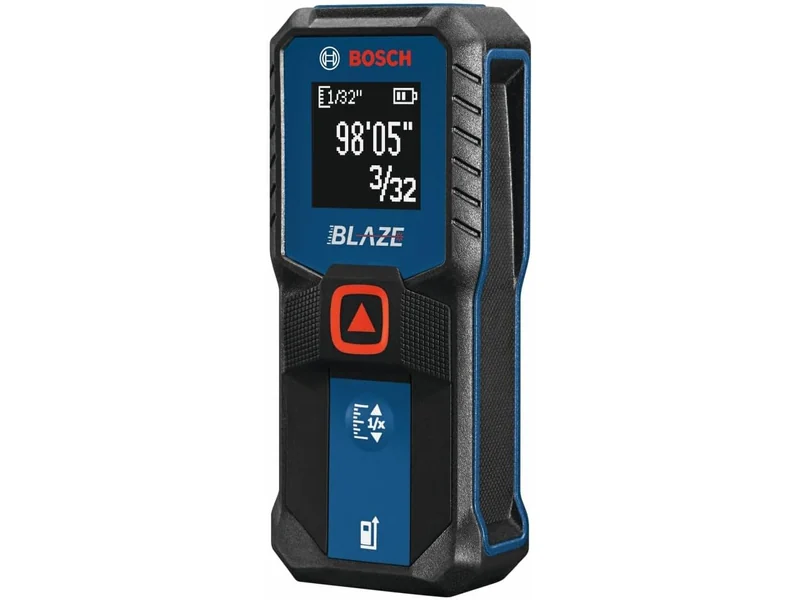
- Choose the Bosch GLM100-23 for uncomplicated indoor measuring. Its 100-foot red beam, two-button layout, live measurement, and rounding function cover rooms, trim, shelving, and estimate work without an app or a complex menu.
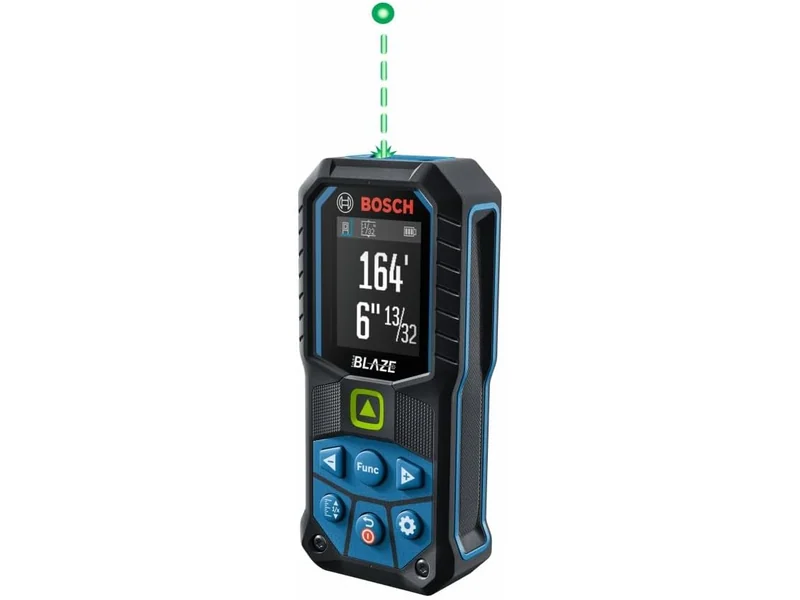
- Choose the Bosch GLM165-25G for a tougher tool and a more visible target. It combines a green beam, 165-foot stated range, IP65 housing, color screen, haptic confirmation, and eleven measuring functions. It is not Bluetooth-connected.
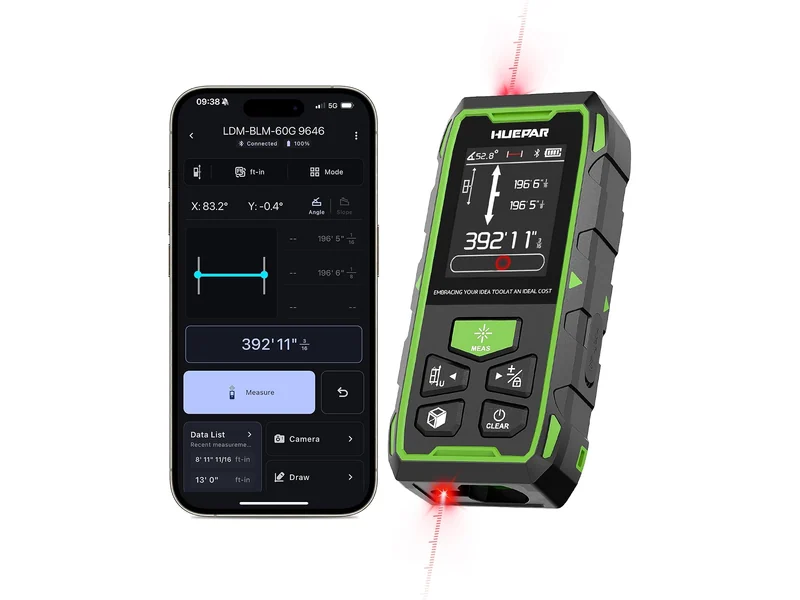
- Choose the Huepar dual-laser meter for room-center measurements and digital records. It measures forward and backward, connects to the Huepar app, stores up to 100 groups on the tool, and supports sketches, annotated photos, and project groups in the app.
- Skip all three for frequent full-range outdoor work in bright sun. Consider a model with a camera viewfinder and tripod support when the dot itself will be difficult to see.
- Do not treat a range claim as a promise for every surface. Dark, glossy, transparent, angled, or strongly lit targets can shorten usable range and increase uncertainty.
| Model | Beam and stated range | Connection | Best fit | Main trade-off |
|---|---|---|---|---|
| Bosch GLM100-23 | Red, up to 100 ft | None | Fast indoor dimensions and estimates | No area, volume, indirect measurement, Bluetooth, or published IP rating |
| Bosch GLM165-25G | Green, up to 165 ft | None | Construction and remodeling where visibility and durability matter | Costs more without adding app transfer or a camera viewfinder |
| Huepar 395-ft dual-laser meter | Dual green lasers, up to 395 ft total stated range | Huepar app | Room surveys, center-of-space measurements, and organized project records | More complex workflow; two-way accuracy claim is lower than its one-way claim |
Start with where you can place the tool
A conventional laser meter measures from one reference point to one target. For a wall-to-wall dimension, that normally means holding the meter against one wall and aiming at the other. This is fast when the reference surface is accessible and flat.
The Huepar changes that geometry. Its front and rear lasers can measure in opposite directions from a position inside the room. That is useful when furniture blocks a wall, when the middle of a hallway is easier to reach, or when repeated wall-to-wall dimensions would otherwise require crouching into corners. The current listing identifies the 395-foot version as model BLM-210GT and supports one-way or two-way operation.
Two lasers do not automatically mean higher accuracy. Huepar claims plus or minus 1/16 inch for one-way measurement and plus or minus 1/8 inch for two-way measurement. The second figure is the relevant one when the tool combines both directions. For cabinet fabrication, precision layout, or a legal survey, confirm dimensions with the method and instrument appropriate to the tolerance.
Visibility is not the same as outdoor usability
Bosch says the green dot from the GLM165-25G can appear up to four times brighter than a standard red beam. That can make a real difference in a sunlit interior, across unfinished framing, or against a target that gives a red dot little contrast.
It does not make the meter a viewfinder-equipped outdoor instrument. At distance in direct sun, the challenge is often locating the dot and holding it on the intended point, not whether the electronics can calculate the distance. A reflective target plate can help at modest distances, while a tripod reduces hand movement. For routine facade, roofline, or site measurements, an optical or camera viewfinder is the more important feature.
The GLM100-23 is best treated as an indoor meter. Its red beam and 100-foot range are adequate for most residential rooms, but Bosch publishes no IP rating for this model. The Huepar listing itself says the dual-laser version is best indoors or outdoors under cloudy conditions and advises avoiding bright direct sunlight.
Bluetooth is useful only when the record matters
The Huepar is the only connected meter in this comparison. Its app can receive readings, organize project groups, add notes and photographs, and build sketches. It can also trigger a measurement remotely, which helps when pressing the physical button would move the tool.
That workflow is valuable for an estimator, property manager, interior designer, or remodeler measuring many rooms. It is much less important when you need one number to cut a shelf. App pairing, permissions, phone battery, software support, and file export all become part of the tool’s usefulness.
Neither Bosch model here has Bluetooth. This distinction matters because similarly named BLAZE models do. The GLM165-25G should not be confused with Bosch’s connected GLM165-27C or GLM165-27CG variants. If measurements must flow into project software, verify the exact suffix before buying.
Bosch GLM100-23: best for simple indoor measurements
The GLM100-23 is the least complicated tool here. Bosch specifies a 100-foot range, plus or minus 1/16-inch accuracy under stated conditions, a red laser, and two AAA batteries. It weighs 0.19 pound and is small enough to live in a tool pouch or desk drawer.
Its interface is built around measuring and rounding. The display can show large numbers, continuous measurement updates as the tool moves, and the rounding button can present results from 1/2 inch down to 1/32 inch. That makes it approachable for room dimensions, flooring estimates, picture placement, shelving, and basic site notes.
The limitations are equally clear. Bosch lists no connection, no IP rating, and no area, volume, or indirect-measurement modes on the product page. A contractor who only records straight dimensions may prefer that simplicity; someone estimating paint, calculating room volume, or transferring readings to a floor plan will outgrow it quickly.
Choose the GLM100-23 when a clean, repeatable indoor distance matters more than extra functions. Skip it for wet or dusty work, app-based documentation, or bright outdoor targeting.
Bosch GLM165-25G: best for green-beam jobsite use
The GLM165-25G is the most robust choice of the three. Bosch specifies a 165-foot range, plus or minus 1/16-inch measuring accuracy under stated conditions, a green beam, an IP65 rating, and a full rubber overmold. The color screen and haptic confirmation are practical additions when a jobsite is noisy or the display needs to be read quickly.
It also expands the math. Bosch documents eleven measuring functions, including length, area, volume, indirect measurements, addition and subtraction, and stakeout. The rounding button remains available, and the tool can run from two AA batteries. A 1/4-inch tripod socket and included belt clip make it better suited to repeated field use than the smaller GLM100-23.
The important caveat is connectivity: Bosch lists this exact model as not connected. Buyers sometimes infer Bluetooth from its price, color display, or resemblance to nearby BLAZE variants. It has none. The green beam and tougher enclosure are what justify the step up.
Choose it for remodeling, construction, and property work where dust resistance, splash resistance, and a visible target matter. Skip it if app transfer is essential or if long outdoor shots routinely require a camera viewfinder.
Huepar dual-laser meter: best for app-connected room surveys
Huepar’s 395-foot model is the most unusual tool here. The listing specifies a 120-meter total measuring range in two-way mode, one-way and two-way switching, green beams, a rechargeable battery, USB-C charging, an auto-rotating display, a magnetic back, and a 1/4-inch threaded mount.
It also provides nine measurement modes, including length, area, volume, wall area, angle, continuous distance, and four Pythagorean calculations. The tool can retain up to 100 groups of measurements. Those features make sense for a survey in which the readings will become an estimate, drawing, or shareable record rather than one cut mark.
The dual-laser design is also its biggest reason to pause. A wall-to-wall figure can combine two directions, so the tool’s position, reference settings, and stability all matter. The seller claims about five hours of continuous runtime and a 1.5-hour charge, but those are not independent results. A built-in battery is convenient until the tool is flat; unlike the Bosch models, you cannot restore it immediately with common replacement cells.
Choose the Huepar when measuring from the middle of a room or sending readings into an app will save real time. Skip it if you want the simplest possible interface, replaceable batteries, or manufacturer documentation as mature and easy to locate as Bosch’s.
Accuracy depends on the measurement, not just the meter
All three listings use attractive accuracy figures, but a correct number still depends on a controlled setup.
- Select the right reference edge. A meter can measure from its front, rear, or tripod reference. The wrong setting introduces the length of the tool into every reading.
- Aim at a suitable target. Clear glass, glossy tile, dark fabric, a narrow pipe, and an angled surface may return a weak or misleading signal.
- Keep the tool square and stable. A diagonal line is longer than the perpendicular distance you intended to record. Use a tripod or firm support when the tolerance is tight.
- Repeat important measurements. A surprising number should be checked from the same reference and, when possible, confirmed with a second method.
- Record the context. Note whether a dimension is finished-wall to finished-wall, rough opening, trim edge, centerline, or an indirect calculation.
A laser meter can speed up documentation during a broader property inspection, but it does not diagnose what is behind a surface. Our home-inspection thermal-camera guide explains how temperature patterns can guide further checks, while the borescope guide covers direct viewing through a known-safe access path.
Who should skip these three
Skip these models if you regularly measure outdoors near their maximum range. A meter with a camera viewfinder, stronger tripod workflow, and documented outdoor targeting will be easier to use than chasing a dot you cannot see.
Skip the app-connected option if your organization cannot install its software, if project data should not leave an approved system, or if a plain written dimension is all you need. Conversely, skip both Bosch models if manual transcription is the bottleneck you are trying to remove.
Finally, a laser distance meter is not a surveying instrument and does not establish a property boundary. It also cannot replace a tape or rigid rule for every task. Short offsets, curved surfaces, inside cabinet dimensions, and cuts that need physical registration may still be faster and more trustworthy with a conventional measuring tool.
FAQ
Is a green laser distance meter better than a red one?
A green dot is generally easier to see, especially in brighter conditions. It does not automatically improve the underlying distance calculation or make the dot visible at maximum range in direct sunlight. Target contrast, stability, and a viewfinder can matter more outdoors.
Does the Bosch GLM165-25G have Bluetooth?
No. Bosch lists the GLM165-25G as not connected. Some similarly named Bosch models add Bluetooth, so check the complete model suffix rather than assuming every GLM165 variant has the same features.
Why would I want lasers at both ends?
Two-way measurement lets you stand inside a room or hallway and measure toward both endpoints without placing the tool against one wall. It can save repositioning, but the combined measurement carries the accuracy limits of the two-way mode.
Can these meters measure outside?
They can operate outside within their documented conditions, but seeing and holding the dot becomes difficult in bright sun. The Huepar listing specifically favors indoor or cloudy outdoor use, and neither Bosch model here has a camera viewfinder.
Is a laser meter accurate enough for cabinets or finish carpentry?
It can be useful for room dimensions and initial layout, but final fabrication should match the tolerance of the work. Confirm critical openings, diagonals, and cut dimensions with a suitable second method and make sure the meter’s reference edge is set correctly.
Bottom line
Buy the Bosch GLM100-23 when speed and simplicity are the point. Buy the Bosch GLM165-25G when a brighter green target, IP65 housing, and more measurement functions justify a larger investment. Buy the Huepar dual-laser meter when measuring from the center of a space and keeping app-based project records will change the workflow.
Do not buy by headline range alone. First decide where the tool can sit, how you will see the target, and where the reading needs to go after it appears on the screen.
Models discussed
Use these as starting points for checking fit. We do not publish a price or claim hands-on testing.
| Model | Format | Best fit | Trade-off |
|---|---|---|---|
| Huepar 395-Foot Dual Laser Distance Meter | 395-foot dual-green-beam app-connected laser meter | Room-center measurements and organized app-based project records | A more complex workflow, with a lower stated accuracy in two-way mode than in one-way mode |
| Bosch GLM100-23 Laser Measure | 100-foot red-beam indoor laser meter | Fast, uncomplicated indoor room dimensions and estimates | No Bluetooth, green beam, calculation modes, or published IP rating |
| Bosch GLM165-25G Green-Beam Laser Measure | 165-foot green-beam IP65 laser meter | Remodeling and jobsite work where target visibility and housing durability matter | No Bluetooth or camera viewfinder despite the higher price and expanded feature set |
Product reference
Huepar 395-Foot Dual Laser Distance Meter
Best for: Room-center measurements and organized app-based project records
Trade-off: A more complex workflow, with a lower stated accuracy in two-way mode than in one-way mode
Product reference
Bosch GLM100-23 Laser Measure
Best for: Fast, uncomplicated indoor room dimensions and estimates
Trade-off: No Bluetooth, green beam, calculation modes, or published IP rating
Product reference
Bosch GLM165-25G Green-Beam Laser Measure
Best for: Remodeling and jobsite work where target visibility and housing durability matter
Trade-off: No Bluetooth or camera viewfinder despite the higher price and expanded feature set
How this guide was researched
We compare documented product features against the job each buyer needs done. We have not physically tested these products. Check current specifications and availability with the manufacturer or merchant.
Affiliate disclosure: If you buy through a qualifying link, we may earn a commission at no extra cost to you.