
Kitchen waste • product review
Reencle Prime Review: Is It Worth Buying for Daily Food Scraps?
Our Reencle Prime review explains daily capacity, odor control, upkeep, compost curing, and who should—or should not—buy this microbial composter.
The Reencle Prime is one of the few kitchen appliances sold as an electric composter that actually maintains a living microbial culture. You can add suitable scraps throughout the day instead of filling a bucket and waiting for a heat-and-grind cycle. That makes it more convenient for a household that cooks often—but more demanding than its drop-in-and-forget marketing can imply.
Our verdict: Reencle Prime is worth considering if you produce a steady, moderate amount of food waste, have room for an always-on floor appliance, and will use or give away the cured output. Its continuous workflow is genuinely different from a batch food recycler. The trade-off is that you are maintaining a small biological system: feed quantity, moisture, airflow, carbon balance, filter condition, and harvesting habits all affect the result.
Focused Gadgets has not physically tested the Reencle Prime. This is a source-led review of the exact current product, based on Reencle’s product page and support documentation, the exact white and silver Amazon listings, and the manufacturer’s current operating guidance. We have not independently measured odor, noise, energy use, processing speed, or compost quality.
Quick verdict
- Best for: a one- to four-person household that creates regular food scraps and wants continuous microbial processing rather than batch dehydration.
- Main advantage: you can add appropriate scraps during normal use without waiting for a separate cycle to finish.
- Main compromise: healthy operation depends on restrained feeding, moisture checks, cleaning, and a plan for curing the harvested material.
- Choose another option if: your scraps arrive in occasional large loads, you have no use for the output, or you want an appliance that can be switched off between batches.
- Color choice: Star White and Iron Silver are finishes of the same Reencle Prime, not different performance tiers.
| Buying question | Reencle Prime answer | Practical meaning |
|---|---|---|
| Is it a dehydrator? | No; it uses a warm, aerated microbial bed | The system stays powered and needs biological balance |
| How much can it accept? | Up to 700 g is recommended daily; 1 kg is the stated maximum | The 14 L chamber is not a 14 L daily allowance |
| Can scraps be added anytime? | Yes, when the previous food has broken down and the bed is healthy | A wet or overloaded bed needs recovery time, not more food |
| Is the output ready for plants? | Not necessarily | Material for planting should be sifted, mixed, and cured before root contact |
| Does it need consumables? | The microbes reproduce, but the carbon filter needs periodic replacement or refill | Check filter supply and cost before buying |
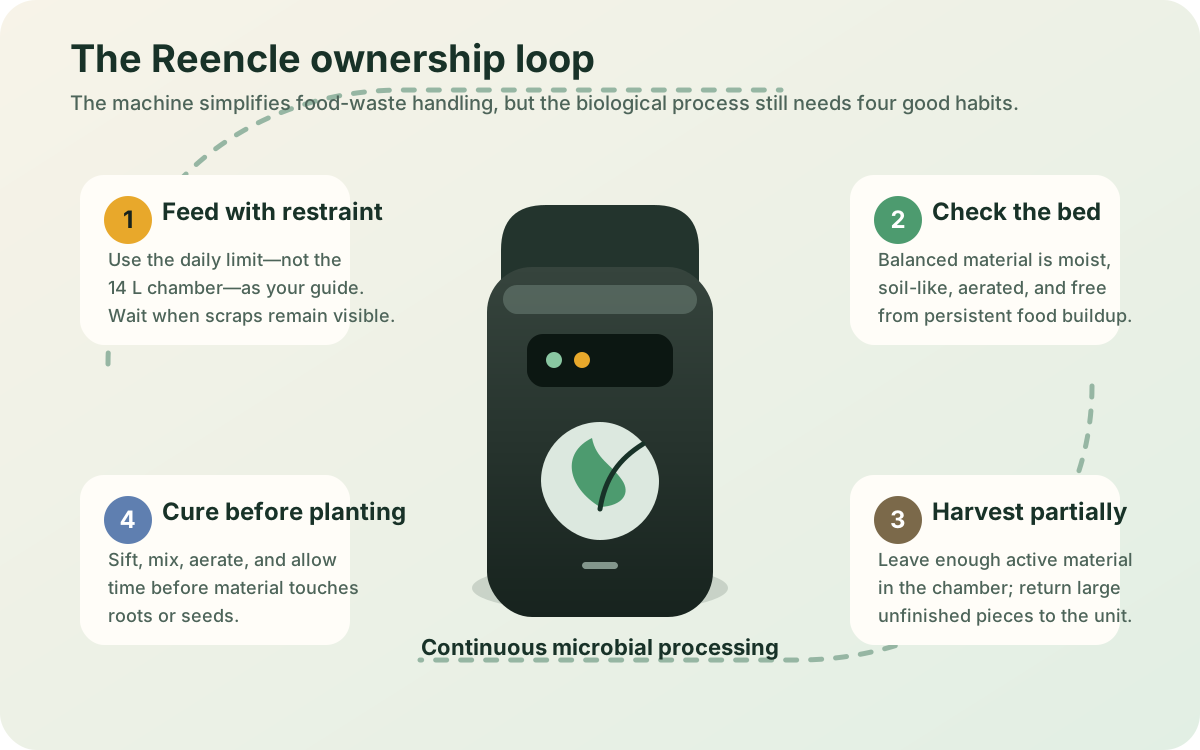
What makes Reencle Prime different?
Many countertop “composters” use heat and a grinding arm to dry food into a smaller material. Reencle Prime instead keeps a microbial bed warm and aerated while a stirring mechanism mixes new scraps into it. The machine runs continuously, and the microbes break down compatible food while the chamber gradually accumulates material.
That difference changes the purchase decision. A batch recycler is primarily a volume-reduction appliance. Reencle is closer to an indoor composting system with powered temperature, aeration, mixing, and odor control. It can produce biologically active material, but the owner has to keep the system within workable limits.
The benefit is a simpler daily gesture: open the small lid, add a suitable quantity, and let the system continue. The cost is ongoing attention. A dehydrator cannot have an unhealthy microbial bed; Reencle can. If you would rather run a defined cycle and wash a removable bucket, see our comparison of electric composters for apartments before choosing.
The 14-liter label is easy to misunderstand
The Prime’s chamber holds 14 liters, but chamber volume does not describe daily processing capacity. Reencle’s current support guidance recommends adding no more than 700 grams per day and lists 1 kilogram as the maximum. The company also advises waiting when previous food remains visible or the microbial bed is too wet.
This distinction matters more than the headline capacity. A household can produce several kilograms of scraps after meal preparation, a party, or a refrigerator cleanout. Physically fitting that load into the chamber does not mean the microbes can process it without odor, excess moisture, or strain on the stirring system.
The ideal household generates smaller amounts steadily. If your waste comes in occasional heavy bursts, you will need a second destination: municipal organics collection, an outdoor pile, a freezer container, or staged feeding. Buying a larger-looking chamber does not remove that bottleneck.
Reencle also says the material level should remain between its minimum and maximum marks. Removing everything would take away much of the active culture; letting the level climb too high can obstruct airflow or burden the mixing mechanism. Harvesting is therefore partial and periodic, not a full-bin emptying routine.
Setup takes hours; the microbial bed takes weeks to mature
Reencle’s current setup instructions call for a flat, stable, ventilated location, removal of the carbon-filter sticker, the full starter pack, and about 1.8 liters of water. The unit warms for several hours before its first small food input. The machine should remain powered during normal operation because turning it off cools the microbial bed and pauses decomposition.
Initial activation is not the same as a fully mature bed. Reencle says the starter material can take roughly two to four weeks, and sometimes longer, to develop its dark, soil-like texture. Feeding should increase gradually during that period. Treating the first week like full-capacity operation risks creating the exact wet, sour environment the filter is then expected to hide.
Before delivery, measure the actual operating space. The current specification is about 12 inches deep, 13 inches wide, and 18.4 inches high, with a weight of about 20.1 pounds. The main lid needs substantially more vertical clearance when opened. This is closer to a slim floor bin than a small countertop appliance, and it needs ventilation rather than a closed cupboard.
The small powered lid is designed for daily additions and opens for a short preset interval. The main lid is for setup, inspection, cleaning, and harvesting. Reencle warns against forcing the powered lid, so buyers should make sure children, guests, and cleaners understand how it works.
Daily use is easy only when feeding stays disciplined
Reencle accepts a broader food range than a conventional backyard pile, including many cooked foods, meat, fish, dairy, fruit, vegetables, rice, pasta, and bread. That flexibility is attractive in a kitchen. It is not permission to insert anything biodegradable.
Hard bones, shellfish shells, large pits, plastic, metal, glass, cleaning chemicals, and pet waste are prohibited. Frozen food should thaw first. Large or fibrous pieces take longer, while very wet fruit and excess liquids can push the bed out of balance. Oil should not be poured into the chamber, even though food with modest oily residue may be acceptable when the bed is healthy.
The most useful habit is to look before adding. Reencle’s squeeze test describes an ideal bed as dark and soil-like, able to hold together when squeezed and then crumble under a finger. Dripping material is too wet; dusty, immediately crumbling material is too dry. Those conditions should be corrected before another wet bowl of scraps goes in.
Dry bread, crackers, cooked rice, or small pieces of unbleached paper can add carbon and absorb moisture when used according to the guidance. High-moisture scraps are better added when the bed is already stable. The appliance reduces the effort of composting, but it does not repeal the relationship between water, carbon, nitrogen, oxygen, and microbes.
Odor control is not the same as odor immunity
Reencle routes air through activated carbon and markets the Prime for indoor use. The filter is an important part of the design, but it cannot compensate indefinitely for an overloaded, wet, dirty, or imbalanced chamber.
The Prime has a Purify function that increases fan speed for 24 hours. Reencle describes it as a supplementary odor-control tool, not a cure for the underlying cause. A strong smell may require correcting moisture, adding an appropriate carbon source, cleaning the inner surfaces and mesh, or replacing exhausted filter media.
The Dry function similarly runs for 24 hours with increased airflow and slightly higher internal temperature. It can help with excess moisture, but Reencle explicitly warns that it is not an instant recovery button for a severely wet bed. That is a valuable reality check: the labeled button helps an operating system; it does not make chronic overfeeding harmless.
Reencle currently estimates carbon-filter life at roughly nine to twelve months. Actual life varies with use, internal cleanliness, moisture, and mesh condition. There is no automatic replacement alert, so an odor near the rear vent is one cue to inspect the filter. Prospective buyers should confirm the current price and availability of replacement media rather than treating the purchase price as the complete ownership cost.
How much electricity does it use?
The manufacturer’s current specification lists 130 watts maximum and about 52 watts average. Reencle has also estimated approximately 1.25 kWh per day in its support material. These are company figures, not measurements from our home.
At the stated daily estimate, annual consumption would be roughly 456 kWh if the usage pattern remained constant. Your cost depends on the local electricity tariff, and real consumption can change with room temperature, moisture, fan use, and operating conditions. Multiply the current local cost per kWh by 1.25 for a rough daily estimate rather than relying on an old dollar figure from a review.
This always-on pattern is the clearest economic difference from a batch recycler. Reencle’s convenience comes from keeping the microbial environment active around the clock. If you produce only one small bucket of scraps every week, the continuous energy and floor-space commitment may be difficult to justify.
The output still needs a plan
Reencle’s biological process is more compost-like than simple dehydration, but freshly harvested material should not automatically be poured around roots or used as potting soil. Because new food is added continuously, one scoop can contain particles at different stages of breakdown.
For planting use, Reencle’s current guidance recommends sifting the harvest, mixing approximately one part Reencle material with four parts soil, and curing it in a breathable container for about three to four weeks. The mix should be aerated during curing and should develop an earthy smell rather than a sour one. Oversized or recognizable pieces can return to the machine.
The company gives a separate method for using material as a thin mulch layer, but that is not the same as placing fresh output directly against seeds or roots. Salt, acidity, incomplete decomposition, and heat from continued microbial activity can all matter. Start with a small test area rather than risking a valued plant.
This is the purchase question many reviews skip: where will the output go? A gardener with beds, containers, or a community plot can use it after proper preparation. An apartment resident without plants may simply trade a wet-food disposal problem for a container of material that still needs a destination.
Cleaning and troubleshooting are part of ownership
The Prime does not require emptying and scrubbing after every cycle, but it is not maintenance-free. The mesh and internal surfaces need to remain clear enough for airflow. Condensation, residue, and material near the intake areas should be addressed before they become odor or mechanical problems.
Reencle’s support library is a strength. It documents wet and dry microbial recovery, odor causes, filter maintenance, blinking-button faults, leakage, lid behavior, and several replaceable parts. Publishing repair procedures is more reassuring than selling an appliance with only a marketing page.
It also reveals the system’s complexity. A fan fault, blocked mesh, stressed stirring assembly, damaged lid mechanism, or collapsed microbial bed requires diagnosis. Some repairs should follow support guidance rather than improvised disassembly. Keep the order information and serial number accessible, and review the current warranty terms for the seller you use.
Current Reencle help material advertises a home-trial period and warranty coverage, but terms can depend on purchase date, country, seller, and product condition. Older policy pages may not match newer summaries. Confirm the applicable return window and warranty in writing at checkout, especially when purchasing through a marketplace seller.
White versus silver Reencle Prime
The catalog includes Star White and Iron Silver listings for Reencle Prime. Amazon identifies them as color variations under the same product family, and Reencle’s model guide also shows Prime in two finishes. Capacity, dimensions, power requirements, and operating method are the same.
Choose by room fit, current seller, and applicable return terms—not by assuming one color is a newer or stronger machine. Verify the color and exact model shown in the cart before paying. Bundles may include different accessories, but a different bundle is not a different composting mechanism.
Both finishes are included in the model section below so buyers can check the current offer for the color they want. They should not be counted as two ranked recommendations.
Reencle Prime versus Vitamix FoodCycler FC-50
The Vitamix FoodCycler FC-50 is the relevant alternative when the goal is reducing the volume of wet scraps rather than maintaining a living compost system. It dries, grinds, and cools one removable-bucket load at a time. The output is dry food compound, not finished compost.
| Priority | Reencle Prime | Vitamix FoodCycler FC-50 |
|---|---|---|
| Workflow | Continuous microbial processing | Closed batch cycle |
| New scraps during operation | Yes, within feeding and bed-condition limits | No; wait for the current cycle |
| Biological care | Required | Not required |
| Placement | Larger, always-on floor-style appliance | Shorter batch appliance with ventilation clearance |
| Output | Active material that should be sifted and cured for planting | Dry compound that needs an appropriate disposal or soil plan |
| Best buyer | Frequent cook with a use for cured output | Buyer prioritizing volume reduction and a defined cycle |
Choose Reencle if continuous input and biologically processed output are the reasons you are shopping. Choose FoodCycler if you prefer a predictable batch routine and do not want to manage microbes. Choose neither when municipal food-waste collection, a freezer container, or an outdoor composter solves the problem more simply.
Who should buy the Reencle Prime?
Buy it if your household creates modest food scraps most days, you are willing to glance at the microbial bed before feeding, and you have a realistic use for cured output. It also suits someone who dislikes holding a full scrap bucket until a batch appliance is ready.
Skip it if you expect to load an entire refrigerator cleanout at once, travel frequently without a maintenance plan, have no ventilated floor space, or want to switch the appliance off between occasional uses. It is also a poor fit for anyone who will treat the carbon filter as a substitute for cleaning and feed control.
Price-sensitive buyers should calculate more than the checkout total. Include electricity, filter media, possible microbial replacement after a major failure, and the value of the floor space. A sealed collection caddy can be the better buy when local organics pickup is convenient.
Return-window setup checklist
- Confirm the carton and rating label identify Reencle Prime in the ordered color.
- Measure the permanent location, including main-lid clearance and ventilation.
- Confirm the carbon-filter shipping seal has been removed before operation.
- Follow the current starter-and-water instructions rather than copying an older video.
- Learn the minimum and maximum material levels before the first harvest.
- Increase feeding gradually and weigh a typical day of scraps at least once.
- Practice the squeeze test after the bed begins to look soil-like.
- Locate current filter replacements and save the applicable warranty terms.
- Decide where harvested material will cure in a breathable container.
- Contact support promptly if lights, fan behavior, leakage, or stirring do not match the manual.
Frequently asked questions
Is Reencle Prime a real composter?
It uses microbes to biologically break down compatible food, unlike appliances that only heat and grind a batch. However, continuously harvested material may still contain incompletely processed particles and should be sifted and cured before planting use.
How much food can Reencle Prime process per day?
Reencle currently recommends up to 700 grams per day and lists 1 kilogram as the maximum. Bed condition matters: do not keep feeding to the limit when visible food remains or the material is too wet.
Does Reencle Prime smell?
The appliance uses an activated-carbon filter and controlled airflow, but no indoor biological system is immune to odor. Excess moisture, overfeeding, dirty surfaces, poor carbon balance, blocked airflow, or exhausted filter media can create smells that require correction.
Can Reencle Prime be turned off at night?
It is designed to remain powered during normal use so the bed stays warm and aerated. Turning it off cools the system and pauses decomposition. Buyers seeking intermittent operation should consider a batch appliance or non-powered collection method.
Do the microbes need regular replacement?
The culture is intended to reproduce during healthy operation, so scheduled microbial refills are not part of the normal routine. A severely damaged or liquefied bed may require recovery steps or replacement, which is why feed and moisture control matter.
Can Reencle compost meat and dairy?
Reencle’s current feed guide allows many meat, fish, and dairy scraps in moderate, suitably prepared amounts. Hard bones, shellfish shells, excess liquid, and large difficult pieces are excluded. Follow the current exact-model guidance rather than general backyard-compost rules.
Is the silver Reencle Prime different from the white model?
No meaningful performance difference is documented. Iron Silver and Star White are color variants of the same 14-liter Prime platform. Compare the current seller, bundle, return terms, and availability.
Bottom line
Reencle Prime earns consideration because it solves a real workflow problem: it accepts suitable scraps continuously and uses a living process rather than waiting for a dry-and-grind batch. For a frequent cook who will manage the bed and use the cured material, that can be more useful than a smaller recycler.
The same design makes it a poor impulse purchase. Its 14-liter chamber does not erase a 700-gram recommended daily limit, the filter does not eliminate the need for balance and cleaning, and the output does not bypass curing. Buy it for the continuous microbial workflow—and only after deciding that the daily habit, operating space, energy use, maintenance, and compost destination fit your home.
Models discussed
Use these as starting points for checking fit. We do not publish a price or claim hands-on testing.
| Model | Format | Best fit | Trade-off |
|---|---|---|---|
| Reencle Prime 14 L Electric Composter — White | 14 L continuous microbial composter | Steady daily scraps and gardeners willing to cure the output | Large always-on system that needs microbial care and curing |
| Reencle Prime Electric Composter 14L Silver | 14 L continuous microbial composter — Iron Silver | Steady daily scraps and gardeners willing to cure the output | Large always-on system that needs microbial care and curing |
| Vitamix FoodCycler FC-50 Food Recycler | 2.5 L batch dry-and-grind food recycler | Reducing wet food waste to a smaller dry compound | Four- to eight-hour locked batch; output is not finished compost |
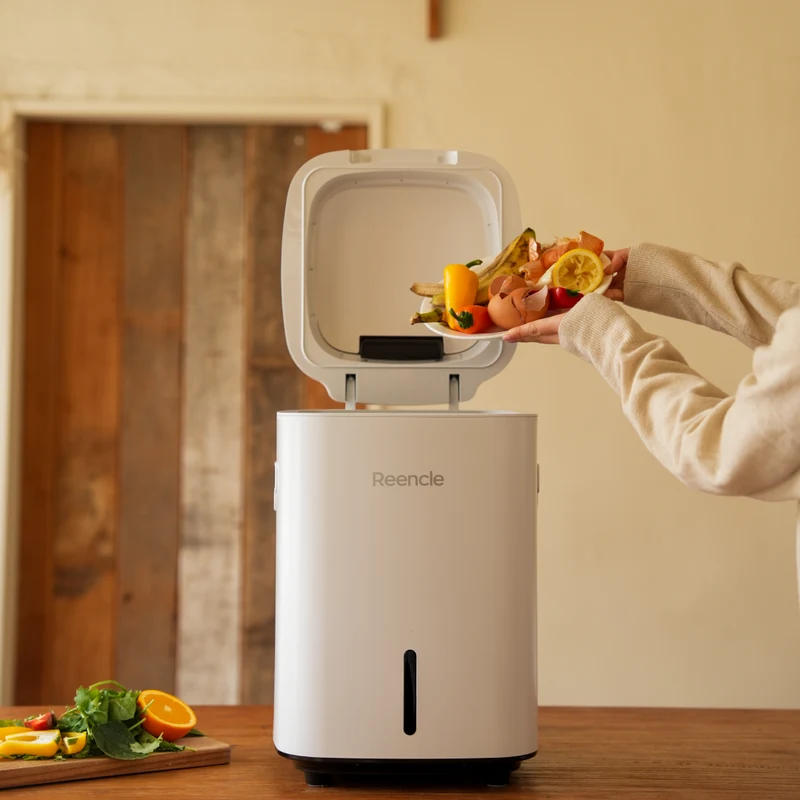
Product reference
Reencle Prime 14 L Electric Composter — White
Best for: Steady daily scraps and gardeners willing to cure the output
Trade-off: Large always-on system that needs microbial care and curing
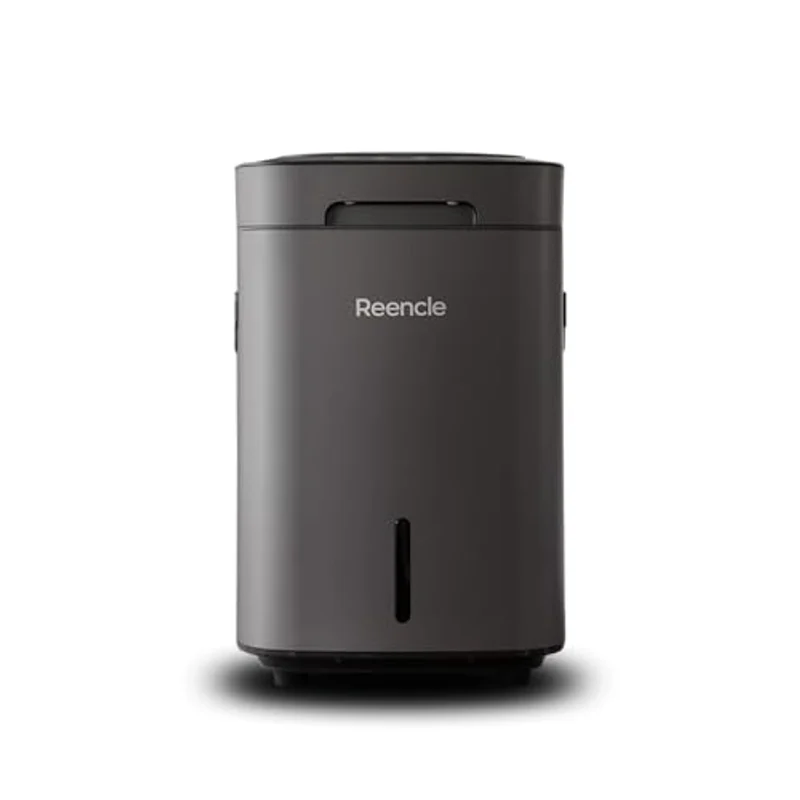
Product reference
Reencle Prime Electric Composter 14L Silver
Best for: Steady daily scraps and gardeners willing to cure the output
Trade-off: Large always-on system that needs microbial care and curing
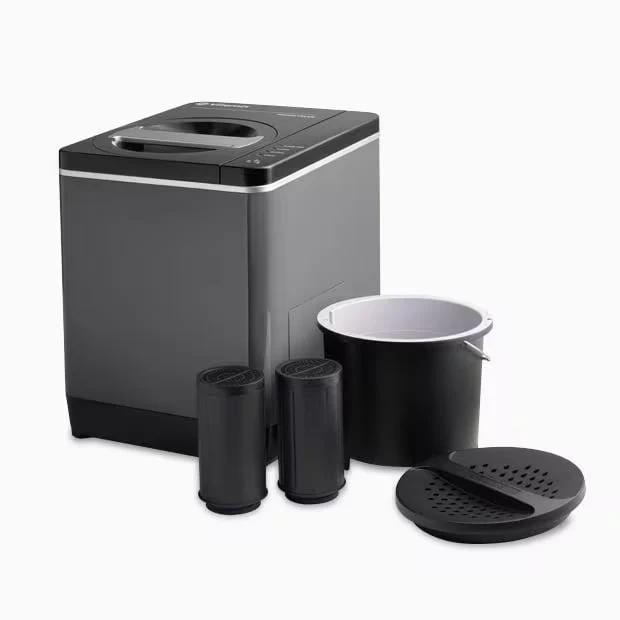
Product reference
Vitamix FoodCycler FC-50 Food Recycler
Best for: Reducing wet food waste to a smaller dry compound
Trade-off: Four- to eight-hour locked batch; output is not finished compost
How this guide was researched
We compare documented product features against the job each buyer needs done. We have not physically tested these products. Check current specifications and availability with the manufacturer or merchant.
Affiliate disclosure: If you buy through a qualifying link, we may earn a commission at no extra cost to you.