
Kitchen waste • buying guide
Best Electric Composters for Apartments: Drying vs. Continuous Processing
Compare the Reencle Prime and Vitamix FoodCycler FC-50 by process, capacity, output, space, maintenance, and apartment practicality.
“Electric composter” can describe two appliances that solve different problems. One keeps a living microbial culture warm and aerated while you add scraps throughout the day. The other locks a bucket, heats and grinds one batch, then leaves a dry material that takes less room in the trash or can be incorporated carefully into soil.
That distinction matters more than the word composter on the box. The Reencle Prime is a 14-liter continuous biological processor. The Vitamix FoodCycler FC-50 is a 2.5-liter batch food recycler with dry, grind, and cool stages. Both can reduce the wet, smelly food sitting in an apartment bin, but only one maintains an active biological process—and neither removes the need for a sensible destination for its output.
Focused Gadgets has not physically tested these machines. This is a source-based comparison using the exact Amazon ASINs, current manufacturer pages, manuals, support documentation, and compost-industry guidance. Noise, odor, processing time, and output quality will vary with the scraps added, loading habits, maintenance, room conditions, and filter condition.
Quick answer
- Choose the Reencle Prime when you want continuous input and intend to use the output in a garden or planter. It accepts food throughout the day, has a recommended daily input of 0.7 kg, and uses microbes rather than a heat-and-grind batch. It is large, remains powered, needs a healthy moisture balance, and its harvested material still needs roughly three to four weeks of curing before direct contact with roots or seeds.
- Choose the Vitamix FoodCycler FC-50 when reducing scrap volume is the main job. Its removable 2.5-liter bucket suits a smaller kitchen, and a batch runs automatically through drying, grinding, and cooling. The result is recycled food compound, not finished compost. Each cycle takes four to eight hours according to the manual, and the machine cannot accept more scraps while it is running.
- Choose neither if your municipality already collects food waste conveniently. A sealed caddy, freezer container, or regular collection may solve the odor problem with less expense and electricity. These machines are easiest to justify when wet scraps otherwise sit indoors for days and you have a clear plan for the processed material.
| Question | Reencle Prime | Vitamix FoodCycler FC-50 |
|---|---|---|
| Process | Continuous microbial decomposition | Batch drying, grinding, and cooling |
| Practical input limit | 0.7 kg recommended per day; 1 kg maximum | One 2.5 L bucket per cycle; do not pack above the fill line |
| Cycle behavior | Add suitable scraps throughout the day | Locked batch lasting 4–8 hours |
| Size | 305 × 331 × 467 mm; 730 mm with main lid open | 280 × 320 × 360 mm; allow 150 mm clearance around it |
| Weight | 9.1 kg | Approximately 9 kg |
| Output | Biologically active material that may need sifting and curing | Dry recycled food compound that is not finished compost |
| Ongoing care | Manage the microbial bed, clean mesh and lid, replace carbon media | Wash bucket, avoid jams, replace carbon filters |
| Best fit | Continuous household scraps plus access to soil or plants | Compact batch volume reduction and easier scrap storage |
The first decision is what you want the output to become
The United States Composting Council draws a useful line: heating and dehydrating food waste does not, by itself, perform biological decomposition or create compost. That does not make a dehydrator useless. It makes it a volume-reduction appliance whose dry output still needs an appropriate next step.
Vitamix calls the FC-50 material “recycled food compound.” Its manual recommends mixing one part compound with eleven parts soil, waiting one to four weeks before planting, watching sodium content, and keeping compound containing animal protein out of soil. Alternatively, the dried material can go through the waste route allowed by local rules. The important point is that a smaller pile is not automatically finished compost.
Reencle uses a living microbial system, so it is closer to indoor composting. The qualification is timing. Because new food is added continuously, a scoop can contain material at different stages of decomposition. Reencle recommends sifting harvested material and curing it for about three to four weeks before it touches roots or seeds. The company allows immediate use as a thin mulch layer under specific instructions, but apartment gardeners should not treat fresh output as potting soil.
If you have no plants, community garden, outdoor curing container, or collection route, decide where either output will go before buying. A machine can change the form of food waste; it cannot make disposal logistics disappear.
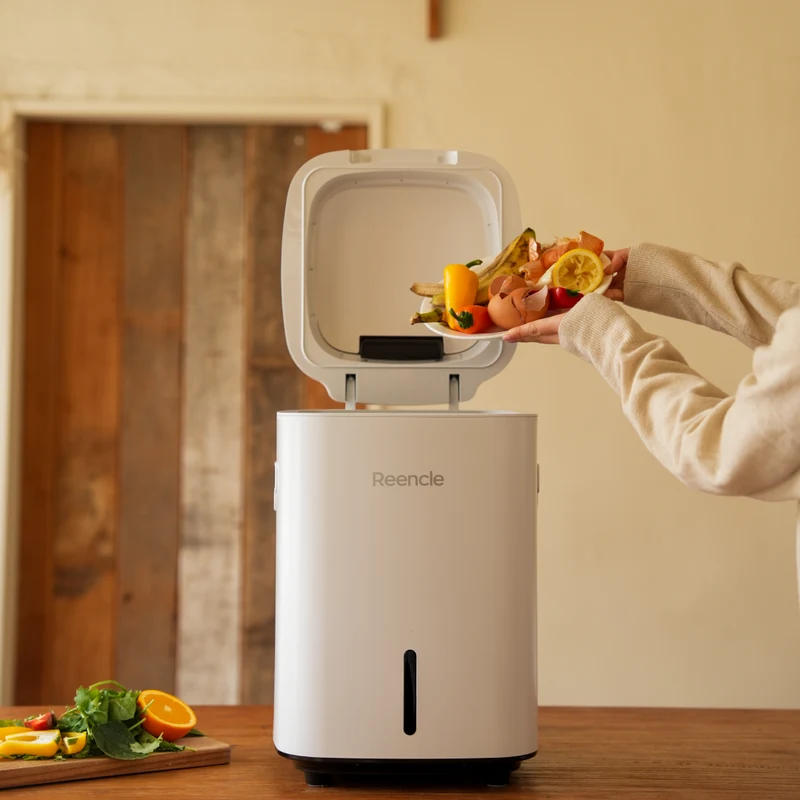
Reencle Prime: better for continuous processing
Reencle Prime behaves more like a small living system than a countertop cycle appliance. After the starter culture is established, suitable scraps can be added as they accumulate. A mixing arm aerates the material while controlled warmth supports the microbes. That workflow avoids keeping a second bucket full while waiting for a cycle to finish.
The 14-liter chamber is not a promise that fourteen liters of new scraps can be loaded at once. Reencle’s current support documentation recommends no more than 0.7 kg per day and lists 1 kg as the maximum. A large dinner-party cleanup can therefore exceed the biological system’s daily appetite even when physical space remains in the chamber.
The machine measures roughly 305 mm wide, 331 mm deep, and 467 mm high. Opening the large lid raises the required height to 730 mm. At 9.1 kg, it is closer to a small floor-standing bin than an appliance you will move whenever the counter is needed. Measure under-cabinet clearance and the foot-sensor path, not just the base footprint.
Reencle states average power consumption of 52 W and estimated energy use of 1.25 kWh per day. That is a manufacturer figure rather than our measurement, but it makes the ownership pattern clear: the unit stays active rather than drawing power only for an occasional batch. Its carbon filter is listed for replacement or refilling every nine to twelve months, with actual life depending on the microbial balance, internal cleanliness, and mesh condition.
Food rules are part of the routine. The current feed guide permits many cooked foods and small soft bones, but excludes large or hard bones, hard shells, long fibrous material unless prepared appropriately, excess liquid, oil, and non-food items. Oversized or difficult scraps can stress the stirring system or remain visible in the output. A varied diet and controlled moisture matter more here than pressing one button.
Reencle Prime comes in white and silver. They are color variants of the same machine, not two recommendations. Our detailed Reencle Prime review explains the daily feeding, moisture control, filter care, energy use, harvesting, and curing routine before you buy.
Vitamix FoodCycler FC-50: better for compact batch reduction
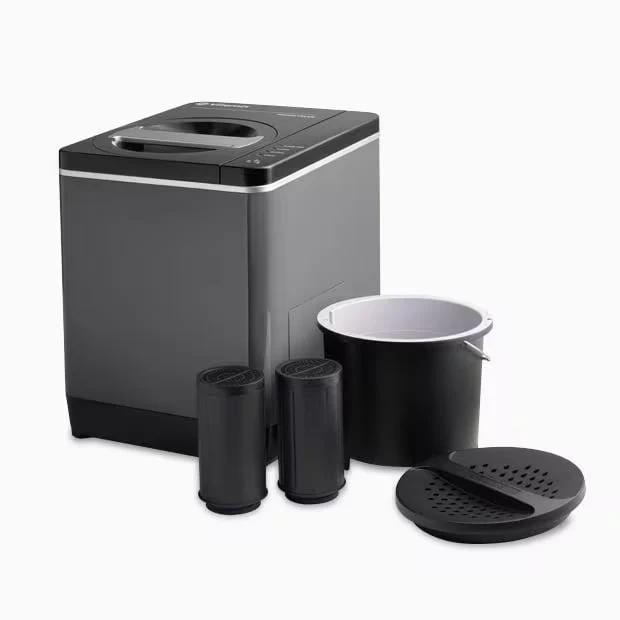
The FC-50 is simpler to understand. Fill the removable bucket without crossing its line, install it, lock the processing lid, and start a dry-grind-cool sequence. The manual lists a four- to eight-hour processing time. Once it starts, the batch owns the machine until it finishes; new scraps need to wait elsewhere.
Its 2.5-liter bucket is much smaller than Reencle’s chamber, but the comparison is not one-for-one. FoodCycler capacity is per batch, while Reencle capacity is governed by daily microbial processing. The FC-50 can run more than once a day if each batch follows the loading and cooling instructions. The practical limit becomes how often you want to run, empty, cool, and clean it.
The FC-50 measures about 280 mm wide, 320 mm deep, and 360 mm high and weighs roughly 9 kg. Vitamix requires at least 150 mm of clearance from walls and surrounding surfaces for ventilation. It is shorter than Reencle and easier to place beneath many cabinets, though the surrounding clearance and 500 W electrical rating still rule out squeezing it into a closed cupboard during operation.
The removable bucket is dishwasher-safe after it cools, which is useful when greasy residue builds up. The trade-off is recurring handling and filter maintenance. Two activated-carbon filters manage processing odors, and the machine signals when they need replacement. The collection lid has its own filter for holding scraps outside the machine, but the manual warns against leaving decomposing waste enclosed for long periods.
Hard pits, large beef or pork bones, nuts, shells, candy, gum, excess liquid, and items larger than a palm can jam or damage the system. The manual also warns that overpacking the bucket can cause an overload. A grinder is not permission to feed it everything that fits through the opening.
Which is easier in an apartment?
For daily interaction, Reencle is easier: open, add an appropriate amount, close. For placement and ownership, FoodCycler is easier: it is shorter, operates only when a batch is started, and its microbial health cannot be upset because it has no living culture.
Odor claims deserve restraint. Both manufacturers use carbon filtration, but neither can make poor maintenance irrelevant. Food left too long, overloaded chambers, spent carbon, dirty mesh, excessive moisture, or an unhealthy microbial bed can all change what reaches the room. “Odor controlled” is more credible than “odorless forever.”
Noise also differs in character. Reencle publishes an average figure of 28 dB, but its motor and mixing arm operate periodically. Vitamix provides no comparable numerical noise specification in the current product material; drying airflow and grinding occur within a defined batch. If a studio apartment doubles as a bedroom, placement and operating schedule deserve more attention than either brand’s quiet-language marketing.
The two machines weigh almost the same, yet Reencle occupies more vertical space and stays in service. FoodCycler’s bucket can collect scraps separately while the main unit is stored elsewhere, although that adds another object to the kitchen routine. Neither is a tiny appliance.
Ongoing cost and maintenance are part of the purchase
Both products depend on activated carbon. Reencle currently specifies a nine- to twelve-month replacement interval for Prime’s carbon media. Vitamix uses two processing filters plus a filtered collection lid and sells replacements separately. Actual frequency depends on use; compare current filter availability and cost before ordering rather than treating the purchase price as the full ownership cost.
Reencle also asks you to maintain the process: keep material above its minimum line, avoid overfeeding, manage moisture, clear the mesh, sift harvested output, and cure material intended for planting. FoodCycler asks for more batch labor: move the bucket, respect cooling time, empty the compound, wash the bucket, and repeat.
Neither maintenance pattern is universally easier. Choose the one that matches the habit you are more likely to keep after the novelty wears off.
Which electric composter should you buy?
Buy the Reencle Prime if food waste arrives steadily, you want to add scraps without waiting for a batch, and you have a useful destination for cured biological output. Its larger physical presence and continuous energy use make sense only if the continuous workflow matters.
Buy the Vitamix FoodCycler FC-50 if your priority is turning a bucket of wet scraps into a smaller, dry material on demand. It is the clearer choice for occasional batches, but calling its output finished compost skips the most important limitation.
Buy neither if weekly organics collection already works, counter or floor space is scarce, or processed output will simply create a second disposal problem. A freezer container can prevent smells until collection day; a conventional outdoor bin handles much more material for less money; vermicomposting can work indoors for households willing to maintain worms and accept a narrower feed list.
Prices, filters, bundles, and availability change. Before buying, confirm the exact model, color, current warranty, replacement-filter supply, electrical requirements, clearance, and accepted-food instructions. The white and silver Reencle listings are finishes of the same Prime platform; the FC-50 should not be confused with Vitamix’s larger Eco 5.
Frequently asked questions
Do electric kitchen composters make real compost?
Not all of them. Heat-and-grind recyclers such as the FC-50 dry and reduce food; their output needs further biological breakdown or careful soil incorporation. Reencle uses microbes, but newly harvested material can still contain incompletely processed scraps and should be sifted and cured before direct root or seed contact.
Can the Reencle Prime sit on a countertop?
It can, if the counter supports its 9.1 kg weight and provides enough room. The main lid needs about 730 mm of total height when open, making under-cabinet placement awkward in many kitchens. Its footprint and always-on workflow often suit a floor position better.
Can the FoodCycler FC-50 process meat and bones?
The manufacturer permits some meat, fish, poultry scraps, and small chicken or fish bones, but prohibits large hard bones and other jam-prone materials. Its manual also says recycled compound containing animal protein should not be incorporated into soil.
Can I add scraps while either machine is working?
Reencle is designed for continuous additions within its daily limit. The FC-50 is a closed batch system; keep new scraps in its collection bucket or another container until the active cycle finishes.
Which model is better for someone without a garden?
FoodCycler is usually the more direct volume-reduction tool, but only if the dry output has an accepted trash, organics, or community-compost route. Reencle’s main advantage is less compelling when there is nowhere to cure or use the harvested material.
Models discussed
Use these as starting points for checking fit. We do not publish a price or claim hands-on testing.
| Model | Format | Best fit | Trade-off |
|---|---|---|---|
| Reencle Prime 14 L Electric Composter — White | 14 L continuous microbial composter | Steady daily scraps and gardeners willing to cure the output | Large always-on system that needs microbial care and curing |
| Vitamix FoodCycler FC-50 Food Recycler | 2.5 L batch dry-and-grind food recycler | Reducing wet food waste to a smaller dry compound | Four- to eight-hour locked batch; output is not finished compost |
Product reference
Reencle Prime 14 L Electric Composter — White
Best for: Steady daily scraps and gardeners willing to cure the output
Trade-off: Large always-on system that needs microbial care and curing
Product reference
Vitamix FoodCycler FC-50 Food Recycler
Best for: Reducing wet food waste to a smaller dry compound
Trade-off: Four- to eight-hour locked batch; output is not finished compost
How this guide was researched
We compare documented product features against the job each buyer needs done. We have not physically tested these products. Check current specifications and availability with the manufacturer or merchant.
Affiliate disclosure: If you buy through a qualifying link, we may earn a commission at no extra cost to you.