
Backyard discovery • product review
Humbirdy 4K Bird Feeder Review: Is No Subscription the Better Buy?
The Humbirdy SH66 promises 4K video, local storage, free bird ID, and no monthly fee. See where it looks strong—and what buyers should verify.
The Humbirdy SH66 4K Ultra AI Bird Feeder has a persuasive answer to the most frustrating smart-feeder question: the manufacturer says bird identification and local recording work without a monthly subscription. It combines that ownership model with dual-band Wi-Fi, a solar panel, a metal enclosure, and a camera designed for high-resolution clips.
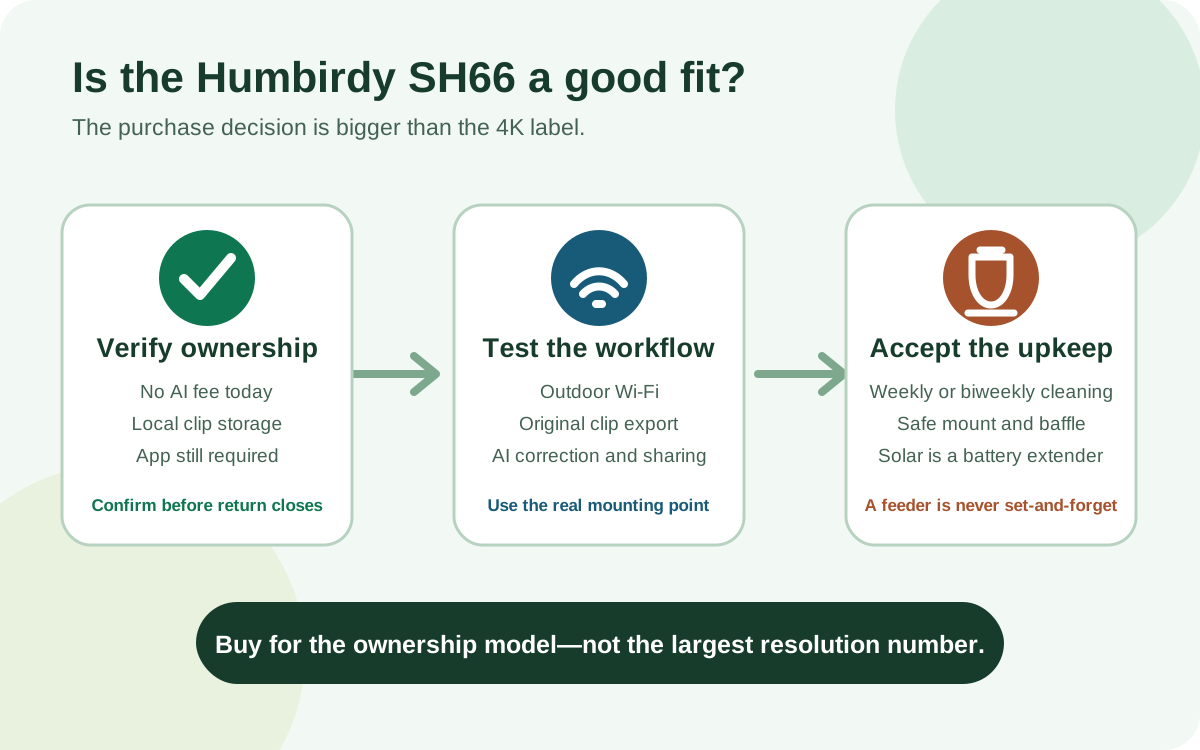
That makes the SH66 one of the more interesting Birdbuddy alternatives, but not an automatic winner. Its value depends on the companion app remaining supported, the camera receiving usable Wi-Fi at the feeder, and the owner being willing to clean a tray-style feeder regularly. The advertised 4K and AI labels are less important than those everyday realities.
Our verdict: the Humbirdy SH66 is a promising no-subscription choice for buyers who prioritize local storage and want to avoid an ongoing AI fee. We would choose it over a generic marketplace feeder because Humbirdy now provides an exact model page, app, support material, and contact route. Birdbuddy remains the safer ecosystem choice for buyers who value a more established support library and do not mind cloud dependence.
Focused Gadgets has not physically tested the Humbirdy SH66. This review is based on the exact current manufacturer and Amazon listings, the official support material, the current iOS app record, and independent bird-feeding guidance. Image-quality, detection-range, battery-runtime, AI-accuracy, and weather-resistance claims have not been independently verified by us.
Quick verdict
- Best fit: a buyer who wants automatic feeder clips, free AI identification, and local storage without committing to a subscription.
- Main advantage: the ownership proposition is clearer than it is for many marketplace-only feeders.
- Main compromise: the experience still depends on Humbirdy’s app, firmware, and support even when recordings are stored locally.
- Most important setup check: confirm strong 2.4GHz or 5GHz Wi-Fi where the feeder will hang; test the complete workflow before the return window closes.
- Most important care requirement: the electronics must not turn a routine feeder-cleaning job into something you postpone.
| Buying question | Humbirdy SH66 answer | Why it matters |
|---|---|---|
| Is a paid plan required? | Humbirdy says AI identification has no subscription fee | The headline ownership cost is easier to predict |
| Where are clips stored? | The exact listing says the camera has built-in local storage | Local storage reduces dependence on a paid cloud archive, but the app is still part of access and sharing |
| Does it support 5GHz Wi-Fi? | The SH66 documentation says 2.4GHz and 5GHz | Dual-band support can simplify setup on modern combined networks |
| Is the camera weather-rated? | Humbirdy claims IP66 protection | This is a manufacturer claim, not proof of every mounting or weather scenario |
| Is it squirrel-proof? | No; Humbirdy explicitly says no feeder is completely squirrel-proof | Placement and a suitable baffle matter more than the metal housing alone |
Why the no-subscription promise matters
Smart bird feeders are not ordinary cameras with seed attached. The hardware, mobile app, event processing, identification service, notifications, and storage policy form one product. A low purchase price can lose its appeal if the feature you wanted later sits behind a recurring plan.
Humbirdy currently states that AI-powered recognition is included at no extra cost and that the SH66 stores recordings locally. The exact Amazon listing specifies built-in 32GB storage and says there is no cloud plan required for saving, downloading, and sharing clips. Those are manufacturer and seller claims, not a guarantee that every future app feature will remain free. Still, they provide a much clearer starting point than a listing that merely includes a memory card while staying silent about AI fees.
“No subscription” also does not mean “no service dependence.” Pairing, notifications, identification, playback, sharing, firmware updates, and account recovery all involve the Humbirdy app or the company’s infrastructure. Local storage protects the recording location; it does not turn the feeder into a fully offline trail camera. Buyers who want files accessible without an account or vendor app should request that workflow in writing before ordering.
This distinction is why our no-subscription bird-feeder camera guide separates the fee question from cloud dependence. The SH66 looks stronger than the undocumented candidates in that guide, but it still belongs to an app-led ecosystem.
Camera specifications look strong, but 4K is not the whole story
Humbirdy’s current SH66 page claims 4K capture, 8MP imaging, a 160-degree field of view, and a 1080p high-frame-rate mode that can be turned into slow-motion clips. The manufacturer also advertises a high-fidelity microphone. On paper, that is an ambitious camera package for a feeder.
Resolution alone does not establish useful image quality. Sensor size, lens sharpness, exposure, focus distance, compression, motion blur, backlighting, and the app’s exported file quality all affect what reaches your phone. Humbirdy does not publish enough optical detail to compare the SH66 scientifically with Birdbuddy or Birdfy, and we have not captured controlled footage from any of them.
The wide-angle claim is also a trade-off. A wider view can catch birds landing at the edge of the tray, but the bird occupies fewer pixels when it is farther from the lens. A narrow close-focus camera can show more plumage detail while missing some arrivals. “Best camera” therefore depends on whether you want an overview of activity or tight portraits.
The slow-motion feature is potentially useful for wing and landing behavior, but it should not drive the purchase until you confirm the workflow. The official support material describes creating slow-motion video in the app, which suggests the feature involves app processing rather than continuously archiving every event at the highest frame rate. Test capture length, export resolution, processing time, and whether the original clip remains available.
The app is the product you will use every day
The camera may sit outside, but the Humbirdy app is where the owner pairs it, receives events, views clips, sees suggested species, and shares access. Humbirdy’s support page documents pairing the SH66 over either 2.4GHz or 5GHz Wi-Fi and provides restart and support steps. That is a meaningful improvement over unbranded feeders whose only documentation is an Amazon bullet list.
The iOS listing shows an actively updated app with a version history through 2026. Recent release notes mention filters, a daily summary, email verification, batch deletion, and bug fixes. Active development is encouraging because app compatibility and notification reliability are ongoing requirements, not one-time specifications.
It is not the same as proof of a polished experience. Public App Store feedback is mixed: some owners praise setup and video quality, while others report incorrect species suggestions, incomplete correction options, or repeated recordings that consume battery. Individual reviews cannot establish how every unit behaves, and app versions change. They do identify sensible tests for a new owner:
- Confirm notifications arrive when the phone is locked.
- Check whether common local birds are identified plausibly.
- Correct a wrong identification and see how flexible the bird list is.
- Download an original clip and compare it with the in-app preview.
- Share access with another household member.
- Delete multiple events and confirm storage management is understandable.
Do those checks early. A feeder can have impressive hardware and still be a poor purchase if its app creates friction every time a bird visits.
Privacy deserves a pre-purchase look
The current Apple privacy panel says the developer may collect email address, user ID, and product-interaction data linked to the user, plus precise location and diagnostics not linked to the user’s identity. Apple notes that these disclosures come from the developer and are not independently verified by Apple.
Location can help narrow a bird-identification region, but buyers should still inspect permissions and the current privacy policy. Grant only the access required for the functions you intend to use. If the app asks for precise location, test whether approximate location is sufficient. Also decide whether you are comfortable sharing a live camera view with other accounts and how you would revoke that access later.
The SH66 points toward a backyard rather than a front door, but it still records audio and video. Aim it away from neighboring property, windows, sidewalks, and private conversation areas. Local storage changes where recordings are kept; it does not eliminate the responsibility to place a networked camera thoughtfully.
Wi-Fi placement matters more than the dual-band label
Dual-band support is genuinely convenient. Many outdoor cameras only accept 2.4GHz, which can complicate pairing on networks that combine band names. The SH66 documentation says the camera can pair on either 2.4GHz or 5GHz.
That does not make 5GHz the best outdoor choice. It can provide more bandwidth at short range, while 2.4GHz generally reaches farther and penetrates walls better. The right band is the one that provides stable signal at the actual feeder location. A phone speed test near the mounting point is not conclusive because the feeder’s radio and antenna differ from the phone’s, but it can expose an obviously weak location.
Pair the camera close to the router first, as Humbirdy’s support instructions recommend. Then move it to the intended location and trigger multiple events. Check live view, notifications, clip loading, and downloads over several hours. A feeder that works beside the router but drops offline at the tree is not ready to keep.
Avoid choosing a mount only for Wi-Fi or only for sunlight. The feeder needs a safe bird approach, an angle that does not stare into harsh backlight, a cleaning route you can reach, a stable structure, and enough solar exposure for the panel. The included long solar-panel cable is useful because it lets the panel and feeder occupy different light conditions.
Solar charging reduces maintenance; it does not create infinite power
Humbirdy documents a 5,200mAh rechargeable battery, USB-C charging, and an external solar panel. The panel can reduce manual charging when it receives useful direct light, but it cannot guarantee continuous operation. Visit frequency, live viewing, recording volume, Wi-Fi retries, temperature, shade, dirt, snow, and app settings all affect the energy balance.
Treat solar as a battery extender. Fully charge the camera before installation, then monitor the battery during the first busy week. If the level trends downward, improve panel exposure, reduce avoidable live viewing, review recording settings, or plan periodic USB-C charging. A cable that merely faces the panel toward a brighter area will not help if leaves or a roof shade it for most of the day.
Humbirdy lists an operating range of 14°F to 113°F (-10°C to 45°C). That is a manufacturer limit, not a promise that charging and runtime remain unchanged at the edges. Lithium-ion batteries commonly deliver less usable energy in cold conditions, and a weather rating does not prevent the solar panel from being covered by snow.
Weather resistance and metal construction are not the same as low maintenance
The SH66 product page describes a full-metal frame, recycled plastic components, and IP66 weather protection. A metal body may resist chewing and flexing better than thin plastic, but it also adds weight. The mount, fasteners, branch, fence, or pole must safely support the feeder when it is full of seed and exposed to wind.
IP ratings describe controlled dust and water tests on the product enclosure. They do not cover every real installation, cable position, opened port, impact, freeze-thaw cycle, or mounting mistake. Close seals after charging, form a drip loop where appropriate, and keep connectors out of standing water. Inspect the body after storms rather than assuming the rating removes the need for maintenance.
Humbirdy itself says no feeder is completely squirrel-proof. The metal body may resist damage, but squirrels can still reach the tray, empty seed, block the view, or strain the mount. Separation from launch points and a suitable pole baffle usually matter more than decorative “squirrel-proof” language.
Cleaning is the most important non-camera feature
The SH66 has a 1.8-liter, six-cup seed-capacity claim and a broad tray. That capacity can reduce refill frequency, but seed exposed to moisture, hulls, droppings, and heavy traffic still needs attention. A large hopper is not permission to top up old seed indefinitely.
Project FeederWatch’s current guidance recommends cleaning seed and suet feeders every week or two, and more often during heavy use or wet weather. It advises taking feeders apart, scrubbing away debris, washing with warm water and dish soap, rinsing thoroughly, and allowing every part to dry before refilling. The ground below the feeder also needs cleaning.
Before buying, look closely at how the camera and cable separate from the seed-contact parts. Ask whether the hopper, tray, and roof can be washed without wetting electronics, whether corners are accessible to a brush, and whether replacement parts are available. If disassembly is annoying, cleaning tends to be postponed—the wrong outcome for both birds and hardware.
If you see sick birds or spoiled seed, stop treating the feeder as a gadget and follow current wildlife-health guidance. Remove contaminated material, clean appropriately, and consider temporarily changing the feeding setup. Notifications are entertainment; feeder hygiene is a responsibility.
What the SH66 specifications mean in practice
| Manufacturer claim | Practical interpretation | What we would verify during the return window |
|---|---|---|
| 4K / 8MP imaging | Potential for detailed clips, not proof of superior optics | Downloaded file resolution, focus at the perch, backlight handling |
| 1080p high-frame-rate capture | Potentially useful for slow-motion edits | Trigger behavior, clip length, export quality, processing workflow |
| 160-degree field of view | Broad coverage around the tray | Whether birds appear large enough and edge distortion is acceptable |
| Free AI for 10,000+ species | No advertised AI fee and a large claimed database | Accuracy for common local birds and correction tools |
| Built-in local storage | Reduced need for a paid cloud archive | Capacity display, overwrite behavior, download speed, access if service is unavailable |
| Dual-band Wi-Fi 6 | More network options than 2.4GHz-only feeders | Stability at the intended outdoor location |
| 5,200mAh battery plus solar | Lower charging frequency under suitable conditions | Battery trend over a busy, cloudy week |
| IP66 claim | Designed for outdoor dust and water exposure | Seal fit, connector protection, drainage, post-storm condition |
Humbirdy SH66 versus Birdbuddy PRO Solar
The two feeders prioritize different kinds of confidence. Humbirdy emphasizes local storage, high-resolution specifications, dual-band Wi-Fi, and no fee for AI identification. Birdbuddy emphasizes a mature postcard-style app, a substantial support library, and clearly documented free and paid membership tiers.
| Priority | Humbirdy SH66 | Birdbuddy PRO Solar |
|---|---|---|
| Avoiding a recurring AI fee | Strong fit; manufacturer says recognition is free | Basic use is free, but advanced recognition and features sit in paid tiers |
| Local recording | Stronger; exact listing claims built-in local storage | Weak fit; the documented Nature Cam platform depends on cloud delivery |
| Wi-Fi flexibility | 2.4GHz and 5GHz claimed | Current documentation specifies 2.4GHz |
| Ecosystem documentation | Improving, with product and support pages | More mature and extensive |
| Camera claims | 4K/8MP and high-frame-rate mode | Birdbuddy documents 2K video and 5MP photos for its current PRO camera |
| Best buyer | Local-storage and no-fee buyer willing to evaluate a younger app | Buyer who values established workflows and accepts cloud dependence |
Choose Humbirdy if local storage and avoiding an AI subscription are non-negotiable. Choose Birdbuddy if ecosystem maturity, support documentation, and its particular sharing experience matter more than offline-style storage. Neither choice is universally better, and neither should be selected from a resolution number alone.
Our smart bird-feeder camera buying guide explains the broader comparison. The separate Birdbuddy versus HARYMOR review shows why exact identity and documentation matter when considering lower-cost alternatives.
Who should buy the Humbirdy SH66?
Buy it if you want a current, named no-subscription feeder; local clip storage is important; your yard has workable Wi-Fi and solar placement; and you are comfortable evaluating a newer app during the return period. It is also a sensible gift only if the recipient can manage account setup, Wi-Fi, periodic charging, storage, and regular feeder cleaning—or has someone who will help.
Skip it if you need a completely offline camera, proven AI accuracy, published independent image-quality testing, a service with years of documented history, or a feeder that can be ignored after installation. Skip it as well if the only viable mounting point has poor Wi-Fi, deep shade, unsafe ladder access, or no practical cleaning route.
Setup checklist before the return window closes
- Confirm the box and app identify the camera as the SH66.
- Fully charge it by USB-C before relying on solar input.
- Pair near the router, update firmware, and then test at the real mounting point.
- Trigger daytime, backlit, and low-light events; download the original files.
- Verify that recording and AI identification work without entering payment details.
- Find the local-storage capacity and overwrite setting in the app.
- Test sharing, revoking shared access, bulk deletion, and account recovery.
- Remove the electronics and perform a dry run of the cleaning process.
- Check the mount with a full hopper and inspect it after wind or rain.
- Record battery percentage for a week to see whether the solar panel keeps up.
If the seller’s description, box, manual, app, and device information disagree, stop and ask support to confirm the exact variant. Do not borrow specifications from a similar-looking Humbirdy model.
Frequently asked questions
Does the Humbirdy SH66 require a subscription?
Humbirdy currently says its AI bird recognition is included without a subscription, and the exact listing says clips can be stored locally without a cloud plan. Confirm the current terms in the app before the return period ends because service policies can change.
Does it work without Wi-Fi?
Do not treat it as an offline trail camera. The SH66 uses the Humbirdy app for pairing, live view, notifications, identification, and access to recordings. Local storage and no subscription do not eliminate Wi-Fi or account dependence.
Is it really 4K?
Humbirdy advertises 4K/8MP imaging and a separate high-frame-rate mode. We have not independently measured the encoded resolution, bitrate, sensor output, or image quality. Download an original clip rather than judging the lower-resolution app preview alone.
Is the Humbirdy bird identification accurate?
The manufacturer claims recognition of more than 10,000 species, but database size is not accuracy. Public app feedback includes both positive reports and obvious misidentifications. Treat the result as a suggestion and verify unusual sightings with a trusted field guide or birding resource.
Is the SH66 squirrel-proof?
No feeder is completely squirrel-proof, and Humbirdy’s own FAQ says so. The metal construction may resist chewing, but placement away from launch points and a suitable pole baffle are still important.
How often should it be cleaned?
Project FeederWatch recommends cleaning seed feeders every week or two, more often in wet weather or heavy use. Take the feeder apart, remove debris, wash appropriate non-electronic parts, rinse thoroughly, and let everything dry before adding fresh seed.
Bottom line
The Humbirdy SH66 is no longer just an anonymous 4K claim in a marketplace title. It now has a traceable model, official product page, active app, support route, local-storage claim, and an explicit no-subscription position. That evidence makes it a credible candidate for buyers who dislike recurring AI fees.
Its risks are equally clear. Local storage still sits behind an app-led workflow, 4K does not guarantee better images, AI can be wrong, solar performance depends on placement and activity, and a tray feeder demands routine cleaning. Buy the SH66 for its ownership model and network flexibility—not because the largest resolution number must be best.
Models discussed
Use these as starting points for checking fit. We do not publish a price or claim hands-on testing.
| Model | Format | Best fit | Trade-off |
|---|---|---|---|
| Humbirdy SH66 4K Ultra AI Bird Feeder | 4K smart bird feeder with local storage and solar charging | Buyers who prioritize local storage and no recurring AI fee | The experience still depends on a comparatively young app ecosystem |
| Birdbuddy PRO Solar Smart Bird Feeder | Integrated camera feeder with solar roof | Documented free core features | Live-view eligibility, Wi-Fi reach, and optional paid features |
Product reference
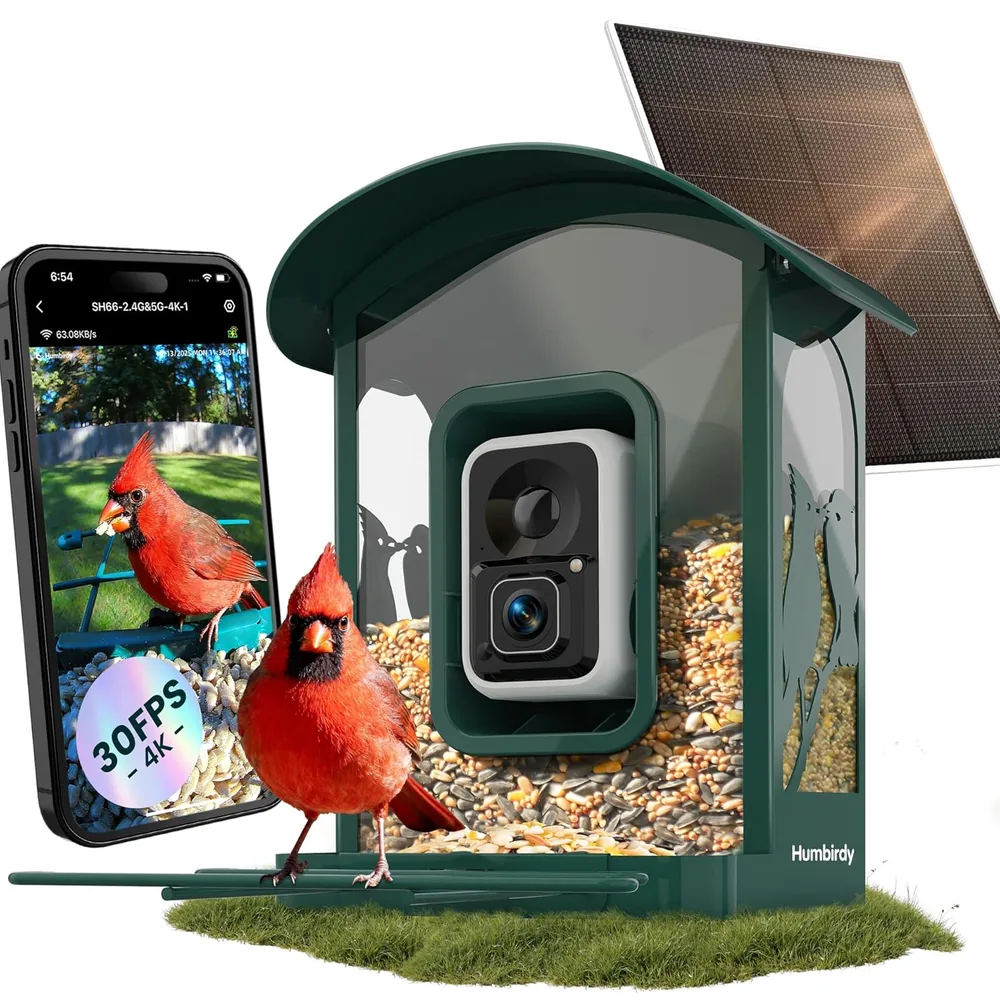
Humbirdy SH66 4K Ultra AI Bird Feeder
Best for: Buyers who prioritize local storage and no recurring AI fee
Trade-off: The experience still depends on a comparatively young app ecosystem
Product reference
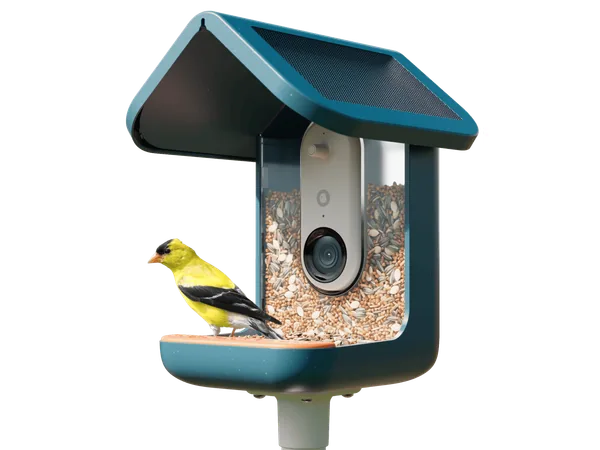
Birdbuddy PRO Solar Smart Bird Feeder
Best for: Documented free core features
Trade-off: Live-view eligibility, Wi-Fi reach, and optional paid features
How this guide was researched
We compare documented product features against the job each buyer needs done. We have not physically tested these products. Check current specifications and availability with the manufacturer or merchant.
Affiliate disclosure: If you buy through a qualifying link, we may earn a commission at no extra cost to you.