
Vehicle maintenance • buying guide
Best Cordless Tire Inflators for SUVs and Trucks: Match the Pump to the Job
Compare DEWALT, Milwaukee, and Fanttik cordless tire inflators by tire size, power source, hose reach, auto-stop, and roadside practicality.
A cordless tire inflator earns its space in a vehicle only if it suits the tire and the way you will power it. Adding a few pounds of pressure to a compact SUV tire before work is a very different job from recovering a large light-truck tire that is close to flat. A 150 PSI label does not tell you how quickly either job will finish, how hot the pump will become, or whether its battery will still be ready after months in the cargo area.
The Milwaukee M18 Inflator is the strongest fit here for repeated passenger-vehicle and light-truck work, especially if charged M18 batteries already travel with you. The DEWALT 20V MAX Corded/Cordless Inflator is the more flexible SUV and household choice because it can use a DEWALT battery or the included 12-volt vehicle cord, and it adds a separate high-volume mode for mattresses and other inflatables. The Fanttik X8 APEX is the compact option for routine top-offs on cars and smaller SUVs; it is easier to pack, but it is not the tool we would choose for frequent large-truck-tire recovery.
Focused Gadgets has not physically tested these inflators. This comparison uses exact retail listings, manufacturer pages, operating manuals, and federal tire-safety guidance. Inflation times, capacity, battery runtime, and accuracy figures are manufacturer or seller claims rather than our measurements.
Quick answer
- Choose the Milwaukee M18 for larger tires and repeated inflation work. Its 36-inch hose, brass threaded chuck, pressure-stabilization routine, four preset memory slots, and focus on light-truck tires make it the most purpose-built option here. It is sold as a bare tool, so it makes the most financial sense for an existing M18 owner.
- Choose the DEWALT for the most adaptable power plan. It can run from a 20V MAX battery or the included 12V DC cord. An AC adapter is supported but sold separately. Its high-volume inflate/deflate hose also makes it useful beyond tires.
- Choose the Fanttik for compact emergency top-offs. It has an internal rechargeable battery, automatic shutoff, a light, and USB power-bank functionality in a much smaller package. Its shorter hose and small built-in battery are less appealing for large tires or repeated fleet work.
- Skip all three as a substitute for tire repair. An inflator can restore pressure after a harmless seasonal drop, but it cannot make a punctured, cut, bulged, or internally damaged tire safe.
- Set pressure from the vehicle placard, not the tire sidewall. The sidewall number is not the vehicle manufacturer’s recommended operating pressure.
| Model | Power arrangement | Hose and connection | Best fit | Main trade-off |
|---|---|---|---|---|
| Milwaukee M18 Inflator | Removable M18 battery; bare tool | 36-inch hose, threaded brass Schrader chuck | Repeated top-offs and larger passenger or light-truck tires | Battery and charger are not included |
| DEWALT 20V MAX Corded/Cordless Inflator | 20V MAX battery or included 12V DC cord; optional AC adapter | High-pressure threaded chuck plus high-volume inflate/deflate hose | SUV owners wanting a backup power source and broader household use | Bulkier than a compact internal-battery inflator; battery and AC adapter sold separately |
| Fanttik X8 APEX | Internal rechargeable battery | Compact hose with locking connection | Glovebox-size car and small-SUV top-offs | Built-in battery and smaller format are not ideal for repeated large-tire work |
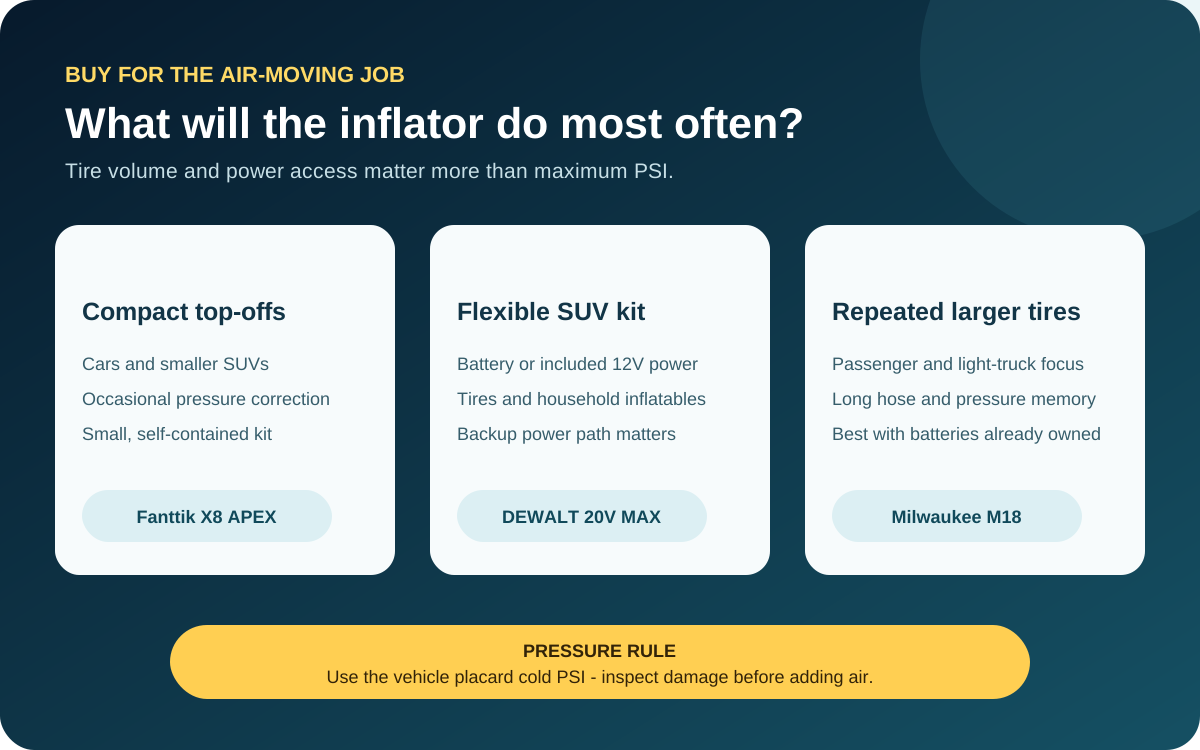
First decide whether this is a top-off or a recovery job
Most inflator marketing compresses every use into a single speed claim. That hides the distinction that matters most.
A top-off might mean raising a cold tire from 30 to 35 PSI. The pump moves a modest amount of air, and all three products are designed for that kind of work. A near-flat recovery asks the pump to move much more air while pressure and temperature rise. Tire volume matters, so a wide, tall truck tire is a substantially heavier workload than a small passenger-car tire even when both finish at the same pressure.
Milwaukee says its inflator can top off a 33-inch light-truck tire in under a minute. That wording is important: it is a manufacturer top-off claim, not a time to fill an empty tire. Fanttik’s retail page likewise uses test scenarios and tire-size limits that should not be generalized to every SUV or truck. Without a common starting pressure, tire volume, battery state, ambient temperature, and rest schedule, speed figures from different brands are not directly comparable.
For a vehicle that routinely airs down off pavement, a small portable compressor with a documented duty cycle and enough airflow for the tire size may be a better category than any compact cordless inflator. For occasional pressure correction, the convenience of automatic shutoff and cordless operation can matter more than peak output.
Battery ecosystem versus self-contained convenience
The Milwaukee and DEWALT use removable tool batteries. That can be a major advantage when those batteries are already part of your workshop: packs can be rotated, replaced immediately, and used across compatible tools. It can also make a bare-tool price misleading. A buyer starting from zero needs to budget for a suitable battery and charger and then remember to keep the pack charged.
DEWALT provides an unusually useful fallback. Its included 12V DC cable can power the unit from a compatible vehicle outlet when no charged 20V MAX battery is available. The inflator can also accept an AC adapter, but DEWALT says that adapter is sold separately. Do not assume a household cord is in the box.
The Fanttik’s internal battery is simpler: charge one device and store it with its cable. It can also provide USB power to a phone in an emergency. The compromise is familiar to any sealed-battery device. You cannot swap in a fresh pack during a long job, and the battery will age even if the pump sees little use. A scheduled charge check matters more than the presence of a battery icon.
Battery branding does not establish compatibility or suitability by itself. If you are assembling several vehicle tools around one platform, our cordless transfer-pump guide explains why the exact battery interface and the tool’s intended fluid or workload still need separate verification.
Hose reach and chuck design affect every use
A hose that comfortably reaches a valve at the top of a large wheel saves more frustration than another display mode. Milwaukee specifies a 36-inch hose and an all-brass threaded Schrader chuck. The reach lets the body stay on the ground while the valve is in many positions, and the screw-on connection is secure. The trade-off is that threading and unthreading takes longer than snapping on a lever connector and can release a small amount of air.
DEWALT also uses a threaded chuck on its high-pressure hose. Its second, larger hose is for high-volume, low-pressure objects such as air mattresses; it can be moved to a deflation port. The two airflow paths are genuinely different functions. The high-volume hose is not a faster substitute for the tire hose.
The Fanttik keeps its hose compact enough for a small storage case. That is convenient in a crowded cargo area, but it gives you fewer placement options around a large wheel. Before buying any compact inflator, look at where the valves sit on your actual wheels and whether the pump can rest securely rather than hang from the stem.
Milwaukee M18 Inflator: best for repeated light-truck work
Milwaukee positions the M18 Inflator for passenger, light-truck, and other medium-duty tires. It has a stated maximum of 150 PSI, automatic shutoff, four pressure-memory slots, anti-vibration feet, onboard accessory storage, and compatibility with M18 batteries. The manufacturer backs the tool with a five-year warranty.
Its most useful feature is not the maximum pressure. TrueFill is Milwaukee’s name for a sequence that waits for pressure to stabilize, checks it, and resumes filling if necessary. That addresses a real problem: pressure at the hose can read higher while air is actively flowing, then settle after the motor stops. Automatic shutoff is only as useful as the pump’s ability to confirm the settled result.
The long hose, threaded brass chuck, and memory slots suit someone who checks several vehicles or repeatedly uses the same front and rear pressures. A contractor, farm owner, or light-truck driver already carrying M18 packs is the clearest buyer.
The drawbacks are size, cost of entry, and power dependency. This is a bare tool. It does not become an emergency inflator until a charged compatible battery is attached, and it has no included 12V vehicle cord as a fallback. Milwaukee’s speed language is also a controlled manufacturer claim, not proof of how quickly it will handle your tire from your starting pressure.
Choose the Milwaukee when larger tires and repeated use justify a more substantial tool. Skip it when you want a small unit that can live unnoticed in a car or when you own no M18 batteries.
DEWALT 20V MAX Corded/Cordless Inflator: best for versatile SUV use
The DEWALT is the most adaptable inflator in this comparison. Its high-pressure mode supports a target pressure and automatic shutoff for tires and sports equipment. A separate high-volume hose inflates or deflates larger low-pressure items. An LED, onboard accessory storage, rubber feet, a threaded chuck, a Presta adapter, an inflator needle, and a tapered nozzle round out the package.
Its power choices are the main reason to buy it. Owners of DEWALT 20V MAX tools can use a compatible battery for cordless operation. The included 12V DC cord gives the inflator a vehicle-powered backup. DEWALT also lists 110V AC as an option, but the required adapter and the battery charger are not included with this bare-tool package.
That arrangement works well for a family SUV, garage, or road-trip kit that also serves bicycles, balls, and mattresses. If the cordless battery is flat, the vehicle cord can keep the tire function available. The high-volume mode also avoids asking a tire-oriented pump to labor through a large mattress.
The DEWALT is not the smallest option, and its broad feature set does not prove that it will outpace the Milwaukee on a large truck tire. A 12V cord also needs to reach from the outlet to every wheel; verify outlet location, cable routing, vehicle instructions, and whether the outlet remains powered in the required ignition state.
Choose the DEWALT for flexible power and mixed household use. Skip it if fast, repeated work on larger truck tires is the only job or if a pocketable roadside unit is the priority.
Fanttik X8 APEX: best compact option for routine top-offs
The Fanttik X8 APEX puts the pump, display, light, and rechargeable battery into a compact rectangular body. It lets the user select a target pressure and stops automatically. The current package includes adapters for common small inflatables, and the unit can serve as a USB power bank.
That combination is attractive for a commuter who wants to correct seasonal pressure changes, address a slow leak long enough to reach service, or check a spare before a trip. There is no separate tool battery and charger to buy. Its small case is much easier to assign a permanent place in a hatchback or compact SUV than either workshop-style model.
Compactness is also the limitation. The hose is shorter, the battery cannot be swapped, and thermal limits matter more when a small compressor is asked to move a large volume of air. Fanttik’s own material focuses on car-size tires and gives operating and cooling instructions. The exact retail package advertises a maximum supported tire diameter rather than presenting the product as a general large-truck solution.
Manufacturer pages for this product have used differing time and battery descriptions over time, so this guide does not turn those figures into a buying promise. The relevant conclusion is narrower: it is a convenient top-off tool, not our first choice for regularly inflating large SUV or pickup tires from very low pressure.
Choose the Fanttik when storage space and simple self-contained charging matter most. Skip it for repeated fleet use, off-road air-up duty, or any tire outside the exact listing’s stated size guidance.
Automatic shutoff still needs a final gauge check
Automatic shutoff lets you set a target and step back, but it does not remove the need for a sensible pressure routine.
- Find the vehicle’s cold-pressure specification. NHTSA directs drivers to the tire-and-loading label on the driver’s door edge or doorjamb, or the owner’s manual. Do not use the maximum number molded into the tire sidewall as the target.
- Check the tire cold when possible. NHTSA defines cold for this purpose as not driven for at least three hours. Driving heats the tire and raises its measured pressure.
- Inspect before connecting the pump. Look for a cut, bulge, exposed cord, damaged valve, or a tire that has been driven while severely underinflated. Air pressure cannot reverse structural damage.
- Connect without loading the valve stem. Place the inflator securely and route the hose so the pump’s weight does not pull on the stem.
- Set the correct target and monitor the first cycle. Do not walk away from an unfamiliar pump. Listen for unusual operation and follow the manual’s run-time and cooling directions.
- Let the reading settle. Confirm the final pressure with a reliable gauge, particularly when the adjustment is safety-critical or the inflator’s behavior is unfamiliar.
- Recheck a recurring loss. A tire that repeatedly needs air has a leak or another problem that deserves inspection; the inflator is not the repair.
Tire-pressure monitoring systems do not replace this routine. NHTSA notes that the warning normally appears only after a tire is significantly underinflated. Monthly cold checks can catch a smaller loss before the dashboard light appears.
What matters more than maximum PSI
All three products advertise pressure capability far above the normal placard pressure of most passenger vehicles. That does not make them equally effective.
- Airflow at working pressure influences how quickly the tire fills, but manufacturers do not always publish it in a comparable form.
- Duty cycle and thermal protection determine how long the compressor may run before it needs to cool. Follow the exact manual rather than assuming a compact unit can run continuously.
- Tire volume turns a simple pressure target into a small or large air-moving job.
- Battery energy and state of charge affect how many tires can be serviced and whether rated performance is available in cold weather.
- Hose reach and valve connection determine whether the inflator can sit safely while attached.
- Pressure stabilization and gauge behavior affect how closely automatic shutoff lands on the intended cold pressure.
- A backup power path may matter more in an emergency than a small speed advantage.
Because brands use different tires, starting pressures, batteries, and test conditions, we would not rank these products by their advertised inflation time alone.
Who should skip these inflators
Skip a portable inflator and seek professional help when a tire has sidewall damage, exposed reinforcement, a bulge, a damaged wheel, or evidence that it was driven flat. Stop using an inflator if the hose, cord, battery, plug, or valve connection is damaged or becomes abnormally hot.
Drivers who routinely air down large tires should consider a compressor designed and documented for that repeated workload. Owners who only need pressure at home may get better long-term value from a mains-powered compressor with a tank, a longer hose, and serviceable parts. Someone who cannot maintain a rechargeable battery should carry a verified corded option and a separate pressure gauge instead of trusting a forgotten internal battery.
Finally, do not buy a bare cordless tool solely because its shelf price looks low. Add the correct battery and charger to the comparison unless you already own them.
FAQ
What size inflator do I need for an SUV?
The tire’s overall size and the amount of missing air matter more than the SUV label. A compact crossover needing a five-PSI top-off is a much lighter job than a large all-terrain tire near flat. Check the exact inflator’s tire-size guidance, run-time limits, hose reach, and fill scenario.
Is 150 PSI enough for truck tires?
Maximum pressure is not the same as useful airflow or duty cycle. A pump may be capable of reaching a high pressure in a small object yet take a long time or overheat while filling a large tire. Match the tool to the tire volume and workload.
Can I leave a cordless inflator in the car?
You can store one in a vehicle if the manual permits the expected temperatures and the unit is secured from movement and moisture. Rechargeable batteries lose charge and age, so inspect and recharge the inflator or removable pack on a schedule.
Should I inflate to the PSI printed on the tire?
No. Use the vehicle manufacturer’s recommended cold pressure on the tire-and-loading placard or in the owner’s manual. The sidewall marking is not the vehicle’s normal operating target.
Will an inflator fix a slow leak?
No. It may restore enough pressure to reach a safe inspection point, but recurring pressure loss needs diagnosis and repair. Do not reinflate and drive on a visibly damaged tire simply because it holds air temporarily.
Is a removable tool battery better than an internal battery?
It is better for repeated work and immediate battery swaps, especially when you already own the platform. An internal battery makes the kit smaller and simpler. The better choice depends on whether the tool lives in a workshop rotation or sits in a vehicle for occasional use.
Bottom line
Buy the Milwaukee M18 Inflator for repeated passenger and light-truck top-offs when you already have charged M18 batteries. Buy the DEWALT 20V MAX Corded/Cordless Inflator when a removable battery, included 12V fallback, and high-volume household mode make a more useful all-round kit. Buy the Fanttik X8 APEX when compact storage and routine car or small-SUV top-offs are the priority.
Whichever format you choose, check the tire cold, use the vehicle placard pressure, respect run-time limits, and treat repeated air loss as a repair problem rather than an inflation problem.
Models discussed
Use these as starting points for checking fit. We do not publish a price or claim hands-on testing.
| Model | Format | Best fit | Trade-off |
|---|---|---|---|
| DEWALT DCC020IB 20V MAX Tire Inflator | Removable-battery inflator with included 12V power cord and high-volume mode | SUV and household use where a 12V backup and high-volume inflate/deflate mode add flexibility | Bulkier than a self-contained inflator; the battery, charger, and optional AC adapter are sold separately |
| Milwaukee M18 Inflator 2848-20 | Bare-tool M18 inflator with pressure stabilization, memory presets, and 36-inch hose | Repeated passenger and light-truck top-offs for owners already using M18 batteries | Battery and charger are not included, and there is no 12V vehicle-power fallback |
| Fanttik X8 APEX Tire Inflator | Compact inflator with a built-in rechargeable battery and automatic shutoff | Routine car and smaller-SUV top-offs where compact storage matters most | The shorter hose and non-swappable battery are less suited to repeated large-tire work |
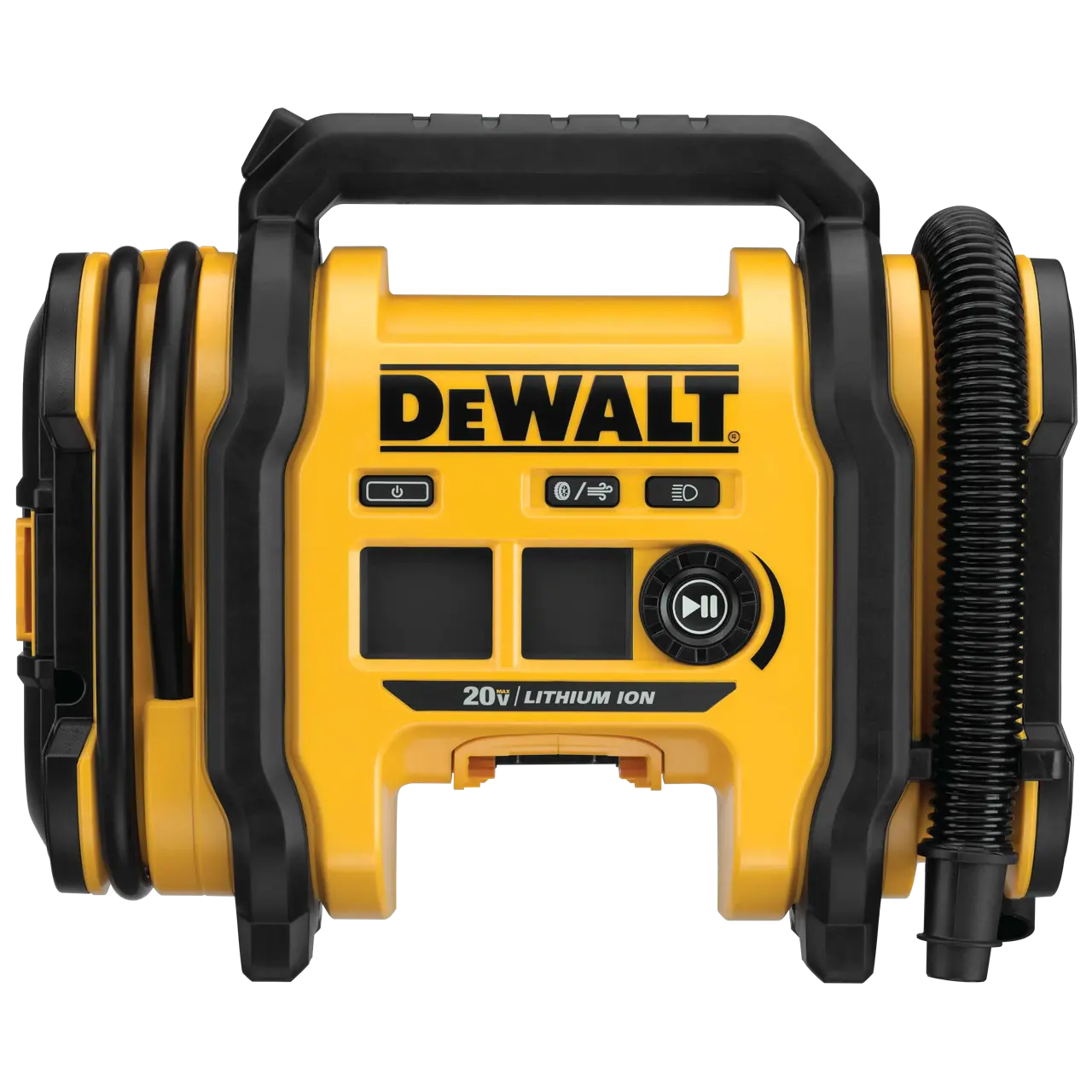
Product reference
DEWALT DCC020IB 20V MAX Tire Inflator
Best for: SUV and household use where a 12V backup and high-volume inflate/deflate mode add flexibility
Trade-off: Bulkier than a self-contained inflator; the battery, charger, and optional AC adapter are sold separately
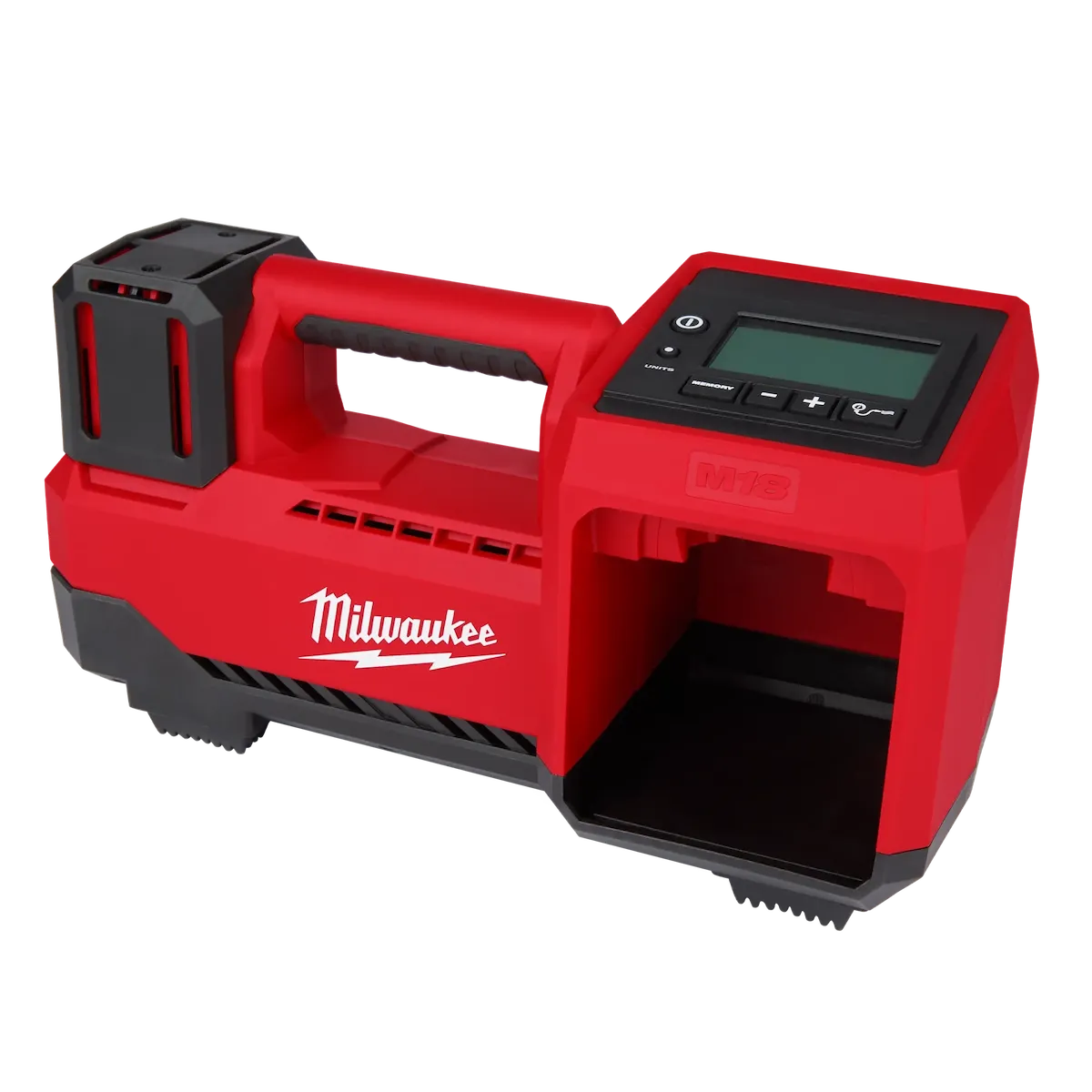
Product reference
Milwaukee M18 Inflator 2848-20
Best for: Repeated passenger and light-truck top-offs for owners already using M18 batteries
Trade-off: Battery and charger are not included, and there is no 12V vehicle-power fallback
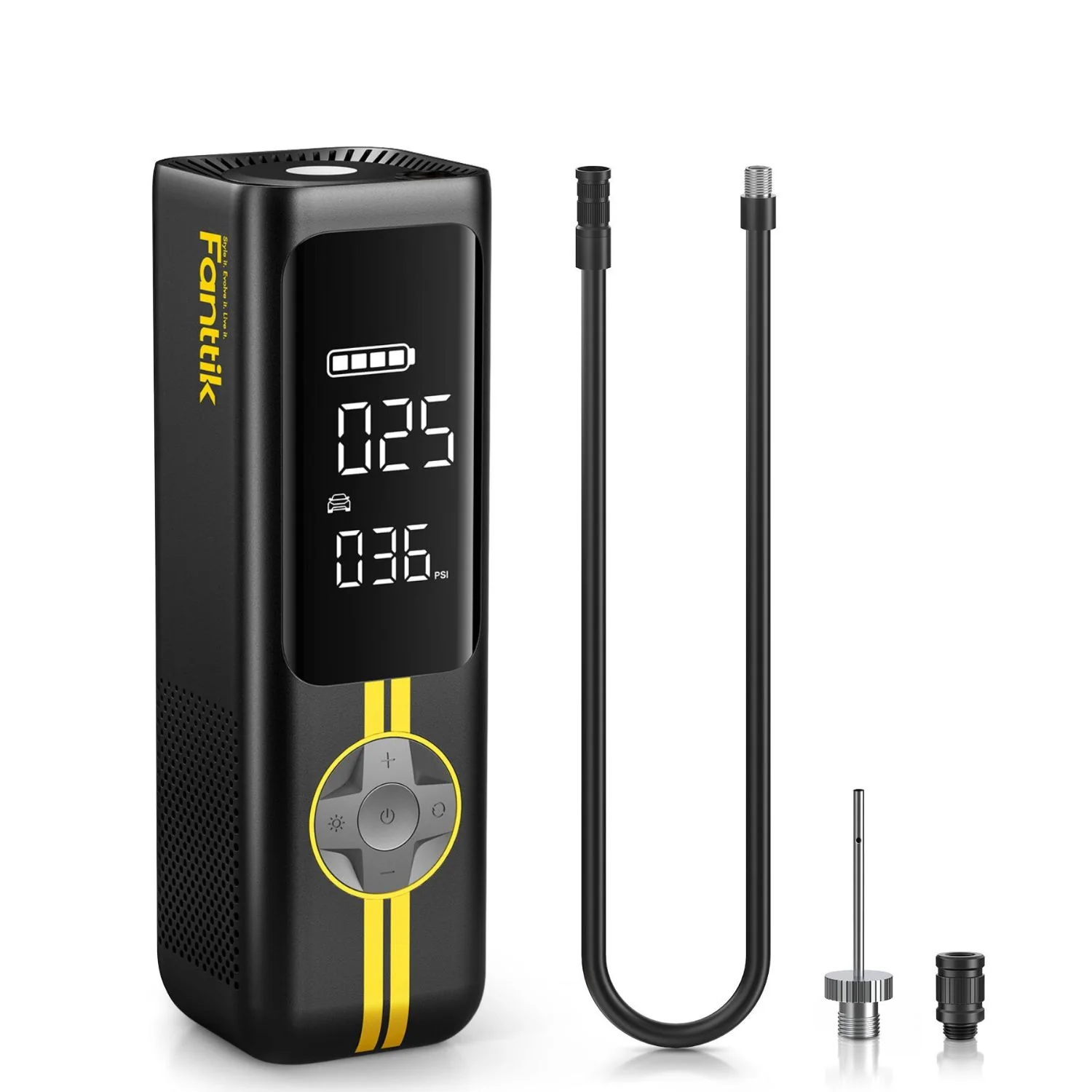
Product reference
Fanttik X8 APEX Tire Inflator
Best for: Routine car and smaller-SUV top-offs where compact storage matters most
Trade-off: The shorter hose and non-swappable battery are less suited to repeated large-tire work
How this guide was researched
We compare documented product features against the job each buyer needs done. We have not physically tested these products. Check current specifications and availability with the manufacturer or merchant.
Affiliate disclosure: If you buy through a qualifying link, we may earn a commission at no extra cost to you.