
Roof ventilation • buying guide
Best Solar Attic Fans: Check the Roof Before the CFM
Compare three solar attic fans by controls, roof format, and documented trade-offs after checking air sealing, intake, and installation fit.
The best solar attic fan may be no fan at all. That is not a clever way to avoid making a choice; it is the first decision a responsible buyer has to make.
A powered attic ventilator creates suction. If an attic has generous, unobstructed soffit intake and a well-sealed ceiling, the replacement air can come from outdoors as intended. If intake is inadequate or the ceiling leaks, the fan can pull cooled air from the living space, increase air-conditioner work, and potentially affect naturally drafted combustion equipment. A solar panel changes where the motor gets electricity. It does not change that pressure relationship.
This guide compares three different approaches: the OmniPV 40W Hybrid for buyers who want solar operation backed by an AC adapter, the Hon&Guan 40W for adjustable controls and dual-power operation, and the Remington Solar 20 Watt Round Series for buyers who prefer a simpler integrated panel. The airflow figures attached to these listings are manufacturer or seller claims, not directly comparable independent test results.
Focused Gadgets has not physically tested these fans. This guide uses current manufacturer material, exact-link checks, and building-science guidance from ENERGY STAR, the U.S. Department of Energy’s Building America Solution Center, and Building Science Corporation. A roofer, HVAC contractor, energy auditor, or building professional familiar with your climate and roof assembly should confirm that powered ventilation is appropriate before a roof opening is cut.
Quick answer
- Start with the ceiling, not the fan. Seal penetrations between the house and attic, confirm insulation coverage, and keep bathroom and kitchen exhaust ducts vented outdoors.
- Measure usable intake. A fan cannot exhaust its rated airflow when soffit or other low intake vents are too small, blocked by insulation, painted shut, or disconnected from the attic.
- Do not add a fan to an unvented, conditioned attic. Spray-foamed roof assemblies and other sealed attics are designed differently from vented attics. Get assembly-specific advice.
- Treat high CFM as a load, not automatically a benefit. More exhaust can mean more negative pressure. DOE guidance favors minimizing fan flow when a powered fan is used.
- Choose the fan only after the attic passes the building-fit checks. Product controls and panel wattage cannot compensate for blocked intake, ceiling leakage, or unsuitable flashing.
| Your attic condition | Sensible next step |
|---|---|
| Ceiling leaks or attic hatch is unsealed | Air-seal before considering powered ventilation |
| Soffit vents are blocked or intake area is unknown | Clear, measure, and balance passive intake first |
| Existing ridge-and-soffit system is balanced | Diagnose the actual heat or moisture problem before changing airflow |
| Atmospheric-combustion appliance is near the pressure boundary | Get a combustion-safety assessment before installing an exhaust fan |
| Unvented or conditioned attic | Do not install a vent fan without assembly-specific professional guidance |
| Vented attic, sealed ceiling, adequate intake, suitable sunny roof | A correctly flashed, modestly sized solar fan may be considered |
Why attic fans can work against the house
In a conventional vented attic, outside air enters low, usually through soffit vents, and warmer air leaves high through ridge, roof, or gable vents. Wind and buoyancy drive that passive exchange. A powered fan accelerates the exhaust side and lowers attic pressure.
ENERGY STAR’s attic-ventilation guidance warns that an attic fan can draw conditioned air out of the home when soffit vents are blocked and the attic floor is not well sealed. DOE’s Building America attic-fan guidance similarly puts ceiling air sealing, sufficient intake, lower airflow, and combustion safety ahead of fan capacity.
That creates an unintuitive result: a fan can make the attic air cooler while making the house less efficient. The temperature at one attic thermometer is not the same as whole-home energy performance. Heat reaches living space through conduction, radiation, and air leakage, and attic insulation already limits much of the conductive path. Building Science Corporation describes the cooling contribution of attic ventilation as modest when insulation is adequate.
Solar power removes the fan’s direct grid-electricity consumption during sunny operation. It does not prevent the fan from pulling already conditioned air through ceiling gaps. Nor does it guarantee airflow at the hottest point of the day: panel orientation, roof pitch, clouds, shade, dust, and cell temperature all influence output.
Check these five conditions before shopping
1. Is the attic supposed to be vented?
The advice in this guide applies to a conventional vented attic with insulation and an air-control layer at the ceiling. An unvented attic moves the enclosure to the roofline and is intentionally separated from outdoor ventilation. Cutting an exhaust opening into that assembly can defeat its design.
If spray foam is visible on the roof deck, HVAC equipment sits inside a sealed attic, or you cannot identify a continuous path from soffit to ridge, stop and have the assembly identified first.
2. Is the ceiling air barrier continuous?
Recessed lights, plumbing and wiring holes, open wall tops, attic stairs, dropped soffits, and duct chases can connect the living space to the attic. ENERGY STAR’s attic air-sealing project shows why these bypasses deserve attention before insulation is added or airflow is increased.
Some penetrations require fire-rated methods or safe clearance from heat-producing equipment. Do not bury non-rated recessed lights or seal around flues with ordinary foam. The point is diagnosis and proper repair, not indiscriminate caulking.
3. Is there enough real intake area?
Vent packaging often advertises gross dimensions, but airflow depends on net free ventilating area after screens, louvers, and grilles restrict the opening. DOE’s passive-ventilation calculation guide describes a common code approach of one square foot of net free area per 300 square feet of attic floor when qualifying conditions are met, with roughly 40 to 50 percent high and the remainder low. Other assemblies may require 1:150 or local-code treatment.
That ratio is a passive-ventilation reference, not a universal fan-sizing equation. A powered-fan manufacturer should state the intake requirement for its installed airflow, and the installer should calculate it using the vents’ published net-free-area values. If the intake cannot be documented, a headline CFM number is not actionable.
4. What happens to other exhaust paths?
A strong roof fan may pull air through nearby ridge or gable vents instead of sweeping from low soffits across the roof deck. This short-circuit can leave lower areas under-ventilated while drawing weather through an opening designed only for passive exhaust.
Pressure can also matter around fireplaces, water heaters, furnaces, or boilers that rely on natural draft. DOE recommends combustion-safety attention where depressurization could cause backdrafting. Carbon-monoxide alarms are essential protection, but they are not a substitute for a safe pressure assessment.
5. Can the roof accept the installation?
A shingle-roof fan normally needs an opening through the deck and flashing woven into the roofing so water sheds over, not into, the assembly. Tile, standing-seam metal, corrugated metal, low-slope membranes, and flat roofs need different curbs, flashings, sealants, and fastening details. “Fits most roofs” is not an installation plan.
Check roof warranty terms, wind and snow requirements, coastal corrosion exposure, pest screening, and required clearances from ridges, valleys, plumbing vents, skylights, and fire-rated separations. A leak around a poorly flashed fan can cost far more than the product.
Why CFM claims are hard to compare
CFM is airflow in cubic feet per minute, but the number is meaningful only with test conditions. A free-air fan on a bench does not face the pressure losses created by intake screens, narrow soffit slots, duct-like rafter bays, roof grilles, and wind. A panel-driven motor may also change speed as solar input changes.
The three listings advertise very different airflow figures, but no shared independent test method could be verified across them. That prevents an honest fastest-fan ranking. It also matters because DOE explicitly recommends lower CFM as one way to limit negative-pressure risk when powered attic ventilation is used.
Do not size a fan by multiplying floor area by a marketplace rule of thumb. Ask instead:
- What installed airflow does the manufacturer document, and at what pressure and solar input?
- How much net free intake area does that airflow require?
- Where will replacement air actually enter?
- Will existing ridge or gable exhaust vents short-circuit the intended path?
- Who is responsible for the roof flashing and leak warranty?
Which solar attic fan fits which buyer?
OmniPV 40W Hybrid: best for solar plus AC backup
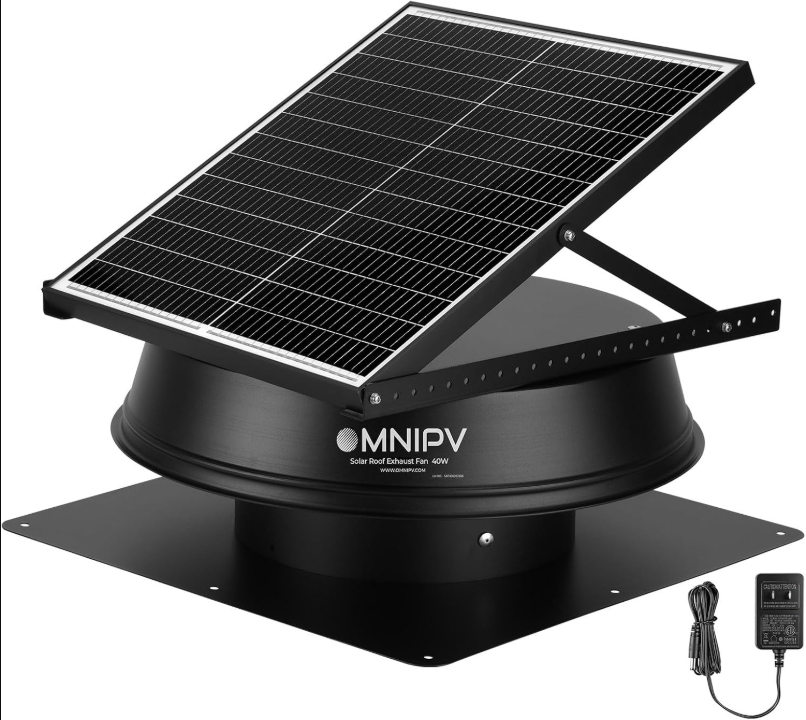
The OmniPV combines a 40-watt adjustable solar panel with an included AC adapter and a thermostat listed to switch the fan on at 75°F. Its exact retail listing claims up to 2,100 CFM and shows a conventional round fan body on a square roof flashing. Treat that airflow as a seller claim rather than an installed result.
This is the most flexible power arrangement of the three. Solar output can carry daytime operation, while the adapter provides a path to operation when sunlight is weak. That flexibility also makes control strategy more important: continuous powered exhaust after sunset may draw humid outdoor air or conditioned indoor air when the envelope and intake are not ready for it.
Choose the OmniPV when hybrid operation is genuinely useful and an installer has confirmed the intake and flashing plan. Skip it if the adapter would merely mask a shaded panel or if you want manufacturer documentation that states installed airflow and required net free intake in detail.
Hon&Guan 40W 2000 CFM Solar Attic Fan with Thermostat: best for adjustable operation
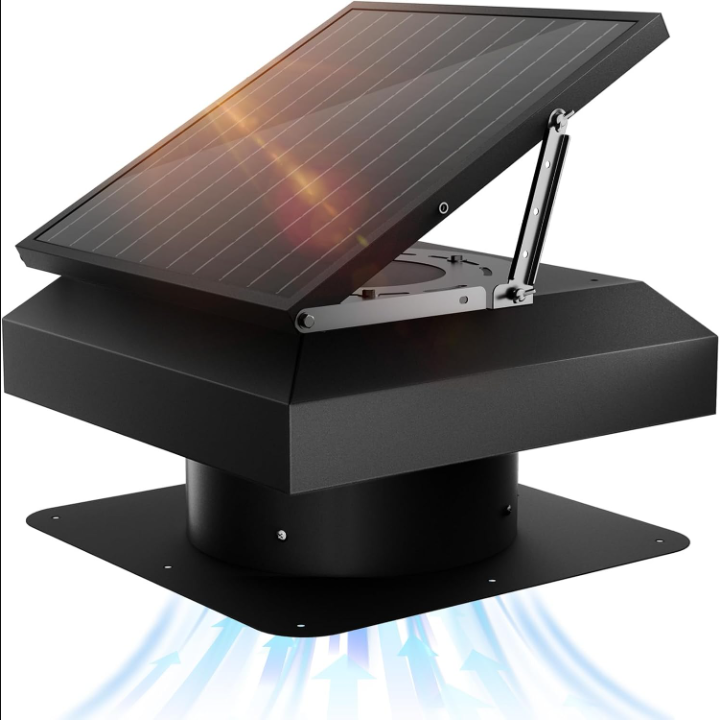
The listing describes a 12-inch roof fan with a 40-watt adjustable panel, thermostat, AC adapter, two controller modes, and adjustable fan speed. It claims airflow up to 2,000 CFM and coverage up to 2,500 square feet. Those are seller claims; this exact model does not have the depth of published manufacturer documentation needed for a rigorous installed-airflow comparison.
Its main appeal is control. A tilting panel can help with solar orientation, while speed and dual-power choices give an installer more ways to limit or extend operation. More settings are not automatically safer, however. The homeowner still needs a defined intake requirement and a plan for how thermostat and powered modes interact with outdoor humidity.
Choose the Hon&Guan when panel adjustment and operating control matter more than having the strongest documentation package. Confirm the included controller, adapter, roof flashing, warranty, and current listing contents before ordering.
Remington Solar 20 Watt Roof Mount Solar Attic Fan - Round Series: best for an integrated panel
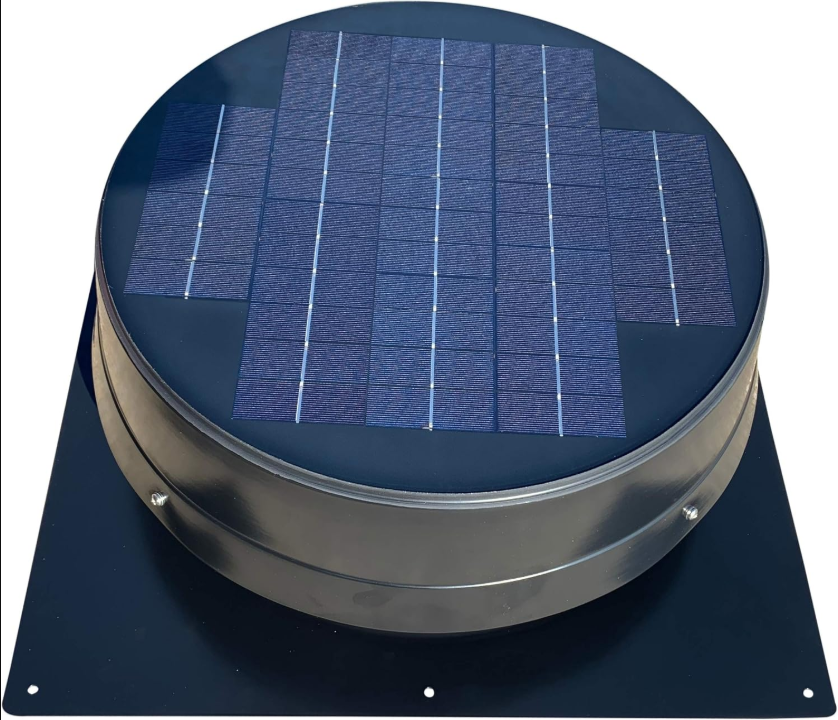
This Remington model uses a 20-watt panel integrated into the round fan cap rather than a separate panel on an adjustable rack. That creates a tidier roof profile with fewer external panel supports. It also means the panel follows the roof plane, so roof direction, pitch, and shade deserve extra attention.
Remington publishes installation material for its solar attic-fan families, including roof-opening, rafter-clearance, flashing, sealant, and placement guidance. The exact listing identifies this model as the 20W Round Series. Warranty language across current Remington pages is not consistent enough to summarize confidently, so verify the written warranty supplied with the exact listing.
Choose the Remington when a low-profile integrated panel and established installation documentation matter more than hybrid power or adjustable-panel positioning. Skip it on a shaded or poorly oriented roof where the fixed panel will not receive useful sun.
Thermostats, humidistats, and hybrid power
A thermostat prevents some unnecessary operation in mild weather, but its threshold should be documented and appropriate for the installation. A humidistat may activate the fan during cool or damp conditions, when the direction of moisture movement and the outdoor dew point matter. More ventilation is not automatically drying in every climate.
A hybrid AC adapter can keep a fan running without sun. That may provide predictable airflow, but it also removes the natural coincidence between solar output and sunny conditions. DOE notes that solar-only operation can avoid running a fan at night or during rain, when outside air may be more humid. Treat hybrid power as a controlled operating mode, not a universal upgrade.
Smartphone controls are similarly secondary. Remote readings cannot fix missing intake, a leaky ceiling, or poor flashing. A simple, documented controller on the right roof is better than an app-connected fan on the wrong one.
What to buy instead when the fan is not the answer
If the top-floor rooms are hot, an energy audit can locate ceiling leakage, missing insulation, duct losses, and pressure imbalances. Air sealing and insulation often address the heat path without adding a roof penetration. If bath fans terminate in the attic, route them outdoors before trying to ventilate away the moisture they add.
If the attic shows condensation, mold, frost, or wet sheathing, identify the moisture source rather than assuming summer cooling is the cure. Indoor humidity, air leakage, roof leaks, blocked vents, and cold-climate ice-dam mechanisms require different repairs. Visible microbial growth or structural decay deserves professional evaluation.
If passive intake and exhaust are inadequate, a roofer can assess whether continuous soffit and ridge ventilation can be corrected while preserving weather resistance and local-code compliance. Passive components have no motor, controller, wiring, or panel to fail, though their placement and net free area still matter.
The buying decision
Consider a solar attic fan only after a knowledgeable professional confirms all four conditions: the attic is intentionally vented, the ceiling plane is well sealed, low intake is adequate for the proposed airflow, and the roof can be flashed correctly. Then prefer an exactly identified model with a published manual, net-free-intake requirement, credible airflow test conditions, replaceable components, clear controls, and an unambiguous warranty.
Of these three, the OmniPV has the broadest power options, the Hon&Guan offers the most operating adjustment, and the Remington Solar Round Series has the simplest integrated-panel roof profile. None is the right purchase until ceiling leakage, intake, roof material, solar exposure, and flashing have been checked. Prices, bundles, specifications, and availability change, so confirm the exact model and included hardware before ordering.
Frequently asked questions
Will a solar attic fan lower my home’s energy bill?
Not necessarily. Solar power avoids direct grid consumption by the fan, but the pressure it creates can pull conditioned air through ceiling leaks. Insulation, air sealing, duct location, climate, intake, fan size, and controls all affect the result. Treat savings claims as unproven unless they apply to a comparable house and installation.
Is a higher-CFM solar attic fan better?
No. Higher airflow increases intake demand and can increase negative pressure. A smaller, correctly supplied fan is preferable to a larger fan that draws from the house or short-circuits through nearby exhaust vents.
Do I need soffit vents with a solar attic fan?
You need adequate low replacement-air intake for a typical roof-mounted exhaust fan, and soffits are the usual location. The required net free area depends on actual airflow, vent restrictions, and the roof design. Do not count blocked or decorative openings as usable intake.
Can I use a solar fan with a ridge vent?
Possibly, but the combination must be designed so the fan does not pull air backward through the ridge and bypass the lower attic. Have the airflow path assessed rather than assuming two exhaust systems will complement each other.
Can a solar attic fan go on a metal or tile roof?
Only with a mounting and flashing system suited to that exact roof profile and material. The manufacturer’s compatibility statement does not replace roof-specific installation details or a review of the roofing warranty.
Should a humidistat run the fan in winter?
That depends on climate, outdoor moisture, attic assembly, and the source of indoor humidity. A humidistat can respond to a symptom while continued air leakage feeds the problem. Diagnose and seal moisture pathways first.
Models discussed
Use these as starting points for checking fit. We do not publish a price or claim hands-on testing.
| Model | Format | Best fit | Trade-off |
|---|---|---|---|
| OmniPV 40W 2100 CFM Solar Hybrid Attic Fan | 40W adjustable panel, thermostat, and AC adapter | Buyers who want solar operation with an AC-powered backup option | The most flexible power setup, but its claimed airflow still depends on sun, intake, and installed resistance |
| Hon&Guan 40W 2000 CFM Solar Attic Fan with Thermostat | 12-inch fan with 40W adjustable panel and dual power | Buyers who prioritize adjustable speed, panel angle, and operating modes | Control options are extensive, but exact-model manufacturer documentation is limited |
| Remington Solar 20 Watt Roof Mount Solar Attic Fan - Round Series | 20W integrated round solar panel | Buyers who prefer a low-profile integrated panel and simpler solar-only operation | The fixed panel follows the roof angle and offers less control than the hybrid models |
Product reference
OmniPV 40W 2100 CFM Solar Hybrid Attic Fan
Best for: Buyers who want solar operation with an AC-powered backup option
Trade-off: The most flexible power setup, but its claimed airflow still depends on sun, intake, and installed resistance
Product reference
Hon&Guan 40W 2000 CFM Solar Attic Fan with Thermostat
Best for: Buyers who prioritize adjustable speed, panel angle, and operating modes
Trade-off: Control options are extensive, but exact-model manufacturer documentation is limited
Product reference
Remington Solar 20 Watt Roof Mount Solar Attic Fan - Round Series
Best for: Buyers who prefer a low-profile integrated panel and simpler solar-only operation
Trade-off: The fixed panel follows the roof angle and offers less control than the hybrid models
How this guide was researched
We compare documented product features against the job each buyer needs done. We have not physically tested these products. Check current specifications and availability with the manufacturer or merchant.
Affiliate disclosure: If you buy through a qualifying link, we may earn a commission at no extra cost to you.