
Assisted astronomy • comparison
Best Smart Telescopes for Beginners: Three Very Different Ways to Image the Sky
Compare the DWARF Mini, Seestar S30 Pro, and Celestron Origin Mark II by portability, field of view, aperture, setup, and realistic imaging goals.
Smart telescopes remove much of the alignment, tracking, camera control, and image stacking that makes conventional astrophotography intimidating. They do not remove the need to choose the right optics. A pocket-size 30 mm imager and a 152 mm backyard observatory may both find a nebula from an app, but they differ radically in what they frame, how much equipment they ask you to move, and how much money is tied up outside after dark.
This comparison covers the exact products behind three catalog ASINs. Two names in the source CSV had become outdated: B0GYX9GSVX now identifies the Seestar S30 Pro, not the S50, and B0FXYL39P9 identifies the Celestron Origin Mark II, not the first-generation Origin. The DWARFLAB DWARF Mini listing remains correctly identified. Buying by an old product name would make every comparison that follows unreliable.
Focused Gadgets has not physically tested these telescopes. This is a source-based buying analysis using current manufacturer specifications, manuals, exact merchant destinations, and independent specialist coverage. Image quality still depends on sky brightness, transparency, wind, target altitude, tracking, stacking time, focus, processing, and firmware—not a specification table alone.
Quick answer
- Choose the DWARF Mini when carrying the telescope matters most. It weighs 840 g, uses a 30 mm f/5 telephoto system, and can shoot through telephoto and wide-angle cameras. Its 2-megapixel telephoto sensor, narrower native frame, 64 GB storage, and lack of an included tripod are the costs of making the kit this small.
- Choose the Seestar S30 Pro for the strongest all-round portable package. It pairs a 30 mm f/5.3 telephoto lens with a much larger 8.3-megapixel telephoto sensor, a separate 8.3-megapixel wide camera, 128 GB storage, active anti-dew control, and dedicated wide-field modes. It is almost twice the DWARF Mini’s weight, and its longer-exposure equatorial mode needs additional mounting hardware.
- Choose the Celestron Origin Mark II only when a home observatory is the real goal. Its 152 mm f/2.2 RASA, 8.3-megapixel camera, full-height tripod, integrated dew control, and interchangeable filter drawer target more ambitious deep-sky imaging and group viewing. The complete system weighs 41.6 lb, costs several times more than the compact models, and is transported as three substantial components.
- Choose none of them for traditional visual astronomy. These are app-controlled imaging systems. If you want to learn the sky at an eyepiece, manually aim a telescope, or visually observe planets at high magnification, a conventional telescope is a different—and often better—purchase.
| Model | Optics and native tele frame | Weight and format | Standout capability | Main compromise |
|---|---|---|---|---|
| DWARFLAB DWARF Mini | 30 mm, 150 mm, f/5; 2.45° diagonal; 2.07 MP | 840 g pocket-size unit; tripod sold separately | Smallest travel load and up to 90-second advertised EQ exposures | Small tele sensor and narrower native composition |
| Seestar S30 Pro | 30 mm, 160 mm, f/5.3; 4.6° tele field; 8.3 MP | 1.65 kg integrated unit with a 3/8-16 mounting thread | Broad tele frame plus separate 4K wide camera and Milky Way tools | EQ mode needs optional support hardware; sealed optical system |
| Celestron Origin Mark II | 152 mm, 335 mm, f/2.2; 1.32° × 0.75°; 8.3 MP | 18.87 kg assembled system split into tube, mount, and tripod | Large, fast optics and integrated filter workflow for deep-sky imaging | High cost, large storage footprint, and car rather than backpack portability |
The deciding question is what you want to frame
Aperture is important, but it is not a universal score. The DWARF Mini and Seestar S30 Pro both use 30 mm telephoto apertures. The Seestar’s larger IMX585 sensor gives it a substantially broader native telephoto field than the Mini’s IMX662 while retaining 2.9 μm pixels. That makes the S30 Pro a more natural fit for large nebulae, the Andromeda Galaxy, broad star fields, and compositions that would require a mosaic on the Mini.
The DWARF Mini’s narrower tele frame can make a smaller target occupy more of the final image without a digital crop, but its 2.07-megapixel output leaves less room for cropping and large prints. Its separate wide camera is useful for aiming and wide scenes; it does not turn the 30 mm telephoto channel into a high-resolution planetary telescope.
Origin Mark II sits in another category. Its 152 mm aperture is more than five times the diameter of the compact scopes, and its f/2.2 RASA is designed to collect deep-sky image data quickly. Its 335 mm focal length and 1.32° by 0.75° field are better suited to smaller nebulae, galaxies, and clusters than sweeping Milky Way landscapes. Bigger optics therefore buy light collection and target scale, not the widest possible composition.
Before ordering, use each manufacturer’s field-of-view preview or an astronomy framing tool with the exact camera and focal length. “More powerful” means little if the target does not fit.
DWARFLAB DWARF Mini: best when the telescope must travel
The Mini is the easy model to take on a flight, hike, or short-notice drive to darker skies. Its body measures about 100 by 184 by 61 mm and weighs 840 g. The official package contains the telescope, solar filter, USB-C cable, and cleaning cloth; DWARFLAB lists its compact tripod separately. Budget and pack for stable support rather than assuming the product photo represents the whole field kit.
The telephoto system combines a 30 mm aperture, 150 mm focal length, IMX662 sensor, and 2.45° diagonal field. A second 6.7 mm wide camera helps with aiming and landscape-oriented modes. The app provides autofocus, plate-solving calibration, GoTo, tracking, stacking, mosaics, scheduled sessions, calibration frames, and mobile processing. Files include JPEG, video, and raw astronomy formats, with 64 GB of onboard storage.
DWARFLAB advertises long exposures in equatorial mode, but exposure limits depend on the app mode and current firmware. The manual documents shorter automatic exposures and longer manual or scheduled options. Treat “90 seconds” as a mode-specific capability, not a promise that every target benefits from a 90-second frame. Accurate polar alignment, wind, tripod stability, sky glow, and rejected frames still set the practical limit.
The Mini is the best fit for a buyer who will accept a smaller sensor to reduce the chance that the telescope stays home. Skip it if large native frames, high output resolution, built-in dew control, or an included tripod matter more than shaving roughly 810 g from the Seestar body.
Seestar S30 Pro: best all-round portable choice
The S30 Pro is not the S50 that the catalog originally named. The exact affiliate ASIN now opens a dual-camera S30 Pro listing, and ZWO’s current documentation confirms a 30 mm, 160 mm f/5.3 four-element apochromatic telephoto lens with an 8.3-megapixel Sony IMX585. Its 4.6° telephoto field is the comparison’s most useful single-frame compromise for large deep-sky targets. The separate 6 mm f/1.75 wide camera also records 8.3-megapixel images across a manufacturer-stated 63° field.
Those cameras support different jobs. The tele channel handles tracked deep-sky stacks, lunar and solar imaging with the required filter, and distant daytime subjects. The wide channel enables Milky Way, landscape, star-trail, and time-lapse compositions. ZWO also includes mosaic processing, raw FITS output, a dual-band light-pollution filter, a dark filter, active anti-dew control, and 128 GB of storage.
At 1.65 kg, the Seestar remains easy to carry from a car or around a campsite, but it is no longer a pocket device. Its 6000 mAh battery is rated by ZWO for about six hours in stargazing mode under laboratory conditions and about four hours for scenery video; temperature and workload will change that. It can work without an internet connection after the app and firmware are installed, using its own Wi-Fi connection.
The standard alt-azimuth workflow is the simple one. Equatorial mode permits manufacturer-stated exposures up to 60 seconds but needs compatible additional mounting hardware and polar alignment. That upgrade can improve tracking and reduce field rotation, yet it also erodes the one-piece simplicity that attracts beginners. Buy the S30 Pro for its native field, sensor area, storage, and broad imaging modes—not merely because “Pro” appears in the name.
Celestron Origin Mark II: best for a committed backyard setup
Origin Mark II is not a premium version of the two compact scopes so much as an automated observatory using a different optical architecture. The exact ASIN is Celestron item 12100 with the newer Origin 678C camera: a back-illuminated Sony IMX678 sensor with 3856 by 2180 effective pixels. First-generation Origin units used an IMX178 camera, so confirming the Mark II identity matters at this price.
The 152 mm RASA operates at f/2.2 with a 335 mm focal length. Celestron integrates autofocus, StarSense alignment, live stacking and processing, automated dew heating, fans, raw-file export, scheduled imaging, and a drawer for standard 1.25-inch or 2-inch filters. The system can show the live image to multiple connected devices and cast it to a TV, which makes it far better suited to a family session, club demonstration, or backyard “control room” than passing one phone around a tiny travel scope.
Light collection is the reason to consider it. Convenience is not the same as compactness. The optical tube weighs 10.6 lb, the mount 17 lb, and the tripod 14 lb. The 41.6 lb system assembles without tools, but it needs storage space and several trips from the house or one deliberate car load. Its 97.9 Wh LiFePO4 battery is rated for more than six hours, with shorter runtime expected in cold conditions.
Origin also has a clearer upgrade path. Filters can be changed, raw frames can be processed elsewhere, and Celestron supports an optional wedge and autoguider for longer exposures. Each addition increases cost and setup. Choose Origin when its aperture, fast optics, shared viewing, and filter flexibility solve a real limitation—not because it sits at the top of a price list.
Light pollution filters help some targets, not every target
All three manufacturers discuss filters intended to suppress selected wavelengths from urban lighting while passing important nebular emission lines. That can improve contrast on emission nebulae. It does not remove sky glow from every source, restore stars hidden by clouds, or make broadband targets behave like narrowband targets.
Galaxies and star clusters emit across a broad spectrum. Celestron explicitly recommends removing its optional nebula filter for broadband objects or dark-sky imaging because the filter also rejects useful light. ZWO similarly warns that Milky Way detail may be limited under significant light pollution even with the S30 Pro’s processing. A darker site, a higher target, longer total integration, and careful processing can matter more than a filter badge.
App convenience creates an ownership dependency
These telescopes put alignment, catalogs, focusing, capture, and processing behind mobile software. That is their advantage and their long-term dependency. Check phone and tablet compatibility, available storage, location permissions, Wi-Fi behavior, export formats, and the manufacturer’s update history before buying.
The S30 Pro and DWARF Mini can export FITS data for external processing. Origin can save raw frames to external storage or make them available over its network. Those options matter if you expect to outgrow automatic processing. None of the three offers the component-level freedom of a conventional mount, interchangeable telescope, and replaceable astronomy camera.
Which one should you buy?
Buy the DWARF Mini if you travel light, want the lowest physical commitment, and are comfortable composing within a smaller 2-megapixel tele frame or spending more time on mosaics.
Buy the Seestar S30 Pro if you want the most balanced beginner package here: a broad 8.3-megapixel tele frame, a useful wide camera, anti-dew control, generous storage, and a straightforward alt-azimuth workflow with room to experiment in equatorial mode later.
Buy the Celestron Origin Mark II if the telescope will live mainly at home, several people will share the view, and faster 152 mm optics justify a major increase in price, size, and setup. It is the strongest deep-sky instrument of the three, but the least sensible impulse purchase.
Skip all three if your goal is visual observing through an eyepiece, detailed planetary work, or learning a modular astrophotography rig component by component. Also postpone the purchase if you do not have a safe observing location with a clear view of enough sky. Automation cannot track through a roof, tree, cloud, or balcony above you.
Prices, bundles, firmware, and included accessories change. Before buying, confirm the exact ASIN and model name, current app requirements, tripod or wedge contents, solar-filter instructions, warranty region, and return terms. Never point an optical system at the Sun without the exact correctly installed solar filter and manufacturer procedure.
Frequently asked questions
Is a smart telescope good for a complete beginner?
Yes, when the goal is app-guided imaging. Automated alignment, GoTo, tracking, and stacking reduce the technical steps needed to produce a recognizable deep-sky image. They do not teach eyepiece observing or eliminate weather, framing, focus, and processing decisions.
Is the Seestar S30 Pro better than the DWARF Mini?
It is the stronger all-round imager on documented hardware: its tele sensor is larger and higher resolution, its native tele field is wider, and it includes more storage and active dew control. The DWARF Mini is much lighter and less expensive to carry into the field. Portability can be the deciding performance feature if it gets used more often.
Is the Celestron Origin Mark II worth the jump in price?
Only when its 152 mm f/2.2 optics, filter drawer, shared live view, and integrated backyard workflow match your plans. It is not six compact telescopes bundled together; it is a different class of instrument with a 41.6 lb system to store and move.
Can these smart telescopes photograph planets?
They can record the bright planets, but none is optimized for high-magnification planetary detail. ZWO describes the S30 Pro as a deep-sky and wide-field system where planets remain relatively small, and Celestron recommends Origin’s snapshot mode while emphasizing its deep-sky design.
Do light-pollution filters make dark skies unnecessary?
No. Selective filters can improve emission-nebula contrast, but they do not remove all artificial light or help every target. Broadband galaxies, clusters, and Milky Way landscapes still benefit greatly from darker, clearer skies.
Models discussed
Use these as starting points for checking fit. We do not publish a price or claim hands-on testing.
| Model | Format | Best fit | Trade-off |
|---|---|---|---|
| DWARFLAB DWARF Mini Smart Telescope | 840 g dual-camera travel smart telescope | Travel and the smallest practical observing kit | 2.07 MP telephoto sensor, narrower native frame, and tripod sold separately |
| ZWO Seestar S30 Pro Smart Telescope | Dual-camera 30 mm portable smart telescope | Broad-field deep-sky and Milky Way imaging in a portable kit | Nearly twice the DWARF Mini weight; EQ mode needs additional hardware |
| Celestron Origin Mark II Intelligent Home Observatory | 152 mm f/2.2 automated backyard observatory | Fast deep-sky imaging and a shared home-observatory experience | 41.6 lb complete system and a much higher ownership cost |
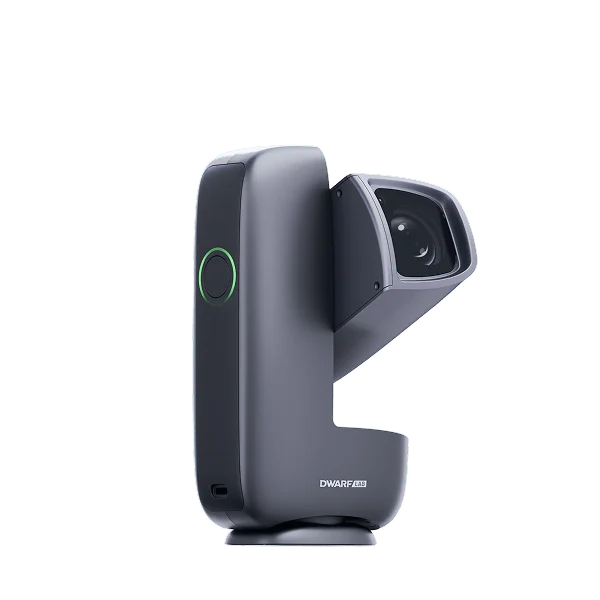
Product reference
DWARFLAB DWARF Mini Smart Telescope
Best for: Travel and the smallest practical observing kit
Trade-off: 2.07 MP telephoto sensor, narrower native frame, and tripod sold separately
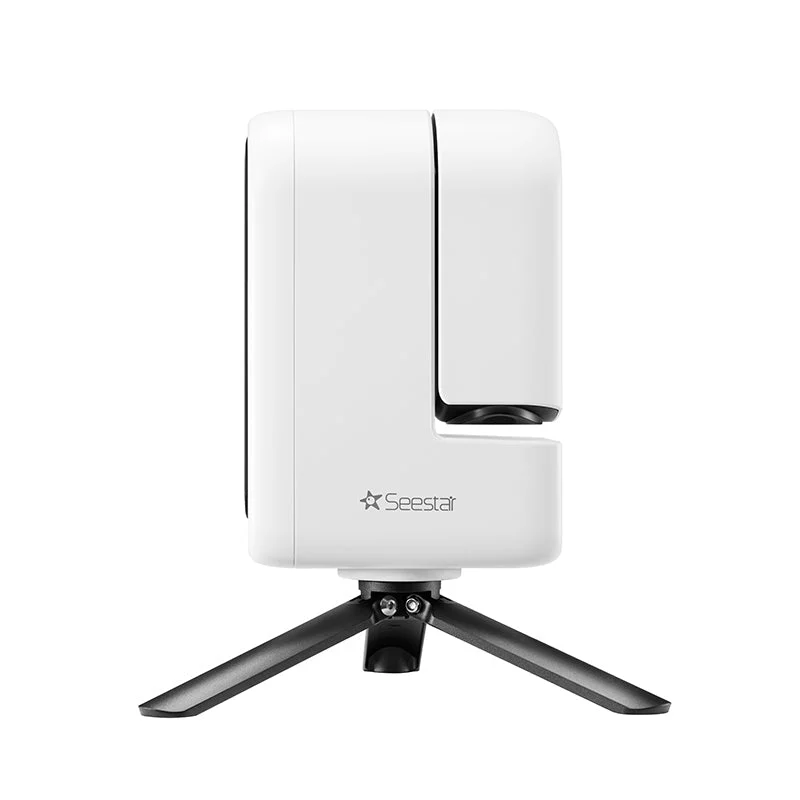
Product reference
ZWO Seestar S30 Pro Smart Telescope
Best for: Broad-field deep-sky and Milky Way imaging in a portable kit
Trade-off: Nearly twice the DWARF Mini weight; EQ mode needs additional hardware
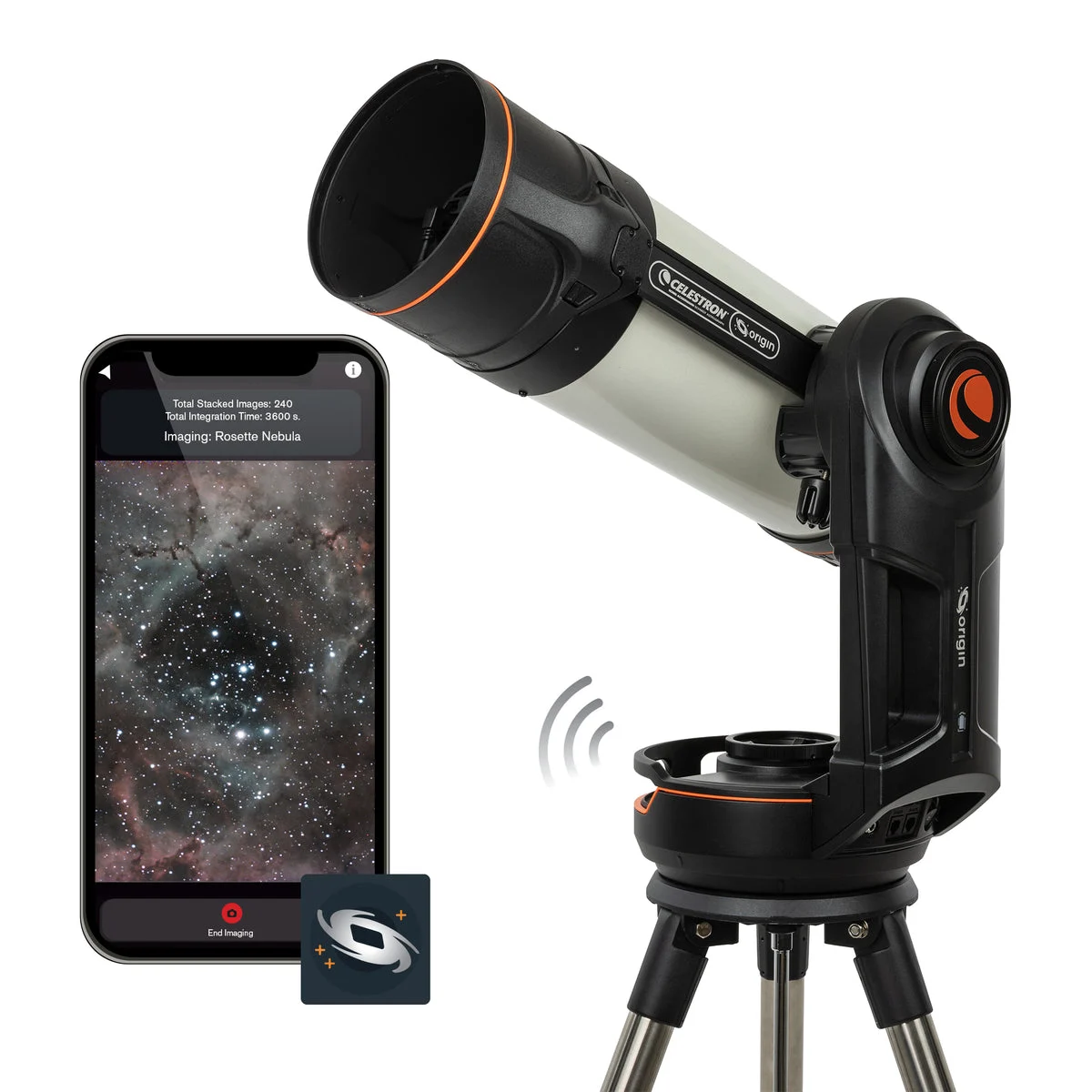
Product reference
Celestron Origin Mark II Intelligent Home Observatory
Best for: Fast deep-sky imaging and a shared home-observatory experience
Trade-off: 41.6 lb complete system and a much higher ownership cost
How this guide was researched
We compare documented product features against the job each buyer needs done. We have not physically tested these products. Check current specifications and availability with the manufacturer or merchant.
Affiliate disclosure: If you buy through a qualifying link, we may earn a commission at no extra cost to you.