
Vinyl care • buying guide
Best Record Cleaning Machines: Manual Washing vs. Ultrasonic Cleaning
Compare the HumminGuru EZ, HumminGuru HG01, and VEVOR 6 L cleaner by workflow, throughput, drying, maintenance, and record compatibility.
A record-cleaning machine is easy to overbuy. A small collection of well-kept LPs may need nothing more elaborate than a manual bath and a drying rack. A shelf full of used records with debris buried in the grooves makes ultrasonic cleaning more persuasive. A collector who wants to press one button and play a dry record shortly afterward is paying for workflow as much as cleaning technology.
The three machines here make those trade-offs unusually clear. The HumminGuru EZ is a manual brush washer. The HumminGuru Original HG01 ultrasonically cleans and fan-dries one record at a time. The VEVOR 6 L uses an industrial-style ultrasonic tank to process several records per batch, but leaves drying and much of the setup to you.
Focused Gadgets has not physically tested these cleaners. This comparison is based on the exact Amazon ASINs, current manufacturer pages, the HG01 manual, archival-care guidance, and current product documentation. Cleaning results depend on the record, contamination, water, cleaning fluid, loading, and maintenance. No machine can repair groove wear, pressing defects, or scratches.
Quick answer
- Choose the HumminGuru EZ for a modest collection and a low-complexity routine. It is quiet, needs no outlet, protects the label with a handled clamp, and includes an eight-record drying rack. Every record still needs hand rotation, brushing, removal, and air-drying.
- Choose the HumminGuru HG01 when convenience matters more than batch capacity. It cleans, drains, and fan-dries one record in the same compact machine. Its one-record workflow is slower for a large backlog, and filters, wheels, water management, and drying performance still need attention.
- Choose the VEVOR 6 L when you have many used records and want batch ultrasonic cleaning for less than a purpose-built automated machine. The large tank and motorized spindle trade polish for throughput. You assemble the record stack, manage several liters of water, keep labels protected, and air-dry the batch afterward.
- Choose none of them for shellac, lacquer, acetate, warped, cracked, or historically important discs until you have format-specific guidance. “Record” is not one material, and a routine that suits modern vinyl LPs is not automatically safe for every grooved disc.
| Buying question | HumminGuru EZ | HumminGuru HG01 | VEVOR 6 L |
|---|---|---|---|
| Cleaning method | Manual bath with goat-hair brushes | Single-record 40 kHz ultrasonic | Multi-record 40 kHz ultrasonic tank |
| Records per wash | One at a time | One at a time | Several; VEVOR documentation conflicts between six and eight |
| Drying | Air-dry rack for up to eight | Built-in dual-fan drying | Separate air-dry rack |
| Automation | None | Clean, drain, and dry modes | Timed ultrasonic tank plus motorized spindle |
| Water volume | 950 ml basin | Up to 400 ml tank | 6 L tank capacity |
| Best fit | Occasional cleaning and smaller collections | Low-handling, one-record convenience | Large used-record backlogs and batch sessions |
| Main trade-off | Labor for every record | High cost and low throughput | Setup, water handling, footprint, and no automatic drying |
First choose a workflow, not a frequency number
“Ultrasonic” describes how a machine agitates the bath; it does not tell you how pleasant the whole cleaning session will be. Loading, label protection, draining, filtering, drying, and putting a clean record into a fresh inner sleeve often consume more attention than the wash itself.
The EZ makes the cleaning action physical and obvious. Brushes contact both sides while you rotate the record by its clamp handle. The HG01 removes that hand work and completes one record before you load another. VEVOR spreads the setup cost across a batch, which is efficient only when you actually have a batch ready.
Collection size matters, but backlog matters more. Someone with 500 already-clean records may use a washer less than a buyer bringing home ten dusty thrift-store LPs every weekend. Buy for the sessions you expect to run, not the number of jackets on the shelf.
HumminGuru EZ: best manual washer
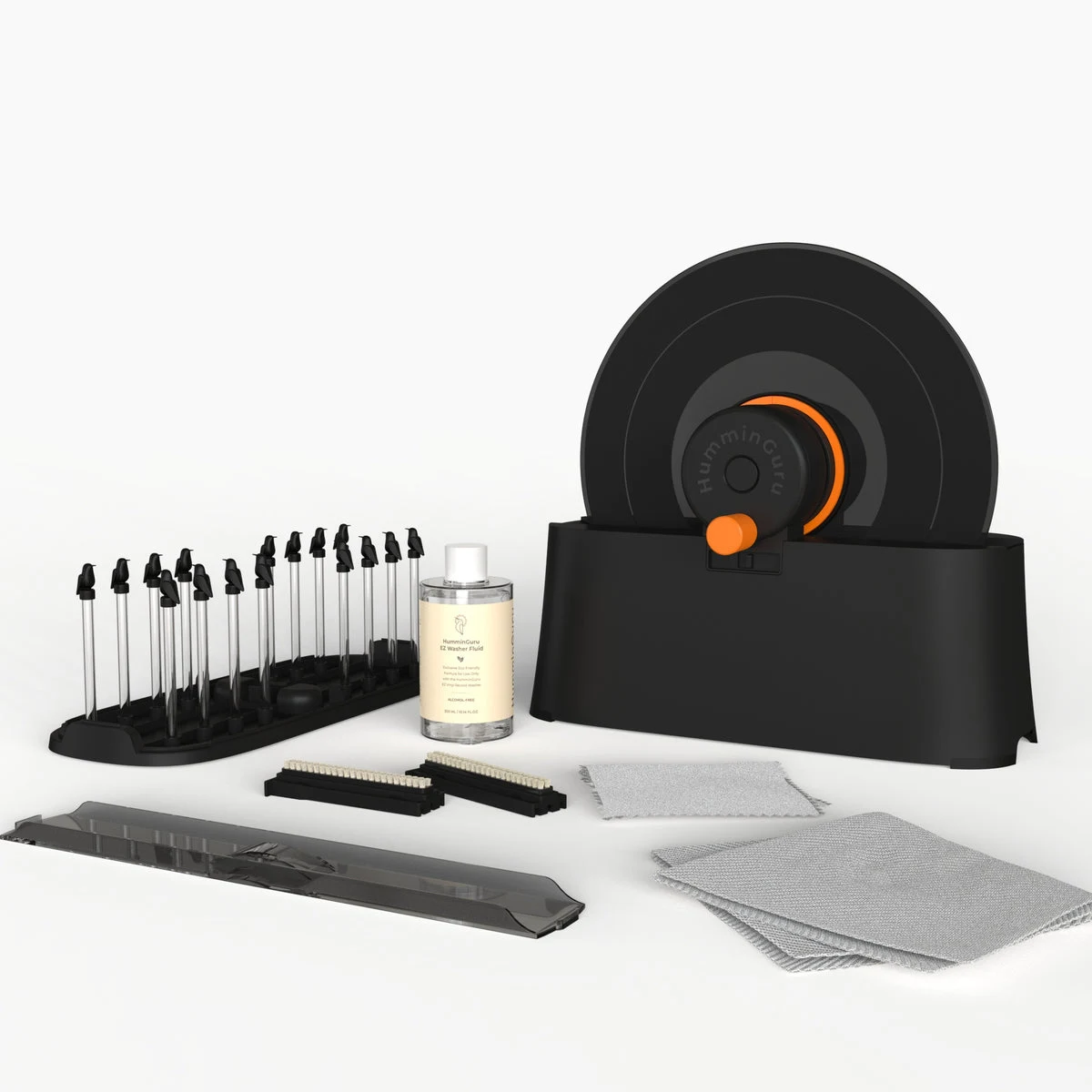
The EZ, model HG021, is the simplest machine here because it is not electric. Its 950 ml basin holds cleaning solution between two removable goat-hair brushes. A rubber-lined clamp covers the label and gives you a handle, so you do not need to grip the wet edge while turning the disc.
HumminGuru instructs users to rotate the handle 12 times clockwise and 12 times counter-clockwise. Four handle turns equal one complete record rotation, so the routine provides three full rotations in each direction. That is more deliberate than casually spinning a record through a generic bath, although it remains manual work repeated for every disc.
The flexible clamp and brush arrangement is specified for records 1–3 mm thick. Standard 7-, 10-, and 12-inch records are supported, with a supplied adapter for 7-inch discs that have a 38 mm center hole. The package also includes a lid, 300 ml of the manufacturer’s alcohol-free fluid, cloths, and a drying rack that stores beneath the washer.
That rack is the practical capacity figure: it holds up to eight records, but the washer cleans only one at a time. HumminGuru says a 950 ml tank mixed with two capfuls of its fluid can handle roughly 10–20 records. Treat that as a manufacturer estimate, not a promise. Water that has visibly collected debris should not be preserved merely to reach a target count.
At 361 × 143 × 243 mm, the EZ needs shelf space comparable to a narrow component rather than a bottle-and-brush kit. In return, it keeps the basin, clamp, brushes, lid, and drying rack together. It is the least intimidating choice here and the only one that remains useful during a power outage. It is also the most repetitive if you have boxes of records to clean.
HumminGuru HG01: best all-in-one convenience
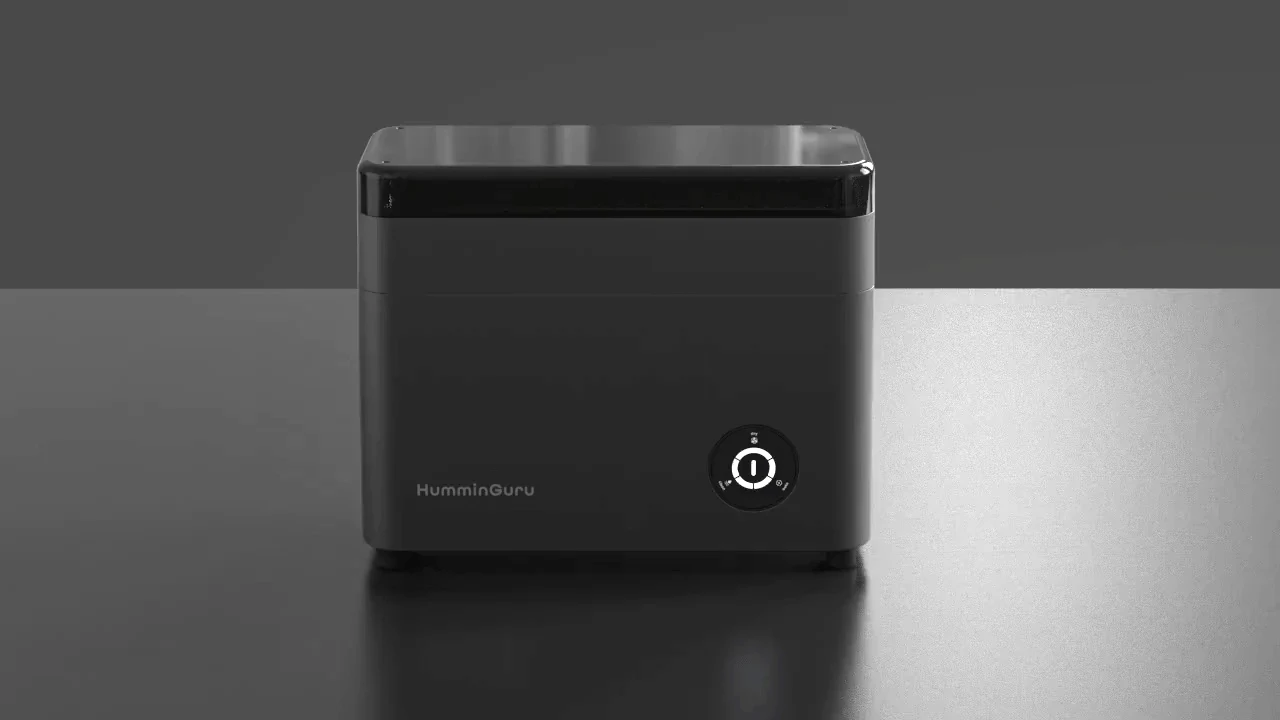
The original HumminGuru HG01 is built around one attractive promise: insert one record, select a mode, and remove it clean and dry. Two 40 kHz transducers work in a narrow stainless-steel basin while the record rotates. After cleaning, the machine drains the bath into its removable tank before fans dry both sides.
The manual offers two- or five-minute cleaning settings and five- or ten-minute drying settings. Auto mode combines those stages, while cleaning-only and drying-only modes are available separately. Complete time therefore varies with the chosen wash and dry combination; “automatic” does not mean the same duration for every record.
The removable tank holds up to 400 ml, with fill references for record sizes. The manual specifies distilled water, warns against unapproved cleaning agents, and tells users not to exceed the indicated level. Too much water risks a wet label and a spill into the machine; too little can leave part of the groove area outside the bath.
Standard operation is for one 12-inch record. Optional adapters support 7- and 10-inch records, and the manufacturer says the machine accommodates heavier 180 g and 220 g pressings. Check whether the adapter you need is included in the current Amazon bundle rather than assuming every accessory shown on HumminGuru’s site is in the box.
The HG01 weighs about 3.1 kg and is roughly 34–35 cm wide and 15 cm deep. Current manufacturer pages and the manual disagree about its exact height, listing approximately 27.4 cm and 20 cm respectively. That difference is too large to smooth over in a comparison table. Measure the intended shelf against the current seller’s documented dimensions, especially if the lid needs clearance.
Convenience does not eliminate maintenance. The water tank and basin filter need rinsing, the air filter must be washed and eventually replaced, and the record-rotation wheels are wear items. The manual also limits continuous operation to one hour followed by at least 30 minutes of cooling. This is an appliance for steady one-at-a-time care, not a production line for fifty LPs in an afternoon.
VEVOR 6 L: best for batch cleaning
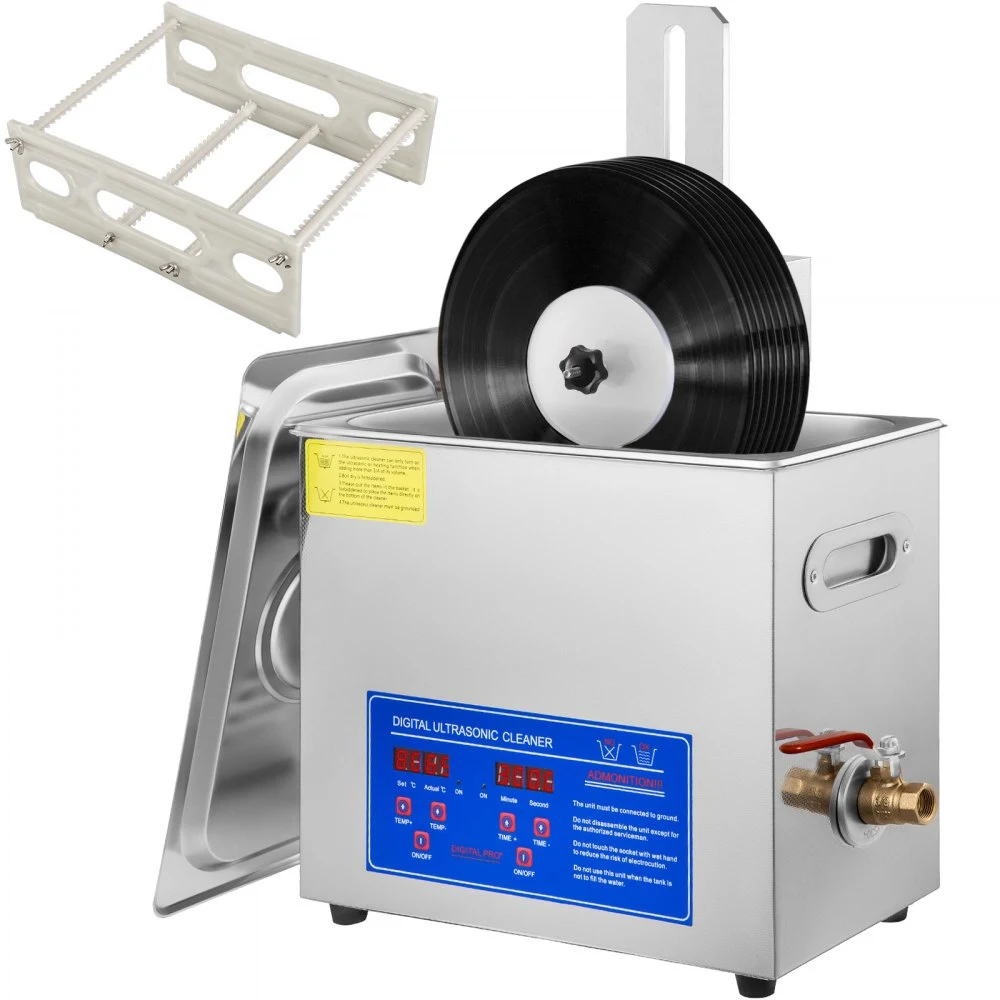
VEVOR’s model is essentially a 6 L stainless-steel ultrasonic cleaner supplied with a motorized record spindle, label covers, and a drying rack. That architecture is less elegant than the HG01 but far more adaptable to a backlog. You assemble several records with spacers, lower the stack into the bath, set the controls, then move the cleaned records to the rack.
The tank operates at 40 kHz with 180 W of stated ultrasonic power. VEVOR lists a 200 W heater, a 0–30 minute timer, and a temperature range from room temperature to 80°C. Those are capabilities of the industrial tank, not a recommendation to heat vinyl to the upper limit. Conservation guidance warns that vinyl discs deform readily with inappropriate or fluctuating heat. Unless current record-specific instructions establish a safe setting, leaving the heater off is the conservative choice.
VEVOR’s own page is inconsistent about batch capacity: its title and feature bullet say eight records, while the description and “Clean Sweep” section say six. Spacer arrangement also changes the distance between discs. Rather than promising a number, this guide treats it as a multi-record system and recommends checking the exact current kit. Fewer, more widely spaced records may be a sensible trade when cleaning matters more than headline throughput, but Focused Gadgets has not tested the effect.
The machine measures about 368 × 340 × 160 mm and weighs 5.2 kg before adding water. Six liters of water adds roughly another six kilograms, so the working setup is not something to balance on a light shelf or carry to the sink while full. The tank and spindle also create more parts to drain, rinse, dry, and store than either HumminGuru.
Unlike the HG01, VEVOR does not fan-dry the records. The included rack keeps the cleaned batch separated while it air-dries. That is perfectly workable when a cleaning session can occupy a counter for a while; it is less appealing when you want to clean one LP and play it immediately.
What cleaning can and cannot fix
Wet cleaning can remove loose dust, fingerprints, oils, and some debris lodged in grooves. It may reduce noise caused by contamination. It cannot reverse groove damage, repair scratches, straighten a warped pressing, or correct non-fill and other manufacturing defects. A noisy record after cleaning is not proof that the machine failed.
Use a fresh antistatic inner sleeve after a thorough wash. Returning a clean disc to a dusty paper sleeve is a cheap way to repeat the job. Keep the stylus and turntable mat clean too; record care is a chain, and the machine handles only one link.
Archival guidance also supports restrained handling. Hold discs by their edges and label areas, avoid touching playing surfaces, and do not clean merely for the ritual of it. Frequent or unsuitable treatment can create problems of its own. Valuable or unusual formats deserve identification before they enter a machine designed around modern PVC records.
Water, fluid, and drying deserve more attention than marketing gives them
Distilled water avoids the mineral residue that tap water can leave behind. The HG01 manual explicitly calls for it. HumminGuru sells dedicated fluids for both machines, with different dosing instructions. Do not assume a homemade mixture that works in an open manual bath is approved for a pumped appliance with filters and internal tubing.
The VEVOR listing is much less specific about record-safe chemistry. Its tank is a general ultrasonic platform, so the buyer owns more of the process decision. Avoid treating forum recipes as universal rules, particularly for non-vinyl discs. If you use a surfactant, follow record- and machine-specific guidance and avoid casual concentration experiments.
Drying determines how soon a record can return to its sleeve. The EZ and VEVOR need rack space and time. The HG01’s fans shorten that step, but the manual acknowledges that complete drying depends on the record, room temperature, and humidity. Inspect the surface rather than trusting the end beep blindly.
Which record cleaning machine should you buy?
Buy the HumminGuru EZ if you clean a few records at a time, value silence and simplicity, and do not mind turning and air-drying every disc. It is also the easiest starting point when you are unconvinced that an electric machine belongs beside the turntable.
Buy the HumminGuru HG01 if one-button clean-and-dry operation is the feature you will use most. It asks for the least handling between dirty sleeve and playable record, but that convenience comes with one-record throughput, maintenance parts, and the highest purchase tier of these three.
Buy the VEVOR 6 L if a large used-record backlog makes batch work more valuable than polish. Plan for a sturdy work surface, several liters of distilled water, assembly, drainage, and air-drying. Its heater is not a challenge to see how warm vinyl can tolerate.
Choose a carbon-fiber brush or careful manual spot cleaning instead if your records are already clean and the problem is ordinary surface dust. Choose professional conservation help for mold, damaged lacquer or acetate discs, rare archival items, or contamination you cannot identify.
Prices, bundles, adapters, filters, and availability change. Confirm the exact ASIN and included accessories before ordering. The VEVOR listing’s own capacity language is inconsistent, so count the supplied spacers rather than buying on an “eight records” headline alone.
Frequently asked questions
Is ultrasonic cleaning always better than a manual washer?
No. Ultrasonic agitation can reach contamination without brushes contacting the groove, but machine design, fluid, loading, water condition, and drying still matter. A careful manual wash may be entirely adequate for light dirt and a small collection.
Can these machines remove scratches or fix a worn record?
No. They remove contamination; they do not restore missing or deformed groove material. Permanent clicks in the same place, groove distortion, and visible scratches may remain after the disc is clean.
Should I use the VEVOR heater for vinyl records?
The tank has a heater because it is a general-purpose ultrasonic cleaner, but its full temperature range is not a vinyl-care prescription. In the absence of clear current instructions for the exact record material, leaving heat off avoids an unnecessary deformation risk.
Does the HumminGuru HG01 dry records completely?
It has five- and ten-minute fan-drying options, but the manual says results depend on the record and room conditions. In high humidity or when droplets remain, use the longer setting or allow additional air-drying before sleeving.
Can I clean 78 rpm records in these machines?
Do not assume so. Many 78s are shellac rather than vinyl, and cleaning chemistry that is acceptable for modern PVC can be unsuitable for other materials. Identify the disc and obtain format-specific guidance first.
Models discussed
Use these as starting points for checking fit. We do not publish a price or claim hands-on testing.
| Model | Format | Best fit | Trade-off |
|---|---|---|---|
| HumminGuru EZ Vinyl Record Washer | Manual brush-bath record washer | Small collections and occasional low-noise cleaning | Every record needs manual rotation and air-drying |
| HumminGuru Original HG01 Ultrasonic Vinyl Record Cleaner | Single-record ultrasonic cleaner with fan drying | Low-handling clean-and-dry operation one record at a time | Higher cost and slower throughput for a large backlog |
| VEVOR 6 L Ultrasonic Vinyl Record Cleaner | 6 L multi-record ultrasonic tank | Batch cleaning a backlog of used records | Hands-on setup, several liters of water, and separate air-drying |
Product reference
HumminGuru EZ Vinyl Record Washer
Best for: Small collections and occasional low-noise cleaning
Trade-off: Every record needs manual rotation and air-drying
Product reference
HumminGuru Original HG01 Ultrasonic Vinyl Record Cleaner
Best for: Low-handling clean-and-dry operation one record at a time
Trade-off: Higher cost and slower throughput for a large backlog
Product reference
VEVOR 6 L Ultrasonic Vinyl Record Cleaner
Best for: Batch cleaning a backlog of used records
Trade-off: Hands-on setup, several liters of water, and separate air-drying
How this guide was researched
We compare documented product features against the job each buyer needs done. We have not physically tested these products. Check current specifications and availability with the manufacturer or merchant.
Affiliate disclosure: If you buy through a qualifying link, we may earn a commission at no extra cost to you.