
Blade maintenance • buying guide
Best Electric Sharpening Systems: Guided Slots or Adjustable Belts?
Compare the Chef'sChoice 15XV and Work Sharp Ken Onion Elite Mk.2 by angle control, abrasives, blade compatibility, upkeep, and learning curve.
The best electric sharpener is not necessarily the one with the most settings. It is the one whose abrasive, angle control, and workflow match the edges you actually maintain.
For a drawer of ordinary double-bevel kitchen knives, the Chef’sChoice 15XV removes most setup decisions. Its spring guides present the blade to three fixed stages that create a 15-degree-per-side edge. For a mixed bench of kitchen knives, pocket knives, hunting blades, scissors, and tools, the Work Sharp Ken Onion Edition Elite Mk.2 offers substantially more control through interchangeable belts, adjustable speed, an angle guide, and a separate blade-grinding attachment.
Those are not two versions of the same appliance. The 15XV is a repeatable kitchen routine; the Work Sharp is a compact powered sharpening system that rewards technique.
Focused Gadgets has not physically tested either sharpener. This guide is based on the exact Amazon ASINs, current manufacturer pages, and current manuals. Performance still depends on blade steel, geometry, damage, abrasive condition, pressure, and technique. Practice on an inexpensive knife before putting a valuable blade into any powered system.
Quick answer
- Choose the Chef’sChoice 15XV for straightforward kitchen maintenance. It is the easier system to repeat because the machine establishes the angle and the stages have defined jobs. The trade-off is a fixed 15-degree edge and far less control over geometry.
- Choose the Work Sharp Ken Onion Elite Mk.2 for varied knives, repairs, and tools. Its guided cassette adjusts from 15 to 30 degrees per side, while the included blade-grinding attachment spans 10 to 35 degrees. It can shape, sharpen, hone, and handle light grinding, but belt choice, speed, pressure, and tip technique are now your responsibility.
- Choose neither for irreplaceable, expensive, or unusually ground blades unless the manufacturer confirms compatibility and you understand the edge geometry. A professional sharpener or a slow manual system can be the safer purchase when preservation matters more than speed.
| Buying question | Chef’sChoice 15XV | Work Sharp Ken Onion Elite Mk.2 |
|---|---|---|
| Core format | Three-stage guided countertop sharpener | Variable-speed belt system with guided cassette and blade grinder |
| Angle control | Fixed 15 degrees per side | 15-30 degrees guided; 10-35 degrees on blade grinder |
| Abrasives | Diamond shaping and sharpening; flexible polishing/stropping stage | Replaceable belts from P120 through fine finishing belts |
| Best fit | Double-bevel kitchen knives and simple repeatable upkeep | Mixed knife collection, damaged edges, tools, and users who want control |
| Straight edges | Yes | Yes |
| Serrated edges | Maintenance in the designated finishing stage | Dedicated fine-belt procedure in the manual |
| Scissors and tools | Not the reason to buy it | Scissor guide, tool cassette, and light grinding capability |
| Learning curve | Lower | Higher, especially with the blade-grinding attachment |
| Main trade-off | Reprofiles knives to the machine’s geometry | More ways to remove too much steel or round a tip |
Start with the edge you want to preserve
Before comparing motors or accessories, identify each blade’s current bevel. A 15-degree double-bevel chef’s knife, a 20-degree Western utility knife, a single-bevel yanagiba, a convex outdoor knife, and a pair of scissors are different sharpening jobs.
The 15XV deliberately converts traditional 20-degree edges to a 15-degree-per-side, three-bevel profile. That is its value proposition, not a neutral maintenance setting. The first sharpening can remove more metal because the system is changing the geometry. Once the edge is established, later touch-ups can rely more heavily on the finishing stage. Buyers who want to preserve a particular factory angle should not assume that a fixed 15-degree machine will do so.
The Work Sharp gives you more choices. Its cassette guide adjusts in half-degree increments from 15 to 30 degrees per side, and its blade-grinding attachment covers 10 to 35 degrees. More choice is only useful if you know which setting belongs on the blade. A wrong but perfectly consistent angle is still wrong.
Chef’sChoice 15XV: best for repeatable kitchen sharpening
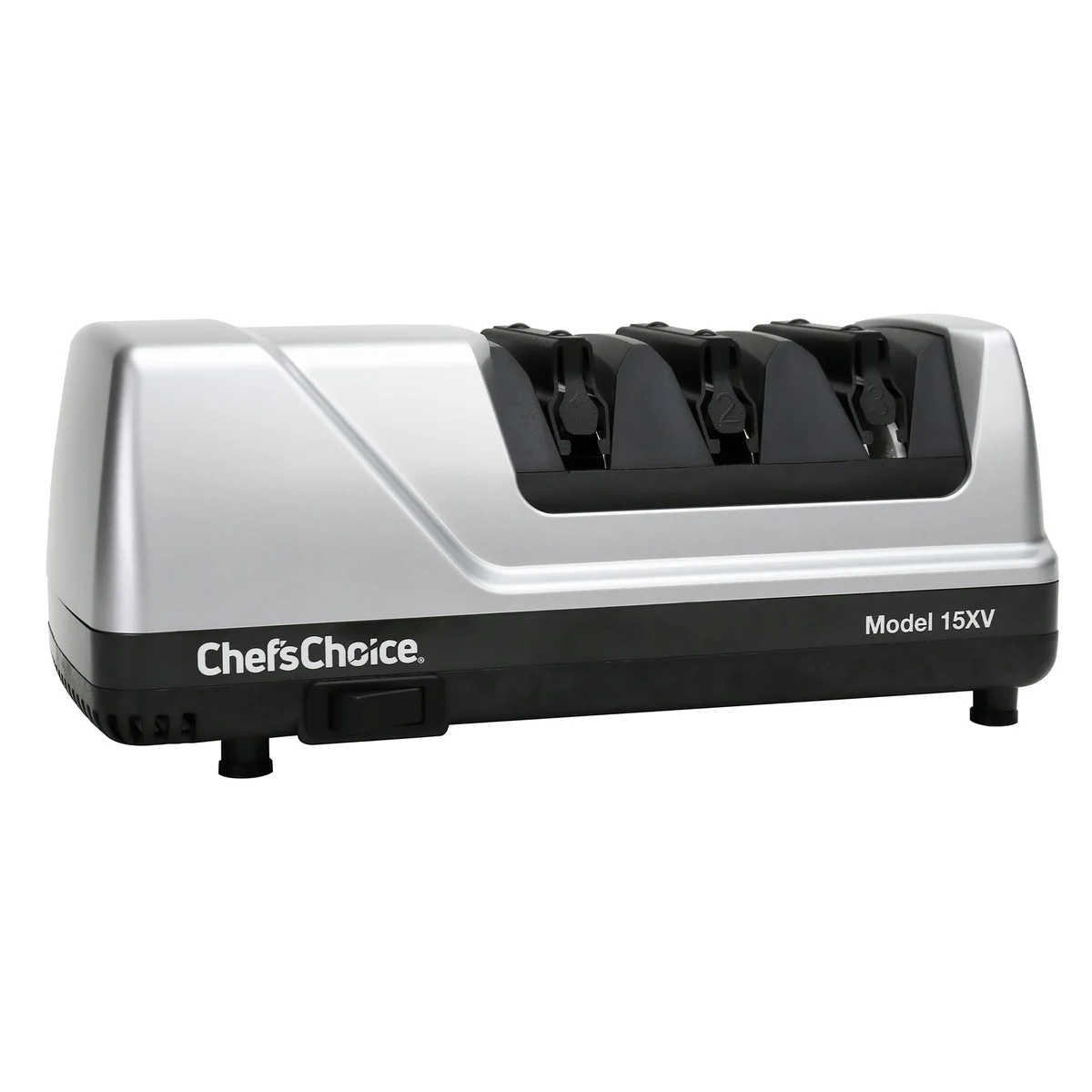
The 15XV is the better fit for a cook who wants a clear routine rather than a new workshop skill. You turn it on, keep the knife moving through the spring-loaded guide, alternate sides as instructed, and progress through the appropriate stages. There are no belts to track and no speed setting to choose.
Chef’sChoice describes the result as a Trizor XV edge: three progressively smaller bevels ending at 15 degrees per side. Stage 1 shapes with diamond abrasives, Stage 2 refines and sharpens, and Stage 3 uses flexible abrasive disks to polish the edge. The manual makes the important distinction that not every session needs all three stages. Using the coarser stages when a finishing-stage touch-up is enough removes unnecessary metal.
The guides are the 15XV’s strongest feature. They reduce the angle variation that can happen when a beginner freehands a knife, while spring action helps the abrasive follow the blade from heel to tip. That does not make technique irrelevant. Pulling too quickly, pressing down, stopping mid-pass, or lifting incorrectly near the tip can still produce an uneven bevel.
The machine is documented for straight and serrated household knives. Serrations are treated in the finishing stage, not reground through every slot. It can also accommodate some single-sided Asian-style edges when the manual’s one-sided sequence is followed. That is not blanket permission for every Japanese knife. Traditional single-bevel blades may have a hollow back, delicate hard steel, asymmetrical geometry, or a maker-specific sharpening method. Check the knife maker’s instructions first.
This is also a re-profiling decision. A thick 20-degree Western knife must lose steel before it reaches a 15-degree apex, and a narrow blade or heavy bolster may limit how completely the slot reaches the heel. The resulting edge may slice more readily, but edge durability still depends on steel, heat treatment, blade thickness, cutting surface, and use. The manufacturer’s edge-retention language is not a guarantee for every knife.
Who should buy it
Buy the 15XV if most of your collection consists of double-bevel kitchen knives, you accept a 15-degree-per-side edge, and predictable setup matters more than customization. It is particularly sensible when an elaborate sharpener would stay in a cupboard because the owner does not want to select abrasives and angles.
Skip it if you need to preserve several factory angles, repair major chips, sharpen axes or scissors, or learn a freehand belt workflow. Also skip it when a knife maker explicitly requires stones, professional service, or a different angle.
Work Sharp Ken Onion Elite Mk.2: best for knives and tools
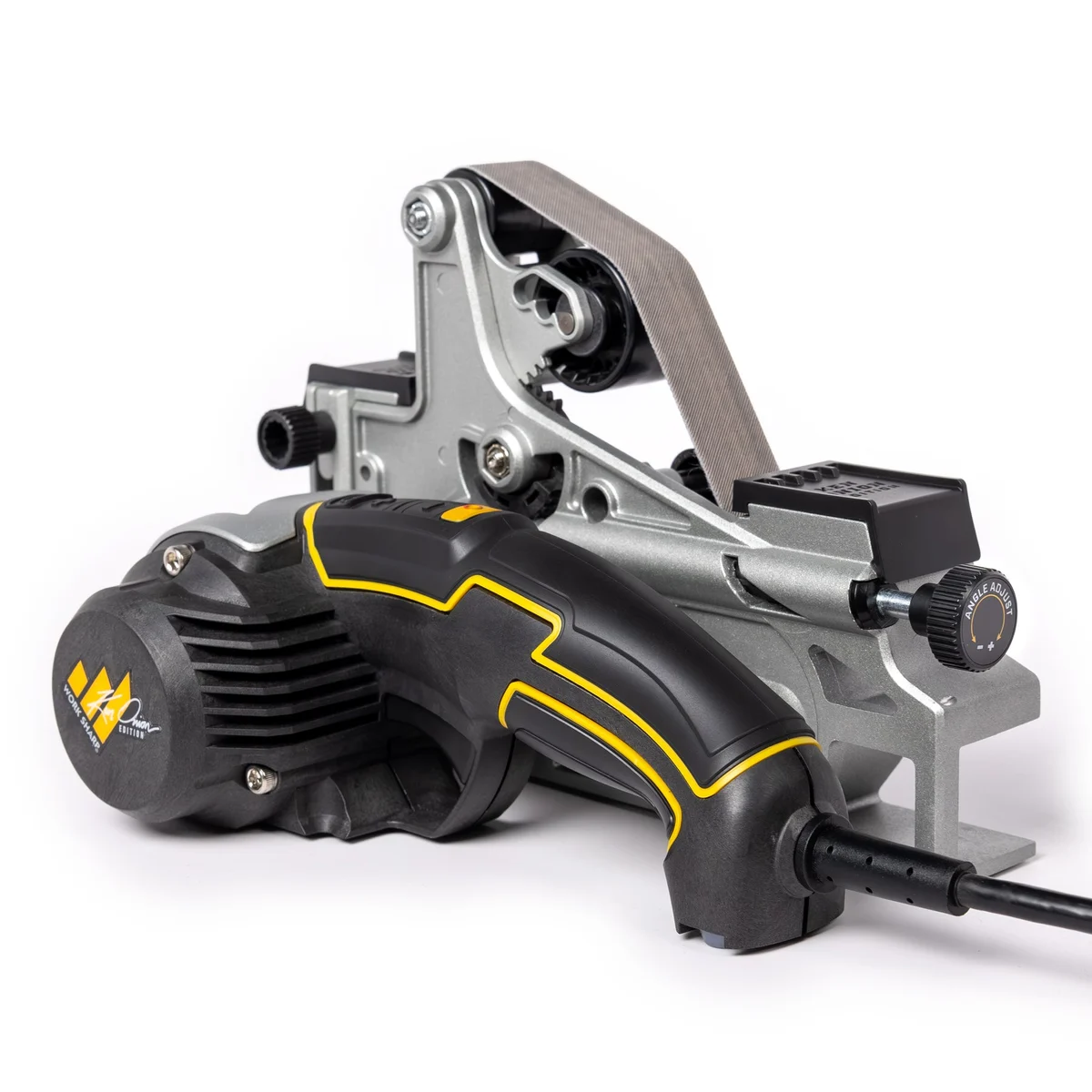
The Elite Mk.2 combines the WSKTS-KO2 powered unit with two sharpening formats. The standard cassette uses 3/4-by-12-inch flexible belts and a leather-lined angle guide. The separate blade-grinding attachment uses 1-by-18-inch belts and exposes more of the abrasive for freehand shaping and sharpening.
That distinction matters. With the cassette fitted, a user can set an angle between 15 and 30 degrees per side and support the blade through a more controlled pull. The tool cassette also provides a 65-degree scissor guide. The grinder attachment extends the nominal range to 10-35 degrees and lets the operator alter convexity, work against a platen, and see more of the contact point. It also removes many of the guardrails that make the cassette approachable.
Seven speed settings range from 850 to 2,590 surface feet per minute according to the manual. Lower speeds provide more time to react; higher speeds accelerate material removal. The manual’s reference chart uses different speeds, angles, and belt sequences for kitchen, outdoor, fillet, cleaver, and serrated blades. Treat that chart as a starting procedure, not evidence that every knife in a category has identical steel or geometry.
The included abrasives cover repair through honing. The cassette kit includes P120, X65, X22, X4, and 6000 belts; the grinder kit adds its own P120, X65, X22, X4, and 12000 sequence. Work Sharp equates X65 roughly to P220, X22 to P1000, and X4 to P3000. Those labels describe abrasive progression, not a promise of a specific sharpness.
Flexible belts tend to create a convex edge rather than the flat bevel associated with a stone or rigid plate. Work Sharp promotes that profile for support behind the apex. Whether you want it is a separate question: collectors trying to preserve a crisp flat bevel or a historically accurate grind may prefer another method.
The control has a cost
A belt can remove metal quickly. Lingering at the tip can round it; excessive pressure can change belt deflection and geometry; using a coarse belt for routine touch-ups wastes steel. The manual specifically advises starting with a practice knife, keeping the blade moving at about one inch per second in its guided procedures, and using only the abrasive needed for the job.
The system also creates abrasive and metal dust. Work Sharp instructs users to wear suitable eye and respiratory protection, keep the workspace clean, and avoid wet conditions and flammable atmospheres. The tool is for consumer sharpening and light grinding, not industrial continuous use; its manual limits extended operation to 30 minutes per hour.
Who should buy it
Buy the Elite Mk.2 if you regularly maintain different edge angles, repair damaged blades, sharpen outdoor knives and scissors, or want a path from guided sharpening to controlled freehand grinding. The price makes most sense when both attachments will be used.
Skip it if all you want is an occasional kitchen-knife touch-up with minimal decisions. The standard Ken Onion Mk.2 without the grinder attachment may also be the more rational Work Sharp configuration if you will never use the 1-by-18-inch platform; confirm current bundle contents before ordering.
Fixed slots versus belts: the ownership differences
The 15XV contains its abrasives inside the appliance. That keeps setup tidy but makes the machine’s geometry and stage design the workflow. Chef’sChoice documents a dressing procedure for the Stage 3 disks when they become loaded. The user does not swap through a shelf of belts, but neither can the user substitute a completely different abrasive progression.
Work Sharp belts are visible consumables. Replacement is simple, and grit selection is part of the system’s versatility. Belts should be kept clean and dry, checked for damage, and replaced when they stop cutting effectively. Belt discoloration alone is not Work Sharp’s wear criterion. Tracking also matters: a belt that is not centered on its pulleys should be corrected before sharpening.
Both machines reward restraint. The coarse stage is for establishing or repairing an edge, not a mandatory first stop every time a knife feels slightly dull. A honing rod may realign an appropriate kitchen edge without grinding it, and a fine finishing stage may restore bite with less material removal. Powered convenience should not become powered over-sharpening.
What neither machine solves
An electric sharpener cannot diagnose heat-treatment damage, remove deep corrosion without changing geometry, or restore steel that has been ground away. It will not make a thick blade cut like a thin one merely by polishing the apex. It also cannot tell you whether a collectible knife should retain its original grind.
Chips, bent tips, cracks, loose handles, and severe recurve geometry deserve inspection before power is applied. A crack is a structural problem, not a sharpening task. Ceramic blades are especially brittle and should only enter a system whose maker explicitly supports them. Do not infer compatibility from the word “diamond.”
Sharpening also creates an edge sharp enough to cause serious injury. Unplug before changing belts or attachments, keep fingers clear of the abrasive path and edge, stabilize the machine, and follow the exact manual. Wipe and wash kitchen knives after sharpening so abrasive or metal residue does not reach food.
Which electric sharpening system should you buy?
For most home cooks choosing between these exact models, the Chef’sChoice 15XV is the more focused purchase. It trades customization for a repeatable 15-degree kitchen workflow. That is a good trade only when the intended knives suit the geometry.
The Work Sharp Ken Onion Elite Mk.2 is the stronger system for an owner who thinks in terms of edges rather than appliances: different angles, different grits, repairs, convex profiles, scissors, and tools. It can grow with skill, but it also exposes expensive blades to beginner mistakes. Use the guided cassette first and learn on replaceable knives before moving to the blade grinder.
Do not buy either merely because a dull knife feels urgent. Confirm the exact knife geometry, read the relevant manual sequence, and decide how much steel you are willing to remove. Prices, bundles, belts, colors, and availability change; check the exact listing before ordering.
Frequently asked questions
Does the Chef’sChoice 15XV keep a 20-degree factory edge?
No. Its defining function is converting traditional 20-degree edges to a 15-degree-per-side Trizor XV profile. Choose a different system if preserving the original angle is the priority.
Is the Work Sharp Elite Mk.2 suitable for beginners?
The guided cassette is approachable, but the system still requires angle, belt, speed, pressure, and pull-rate decisions. The blade-grinding attachment has a steeper learning curve. Start with the manual and a low-value practice knife.
Can either system sharpen serrated knives?
Both manufacturers document serrated-edge procedures, but neither treats serrations like a plain edge. The 15XV uses its finishing stage; Work Sharp uses a fine belt from the flat side according to its manual. Follow the exact procedure rather than running both sides through every stage.
Will an electric sharpener ruin a knife?
It can if the angle is wrong, the abrasive is too coarse, pressure is excessive, or the blade stops moving. Correct use can produce a serviceable edge quickly, but powered abrasives remove steel faster than many manual methods and leave less time to correct a mistake.
Which system is better for Japanese knives?
There is no universal answer because “Japanese knife” can describe many steels and grinds. The 15XV supports certain 15-degree, double-bevel, and documented single-sided procedures. The Work Sharp offers adjustable angles. Neither replaces the knife maker’s instructions, especially for traditional single-bevel or very thin, hard blades.
Models discussed
Use these as starting points for checking fit. We do not publish a price or claim hands-on testing.
| Model | Format | Best fit | Trade-off |
|---|---|---|---|
| Chef'sChoice 15XV EdgeSelect Professional Electric Knife Sharpener | Fixed-angle three-stage countertop sharpener | Repeatable maintenance of compatible kitchen knives | Reprofiles blades to a fixed 15-degree-per-side edge |
| Work Sharp Ken Onion Edition Elite Mk2 | Adjustable belt sharpening and grinding system | Mixed knives, repairs, scissors, and tools | More setup and technique than fixed guided slots |
Product reference
Chef'sChoice 15XV EdgeSelect Professional Electric Knife Sharpener
Best for: Repeatable maintenance of compatible kitchen knives
Trade-off: Reprofiles blades to a fixed 15-degree-per-side edge
Product reference
Work Sharp Ken Onion Edition Elite Mk2
Best for: Mixed knives, repairs, scissors, and tools
Trade-off: More setup and technique than fixed guided slots
How this guide was researched
We compare documented product features against the job each buyer needs done. We have not physically tested these products. Check current specifications and availability with the manufacturer or merchant.
Affiliate disclosure: If you buy through a qualifying link, we may earn a commission at no extra cost to you.